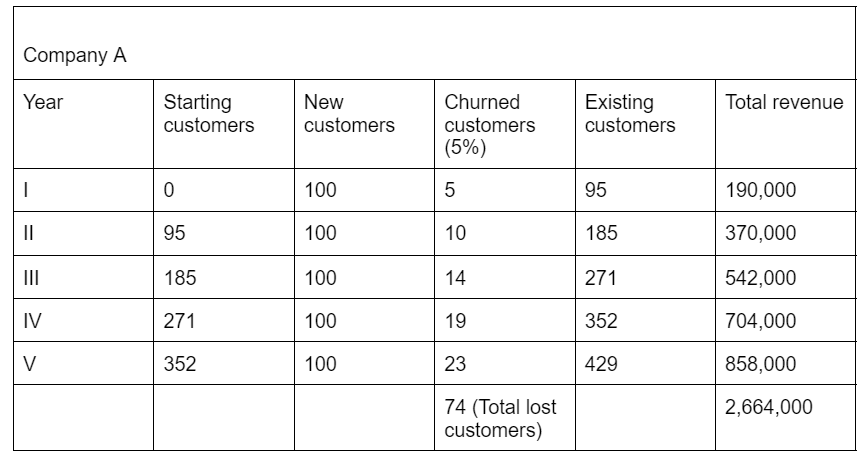

Every customer success platform makes roughly the same promise: pull in usage, support, and billing data, blend it into a health score, and flag which accounts need attention.
That works until the score turns red on an account that looked fine by every other measure, and nobody can say why.
That gap between “the score changed” and “here’s what actually happened” is where most CS stacks fall short.
A health score can tell you that engagement dropped 30 percent. It can’t tell you a key workflow broke after the last release, or that the customer never got proper onboarding.
I have spent time evaluating and comparing customer success and feedback platforms across different teams, including Qualaroo and ProProfs Survey Maker, and have researched the rest against current buyer guides and reviewer sentiment.
Here’s how the field stacks up.
What Is Customer Success Software?
Customer success software centralizes product usage, support interactions, and billing data to track customer health, predict churn risk, and surface expansion opportunities across the post-sale customer journey.
It replaces spreadsheets and gut-feel account reviews with a shared, data-backed view of who is at risk and who is ready to grow.
Most platforms in this category score account health, automate playbooks when that score changes, and give a CS team a single workspace instead of five.
What they generally don’t do well is explain the human reason behind the shift, which is where a direct feedback tool comes in.
Top 10 Customer Success Software Tools
Before the full breakdowns below, here’s the shortlist reduced to what actually matters most when narrowing options: what each tool is built for, what it costs to get started, and how real customers rate it.
| Tool | Best For | Starting Price | Capterra Rating |
| Qualaroo | Real-time, in-the-moment customer feedback and AI-powered survey creation and feedback analysis | Free plan; paid from $19.99/month | 4.7/5 |
| ProProfs Survey Maker | AI-powered CSAT and NPS survey creation | Free plan; paid from $19.99/month | 4.8/5 |
| ProProfs Help Desk | Support ticketing tied to CS metrics | Free plan; paid from $19.99/agent/month | 4.9/5 |
| HubSpot Service Hub | Teams that are already running on HubSpot CRM | Free tools; paid from $10/seat/month | 4.4/5 |
| Gainsight CS | Enterprise-grade health scoring | Custom, contact sales | 4.4/5 |
| Intercom | Unified messaging, support, and AI deflection | Paid from $19/seat/month | 4.5/5 |
| Totango | Modular, multi-product CS programs | Custom, contact sales | 3.7/5 |
| ChurnZero | Mid-market real-time health scoring | Custom, contact sales | 4.7/5 |
| ClientSuccess | Fast-growing mid-market teams | Custom, contact sales | 4.2/5 |
| Custify | Lean B2B SaaS teams | Custom, contact vendor | 4.9/5 |
I put this list together from hands-on use with several of these tools and researched comparisons for the rest, weighing what each platform claims against what it actually does.
Here’s what each one does well, where it genuinely falls short, and which specific job it solves that the others don’t.
1. Qualaroo: Best for Capturing Real-Time User Insights In-App and on Your Website Using Contextual, AI-Powered Micro-Surveys
Qualaroo has been my go-to whenever the real question isn’t “what does the health score say” but “why did this person just get frustrated.”
Most CS platforms score and route data that already exists. Qualaroo generates the missing data by catching feedback in the moment someone is using your product, through the Nudge™, a non-intrusive survey triggered by behavior rather than an email link nobody opens.
The AI Survey Creator drafts a Nudge from a plain-language prompt in under a minute, and once responses come in, native AI Sentiment Analysis and the AI Response Summarizer turn hundreds of open-text answers into a theme that a CSM can act on the same day.
Pros:
- AI Survey Creator drafts a full Nudge from a prompt, no manual setup required
- Advanced targeting by behavior, URL, exit intent, and custom user properties
- Native AI Feedback Analysis suite: AI Sentiment Analysis, Word Cloud, Mood Metrics, Automated Tagging, and AI Response Summarizer
- Identify API ties every response back to a real user by email or customer ID
- Heatmaps and Session Recordings show what a user was doing right before they responded
- iOS and Android SDK for native in-app surveys
Cons:
- There is no dark user interface for long hours or late nights
- Dedicated onboarding/account manager services are available only in paid plans
User Rating: 4.7/5 (Capterra)
Pricing: Free plan available with all premium features. Paid plans start at $19.99/month Essentials, followed by Business at $49.99/month and Enterprise at $149.99/month.
Qualaroo helped Hootsuite lift conversion by 16 percent at 98 percent statistical significance, simply by asking the right question to the right visitor at the right moment.

2. ProProfs Survey Maker: Best for Easily Creating Custom Customer Surveys, CSAT, CX, & NPS Forms Using AI
I first used ProProfs Survey Maker for a CSAT rollout at a team with no dedicated survey tool, just a Google Form nobody updated.
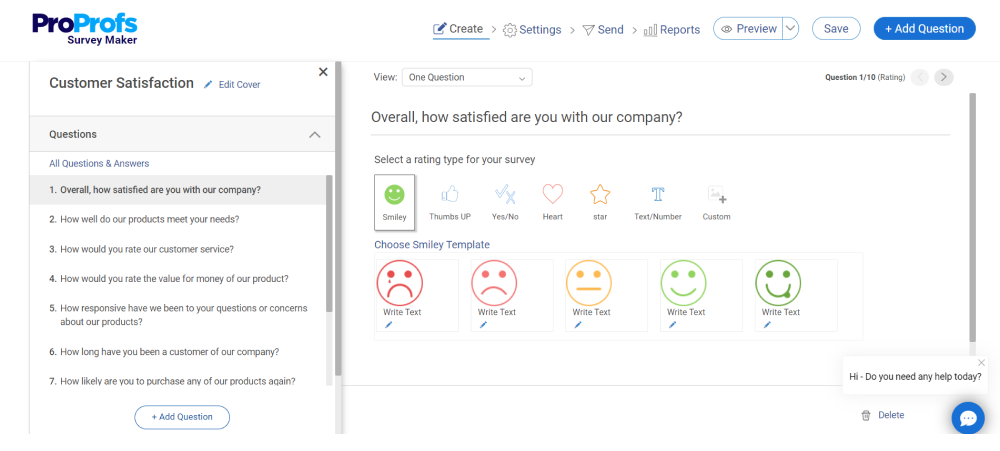
The drag-and-drop editor had NPS, CSAT, and CES questions live across three touchpoints within a day.
It handles the satisfaction-tracking side of customer success that a full CS platform assumes is happening elsewhere but doesn’t build well itself, with sidebar, pop-up, and full-page formats all coming from the same editor.
Pros:
- AI-assisted survey creation for quick CSAT, NPS, and CES setup
- Sidebar and pop-up formats that collect feedback without disrupting the product experience
- Skip logic and a rich question library for targeted follow-ups
- Reasonable entry price relative to feature depth
Cons:
- There is no dark user interface for long hours or late nights
- Dedicated onboarding/account manager services are available only in paid plans
User Rating: 4.8/5 (Capterra)
Pricing: Free plan available. Paid plans start at $19.99/month, billed annually.
3. ProProfs Help Desk: Best for Support Ticketing Tied Directly to Customer Success Metrics
A colleague running support for a small SaaS team switched to ProProfs Help Desk to stop missing requests buried in a shared inbox.
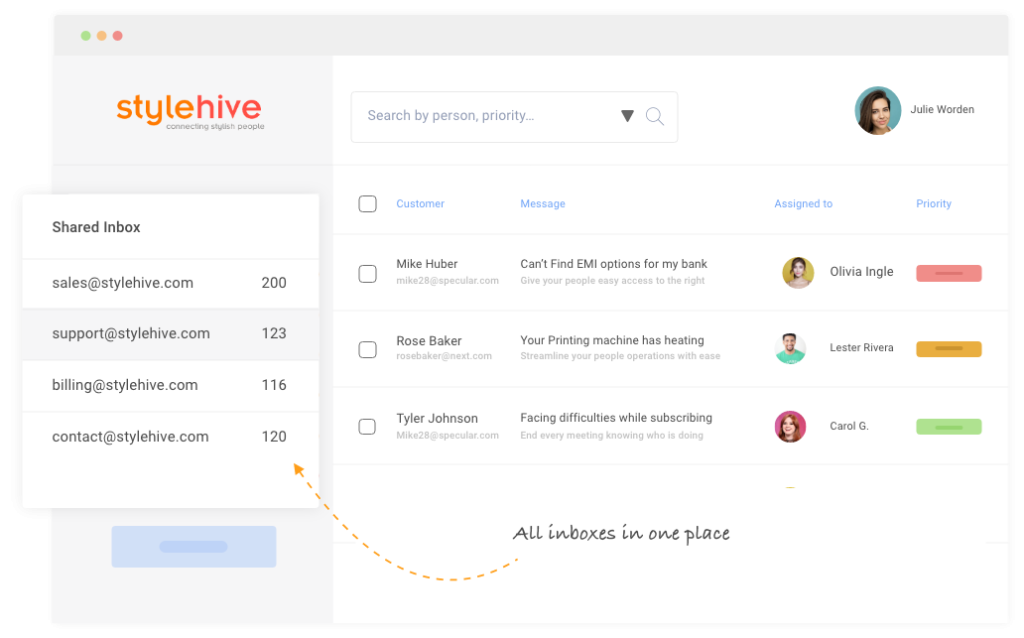
The overdue-ticket tracking solved that in the first week, and the built-in CSAT survey meant satisfaction data started flowing without a second tool.
It’s not built for health scoring, but for teams where support quality is the clearest leading indicator of churn risk.
Having ticket data and satisfaction surveys in one system means a CSM sees the pattern forming instead of hearing about it later.
Pros:
- Permanent free tier for one agent, no credit card required
- AI response drafts are available from the first paid plan
- Pairs natively with ProProfs Survey Maker for CSAT and NPS tracking
- Highest rating on this list
Cons:
- Small review base compared to category leaders like Zendesk or Freshdesk
- Ticket volume caps on lower-tier plans
User Rating: 4.9/5 (Capterra)
Pricing: Free plan for one agent. Paid plans start at $19.99/agent/month.
4. HubSpot Service Hub: Best for Teams Already Running on the HubSpot CRM
A former colleague at a HubSpot-native company put it simply: the value isn’t the ticketing tool; it’s that every ticket already carries the full deal and marketing history.
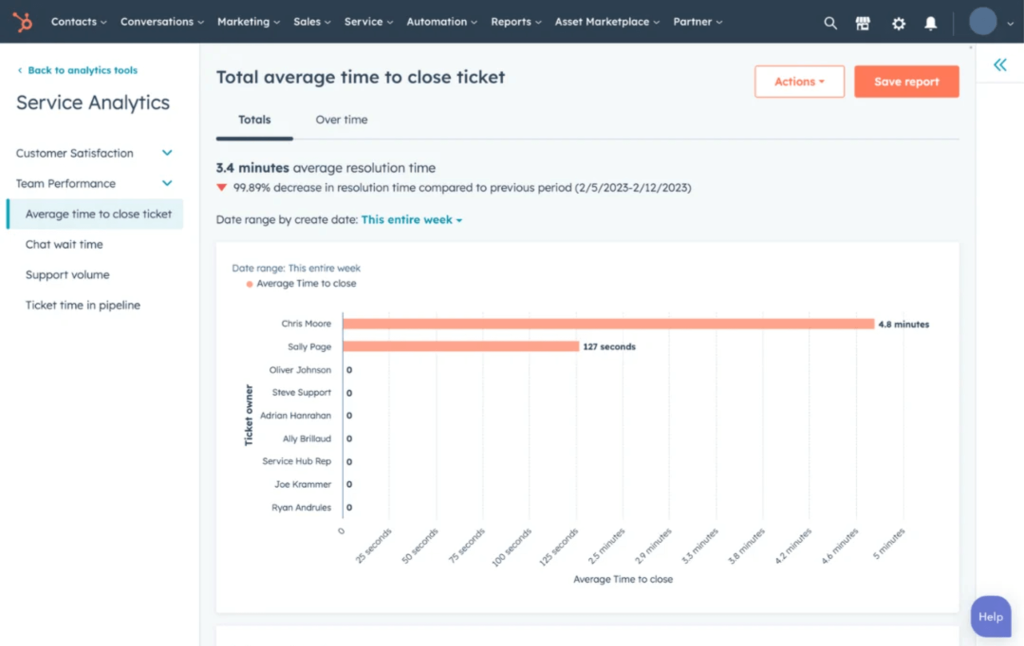
That shared context is the entire case for Service Hub over a standalone help desk.
It bundles tickets, live chat, a knowledge base, and reporting into one workspace, but it’s a service tool built around a CRM, not a purpose-built CS platform with health scoring or churn prediction.
Pros:
- Native CRM connection gives full customer context without stitching tools together
- Free tier available as a genuine entry point for small teams
- Live chat, ticketing, and knowledge base in one workspace
Cons:
- The jump from Starter to Professional is steep, and both upper tiers carry one-time onboarding fees of $1,500 to $3,500
- Not purpose-built for health scoring or churn prediction, the way dedicated CS platforms are
User Rating: 4.4/5 (Capterra)
Pricing: Free tools available. Paid plans start at $10/seat/month for Starter, up to $100/seat/month for Professional, and $150/seat/month for Enterprise, plus onboarding fees on the top two tiers.
5. Gainsight CS: Best for Enterprise-Grade Health Scoring and Journey Orchestration
Gainsight comes up in nearly every enterprise CS shortlist. Its multi-signal health scoring blends usage, support, and revenue data, and its journey orchestration lets a large CS org run genuinely sophisticated, cross-functional programs.
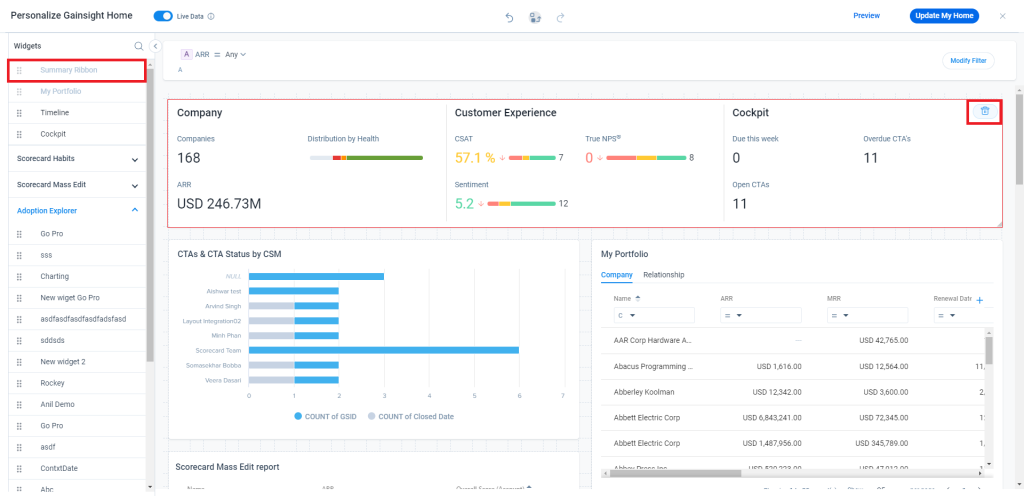
That depth costs usability. The interface can feel crowded, with more tabs and configuration steps than a new admin expects, and it rewards dedicated training over intuitive exploration.
It’s the right choice for a team with a dedicated CS ops function, not a first CSM hire trying to self-serve setup in a week.
Pros:
- Deepest journey orchestration and playbook automation in this category
- Multi-signal health scoring across usage, support, and revenue data
- Backed by the Gainsight Pulse community and strong analyst recognition
- Broad CRM and support integrations
Cons:
- The interface can feel crowded with too many tabs and steps for new admins
- Pricing is not published; every deal starts with a sales conversation
User Rating: 4.4/5 (Capterra)
Pricing: Custom pricing. Contact sales for a quote.
6. Intercom: Best for Unifying Customer Messaging, Support, and AI-Driven Deflection
Intercom is one of the most polished tools on this list. The Messenger UI is genuinely clean, and Fin, its AI agent, is widely regarded as a strong AI support agent on the market.
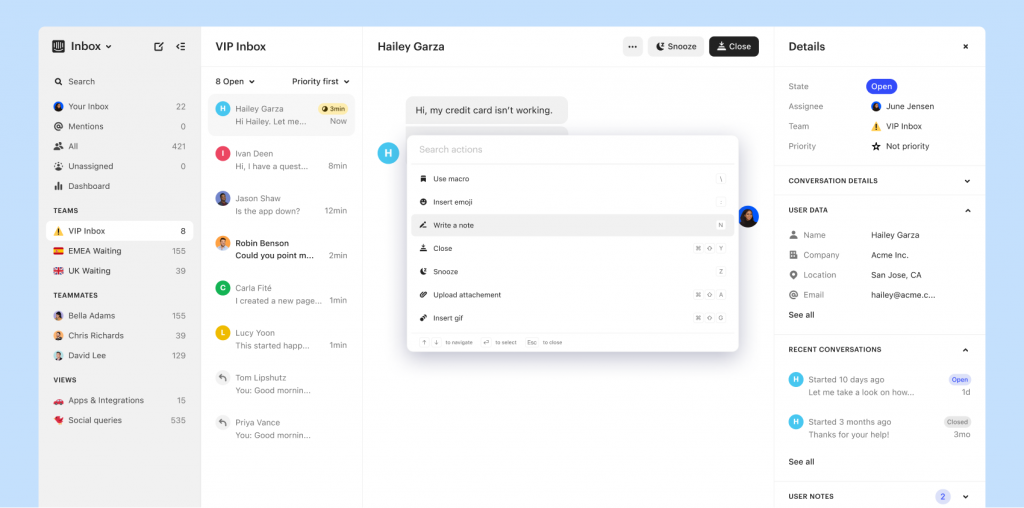
Where it gets complicated is billing. Seat pricing is only the starting cost.
Fin AI resolutions are billed separately, and teams leaning on AI deflection have reported bills climbing well beyond what seat pricing alone would suggest.
Pros:
- Modern, well-regarded messenger interface
- Fin AI agent handles a high volume of resolutions without a human handoff
- In-app messaging and help desk functionality in one workspace
- Large third-party integration ecosystem
Cons:
- Seat pricing plus per-resolution AI billing makes the monthly cost hard to predict
- A pending acquisition by Salesforce has left some buyers uncertain about the long-term roadmap direction
User Rating: 4.5/5 (Capterra)
Pricing: Paid plans start at $19/seat/month for Essential, up to $132 or more per seat on higher tiers. Fin AI is billed separately at $0.99 per resolution.
7. Totango: Best for Modular, Multi-Product Customer Success Programs
Totango’s SuccessBLOC framework packages best-practice CS programs into modular, reusable blocks instead of building every workflow from scratch.
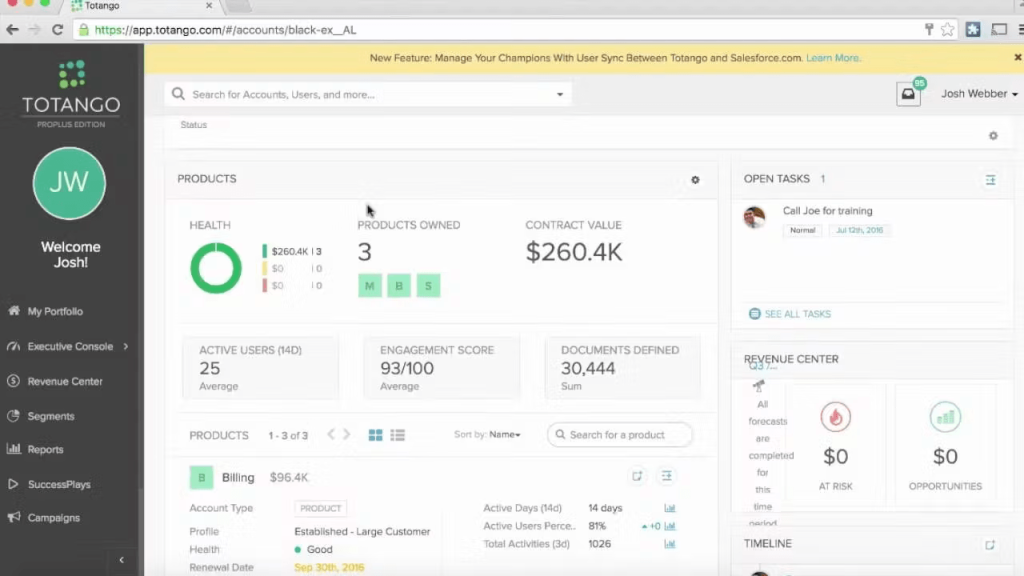
Enterprise names like SAP and GitHub run on it at scale. However, the daily experience is less impressive than the concept.
Users repeatedly describe the platform as slow and hard to navigate, and the timeline view can only be searched by subject line, not full content, a limitation that feels dated for a 2026 product.
Pros:
- Modular SuccessBLOC framework for packaging CS programs
- Broad go-to-market use case spanning CS, sales, and marketing teams
- Used at scale by large enterprise names
Cons:
- The interface feels slow, buggy, and harder to navigate than newer platforms
- No published pricing or free trial; every evaluation starts with a sales call
User Rating: 3.7/5 (Capterra)
Pricing: Custom pricing. Contact sales for a quote.
8. ChurnZero: Best for Mid-Market Teams That Want Real-Time Health Scoring and a Daily Command Center
ChurnZero’s command center gives CSMs a single daily view of which accounts need attention, which playbooks are running, and which health scores just shifted.
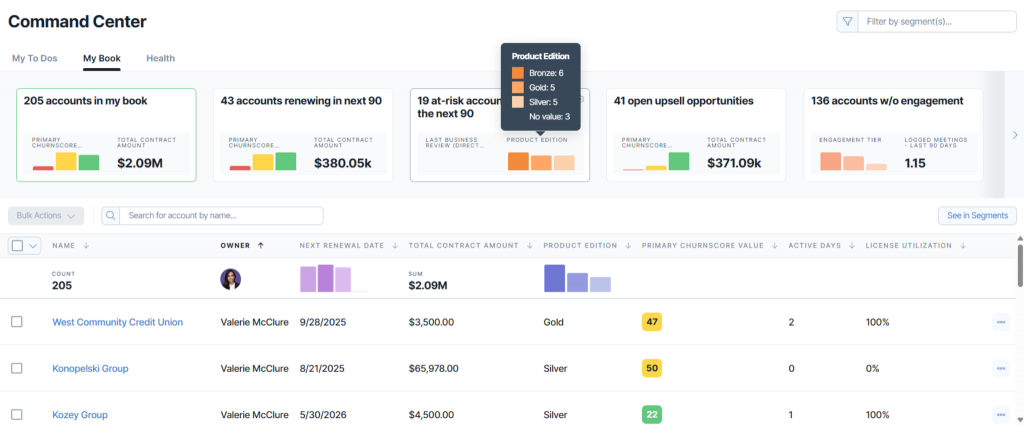
All this happens with in-app communication built in rather than a separate messaging tool.
It’s aimed squarely at mid-market SaaS teams with 20 to 100 CSMs who want usage-based health scoring without Gainsight-level configuration overhead.
Pros:
- Command center view surfaces daily account priorities in one place
- Real-time, feature-level product usage tracking
- Built-in in-app communication, no separate messaging tool required
- Strong satisfaction scores across a solid review base
Cons:
- Entry pricing around $12,000 a year puts it out of reach for very small teams
- Best suited to teams with a dedicated CS ops function rather than a single early hire
User Rating: 4.7/5 (Capterra)
Pricing: Contact sales for an exact quote.
9. ClientSuccess: Best for Fast-Growing Mid-Market Teams That Want to Launch in Weeks
ClientSuccess positions itself against the multi-month rollout reputation of bigger enterprise platforms.
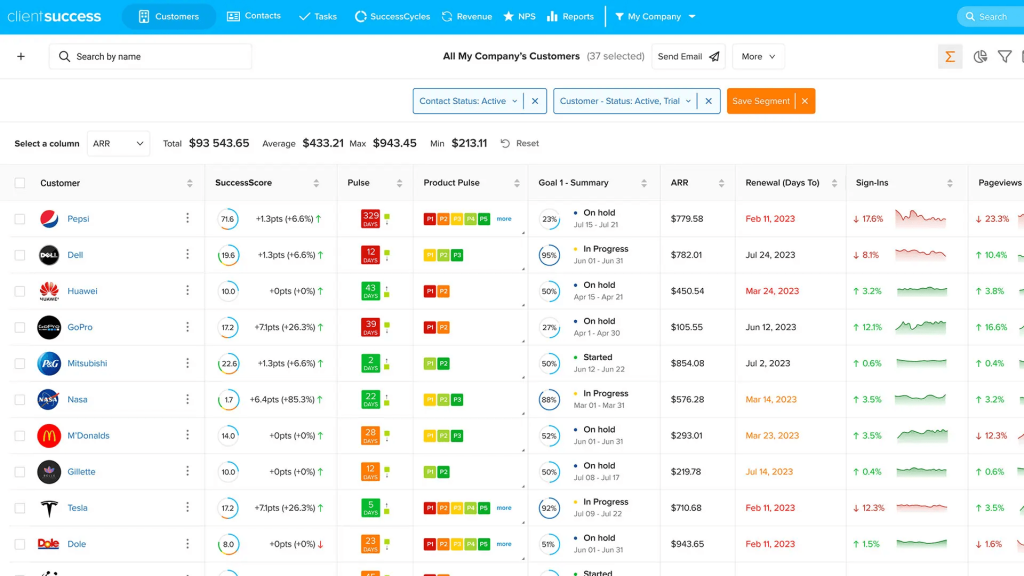
Many of my customer success team members also back that up, consistently praising quick setup and straightforward administration.
That speed comes with less configurability than Gainsight or Totango offer, which is a fair tradeoff for a team that needs a working system now rather than the most customizable one available.
Pros:
- Fast time-to-value, built for teams that want to go live in weeks
- Easy setup and administration
- SIIA CODiE Award winner for customer success management software
Cons:
- Smaller review base than category leaders, so pattern confidence is lower
- Entry pricing around $15,000 a year; contact the vendor for an exact quote
User Rating: 4.2/5 (Capterra)
Pricing: Contact the vendor for pricing.
10. Custify: Best for Lean B2B SaaS Teams That Want Enterprise-Grade Health Scoring Without Enterprise Complexity
Custify carries the highest satisfaction score on this list, and it traces back to CustifyAI. New customers describe a concierge-style rollout: hands-on guidance from Custify’s team to define what “healthy” actually means for their specific product.
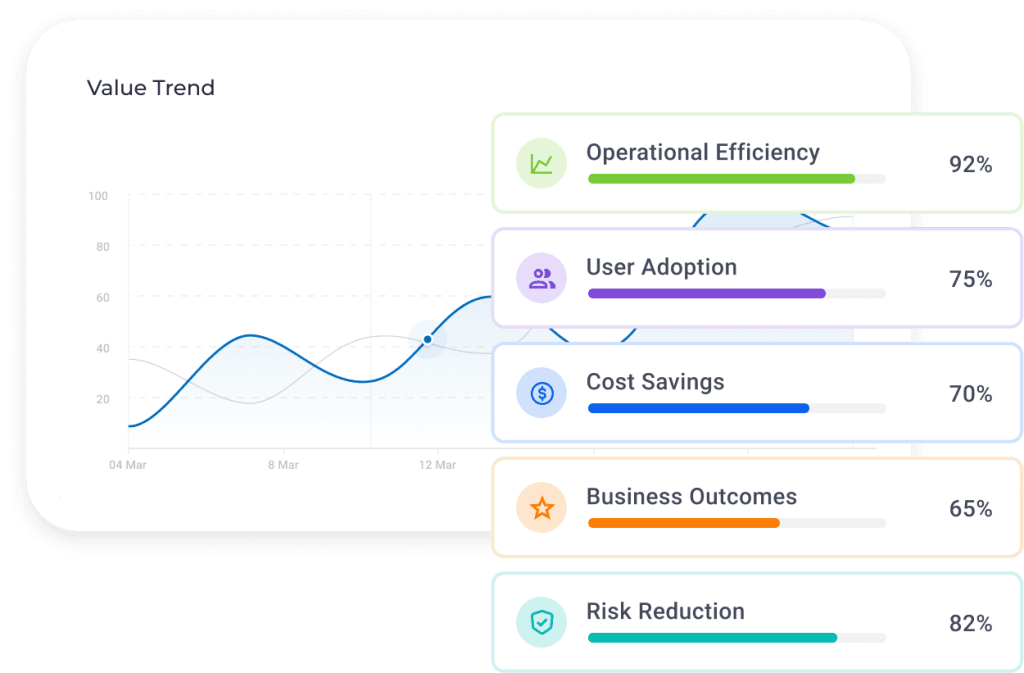
Its embedded assistant, which turns usage, support, and billing data into playbooks and risk summaries directly inside the Customer 360 view, without the heavy manual setup.
The honest limit is who it’s built for. Custify is squarely a B2B SaaS tool, priced and designed around a subscription revenue model, so a services business or a company without recurring revenue at its core won’t find the same fit.
Pros:
- Highest satisfaction score of any tool on this list
- CustifyAI turns customer data into playbooks and risk summaries automatically
- Concierge-style onboarding built for lean CS teams
- Strong CRM, billing, and support integrations without enterprise-level complexity
Cons:
- Smaller review base than category giants like Intercom or HubSpot
- Built specifically for the B2B SaaS subscription model, it’s less of a fit outside of it
User Rating: 4.9/5 (Capterra)
Pricing: Custom pricing. Contact the vendor for a quote.
Which 3 Customer Success Tools Should Be Your Top Picks?
If you read nothing else on this list, these three cover the range most teams actually need to choose between:
1. Qualaroo: Best Overall Pick if Your Real Problem Is Understanding Why, Not Just Tracking What
Every other tool on this list is built to score, route, or automate around data that already exists. Qualaroo is the only one built to capture the actual human reason behind a shifting health score, while the customer is still in your product and willing to explain what’s wrong.
The free plan includes every premium feature up to 50 responses, so there’s essentially no cost to testing whether this closes the specific gap in your current stack.
If your team keeps getting blindsided by churn on accounts that looked healthy on paper right up until they weren’t, that’s usually a sign the health score is missing an input, not that the score itself is broken.
2. Gainsight CS: Best for Enterprise Teams That Need the Deepest Feature Set
Once a CS organization reaches the size where a dedicated ops function exists to run the system, Gainsight’s multi-signal health scoring and journey orchestration become genuinely difficult to match feature for feature.
It’s built for teams running complex, cross-functional programs where a single health score needs to trigger different playbooks depending on account tier, product line, or renewal timing, not a one-size-fits-all workflow.
This is the pick for a team that has outgrown a simpler tool and has the internal capacity to configure something this deep properly, not the pick for a team standing up its first CS motion from scratch.
3. ChurnZero: Best for Mid-Market Teams That Want Speed Without Sacrificing Depth
If Gainsight sounds like more tool than your team actually needs right now, ChurnZero occupies that gap deliberately.
The command center view gives CSMs daily clarity on exactly which accounts need attention without the configuration overhead of an enterprise platform, and in-app communication is built in, so there’s no separate messaging tool to manage on top of it.
The pricing, while not cheap at around $12,000 a year, is at least transparent enough to plan a budget around rather than waiting on a fully custom quote
How Did I Evaluate These Customer Success Tools?
Every tool on this list went through the same six-factor check, blending standard buying criteria with what actually determines whether a CS platform works once it’s live, not just what looks good on a features page.
User Reviews and Ratings: Capterra scores and review volume, since consistency across a large base signals real satisfaction over a marketing claim.
Essential Features and Functionality: Whether health scoring and playbooks solve the reader’s actual problem, not how long the feature list reads.
Ease of Use and Setup: How much onboarding time does a team need before the platform feels usable day to day.
Customer Support: Response quality and speed, especially during initial setup and health-score configuration.
Value for Money: What each tier delivers relative to pricing, including hidden costs like onboarding fees or per-resolution AI billing.
Health Score Depth: How many signals, usage, support, billing, sentiment, actually feed the score, since one-signal scoring misses dissatisfaction that hasn’t shown up as reduced activity yet.
FREE. All Features. FOREVER!
Try our Forever FREE account with all premium features!
How Do You Choose the Right Customer Success Software for Your Team?
The honest starting point is naming what’s actually broken in your current setup, rather than shopping by feature list. Here’s how that maps to the tools above.
| If Your Main Need Is… | Consider This Tool |
| Understanding why an account is at risk, not just that it is | Qualaroo |
| CSAT, Net Promoter Score, or CES survey creation on its own | ProProfs Survey Maker |
| Enterprise-grade health scoring and journey orchestration | Gainsight CS |
| Fast time-to-value for a mid-market team | ChurnZero or ClientSuccess |
| Health scoring without enterprise complexity | Custify |
| Support ticketing tied to your existing CRM | HubSpot Service Hub |
| In-app messaging and AI-driven support deflection | Intercom |
Most teams that get this wrong don’t pick a bad tool; they pick a mismatched one: enterprise depth without the ops capacity to run it, or a lean tool that can’t scale past the next funding round.
Why Do Businesses Need Customer Success Software?
The shift toward a dedicated CS platform usually isn’t triggered by one bad renewal call. It’s death by a thousand small gaps that finally add up to a number leadership can’t ignore.
Here’s what typically pushes a team to finally shop for one.
Health Scores Alone Do Not Explain Churn: A red score is a symptom, not a diagnosis. It flags that something changed, not whether the cause was a broken workflow or an ignored support ticket.
Renewals Get Missed Without Early Warning: Teams relying on a spreadsheet or CRM alone tend to notice risk only when the renewal conversation is already underway.
Feedback Lives in Too Many Places: Support tickets, NPS responses, and usage data usually sit in separate tools owned by separate teams, so nobody has the full account picture.
Expansion Opportunities Go Unnoticed: A customer quietly outgrowing their plan is a signal most teams miss without a system tracking usage and satisfaction together.
CS Teams Cannot Scale Headcount With Accounts: A CSM covering 50 accounts by memory cannot cover 200 the same way. Automation is what lets coverage grow without proportional hiring.
Cross-Functional Visibility Stays Siloed: Sales, support, and product each hold a piece of the customer story. Centralized CS software consolidates those pieces into a single view.
Which Customer Success Software Is Right for You?
If you’ve made it this far, you already know the honest answer to the question this list keeps circling back to: health scores are a symptom report, not a diagnosis.
Each platform above can tell you when an account turns red.
None of them, on their own, can tell you the CSM changed twice in a quarter, or that a key workflow broke after the last release, or that onboarding never actually happened the way sales promised it would.
That’s the specific gap Qualaroo is built to close, and it’s worth being precise about why.
The Nudge™ doesn’t wait for a quarterly survey or a support ticket to surface a problem. It catches the moment itself, while a customer is still on the page, still using the feature, still willing to say what’s wrong instead of quietly disengaging.
Frequently Asked Questions
What is customer success software?
Customer success software brings together customer data such as product usage, support activity, billing information, and feedback to help teams monitor account health. It can identify churn risks, surface expansion opportunities, and organize follow-up workflows. Instead of relying on spreadsheets or memory, customer success managers get a shared view of accounts they can use to make informed decisions.
Does customer success software actually improve retention?
It can help improve retention, but only if someone acts on what it surfaces. A platform flags which accounts are at risk or ready to expand; retention still depends on a CSM actually intervening in time. Pairing health scoring with direct feedback tools like Qualaroo closes that loop faster because you're acting on the root cause, not just the symptom.
What is the best free customer success software?
The best free option depends on what you need most. Qualaroo's free plan includes every premium feature, including AI Sentiment Analysis and the AI Survey Creator, up to 50 responses a month. HubSpot Service Hub also offers genuinely usable free tools if ticketing is your starting point instead of direct feedback.
What is the difference between a CRM and customer success software?
A CRM primarily manages the sales relationship, including contacts, deals, accounts, and pipeline activity. Customer success software focuses on the post-sale relationship, tracking product usage, customer health, renewal risk, and engagement. Many organizations use both systems together, connecting them through integrations so sales and customer success teams can share relevant account information.
Which customer success software is best for small teams?
Small teams typically benefit from customer success software that is easy to implement without requiring extensive administration or technical resources. Custify and ClientSuccess are designed for focused customer success workflows, while ProProfs Help Desk and Qualaroo can cover support and satisfaction tracking at a lower entry cost if you don't yet need a full customer success platform.
Can Qualaroo replace a dedicated customer success platform?
Yes, it can handle all the important parts of the process by collecting direct customer feedback through NPS, customer satisfaction, and other surveys, and performing comprehensive survey analysis using AI. Along with that, you can get to know the users before they have answered your surveys using heatmaps and sessions. For teams that mainly need structured customer feedback, it can quickly fulfill the need for a dedicated CS platform.
How much does customer success software typically cost?
Customer success software can range from free and low-cost survey tools to enterprise platforms with custom pricing. Tools like Qualaroo and ProProfs Survey Maker starts at $0 with their free plan, while paid plans start at $19.99 per month. Dedicated customer success platforms typically cost considerably more, particularly when they include advanced health scoring, integrations, automation, and enterprise support.
What should a customer health score actually include?
A useful customer health score should combine multiple signals rather than relying on product usage alone. Consider factors such as login or product activity, support volume, ticket sentiment, billing history, engagement, and direct customer feedback. Combining these signals provides a more complete picture and can reveal dissatisfaction even when an account's usage hasn't dropped significantly.
How long does it take to implement customer success software?
Implementation time depends on the platform, data sources, integrations, and workflows involved. A lightweight survey or feedback platform, such as Qualaroo or ProProfs Survey Maker, can be set up relatively quickly, while dedicated customer success platforms may require several weeks or months. Enterprise implementations typically take longer because teams need to configure integrations, health scores, automation, permissions, and reporting.
FREE. All Features. FOREVER!
Try our Forever FREE account with all premium features!

 We'd love your feedback!
What did you like & how can we make it even better?
 Thanks for your feedback!
 Ask Your Question
Have a question? Get expert help to make your decision easier.