

Automotive customer experience management is the process by which OEMs, suppliers, and dealer networks track, measure, and improve every customer interaction throughout the ownership journey.
Get it right, and you retain buyers through their next purchase. Get it wrong, and you are funding your competitor’s next sale.
Most automotive brands already know CX matters. What they are missing is a system that connects feedback from sales, service, and support into decisions someone actually acts on.
That is where an in-context feedback tool earns its place, capturing the reaction in the moment instead of days after a customer has already moved on.
This guide breaks down what automotive customer experience management actually involves, where most programs break down, and how to choose a tool or provider that fits your part of the value chain.
What Is Automotive Customer Experience Management?
Automotive customer experience management is the practice of collecting, analyzing, and acting on customer feedback and behavioral data across every touchpoint in the vehicle ownership lifecycle, including research, purchase, financing, onboarding, service, and repurchase, so OEMs, suppliers, and dealers can reduce friction and build long-term loyalty.
It is broader than a CRM and broader than a single survey tool. A CRM tracks who the customer is and what they bought.
Customer experience management tracks how the customer felt at each step and whether that feeling is trending toward loyalty or churn.
In practice, this means three things working together:
- Feedback collection at key moments, not just after a sale closes
- A way to route that feedback to the team that can act on it
- A way to measure whether changes actually moved satisfaction or retention
How Does Customer Experience Management Work Across the Automotive Value Chain?
Automotive customer experience management looks different depending on where you sit in the chain, and a one-size tool rarely fits all three roles well.
| Stakeholder | Primary CX Job | Common Blind Spot |
| OEMs | Brand-level loyalty, connected vehicle experience, and long-term ownership sentiment | Distance from the actual service interaction |
| Tier 1 and Tier 2 Suppliers | Quality feedback, defect signals, and downstream customer impact | Feedback is filtered through the OEM before it ever reaches them |
| Dealers and Service Networks | Sales experience, service transparency, repeat visit behavior | Fragmented systems across sales, service, and F&I |
This is exactly where the passive vs. in-context feedback problem shows up.
Most dealerships and suppliers still rely on emailed surveys sent after the fact, which explains the low response rate and delayed detection of problems.
Qualaroo’s Nudge surveys ask a targeted question while the customer is still on a service portal, parts ordering page, or feedback form, which produces feedback that is 10 times more useful than an email survey sent after the moment has passed.
How Do You Manage Automotive Customer Experience?
Automotive customer experience management works as an ongoing loop, not a one-time project. Here is the process, broken down so you can actually run each stage this week using Qualaroo.
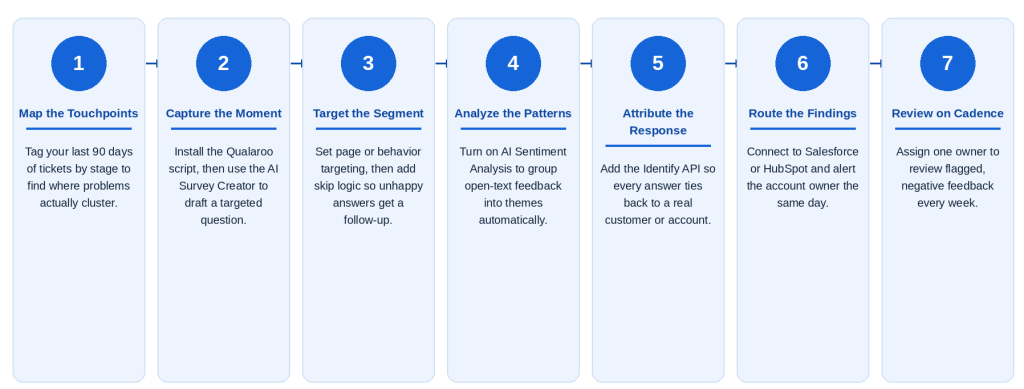
Step 1: Map the Touchpoints That Matter for Your Role
Start with your last 90 days of support tickets, service records, or account complaints, and tag each one with the stage it occurred in: purchase, onboarding, service, or renewal.
This tells you where problems actually cluster, rather than where you assume they do.
- If You Are an OEM: Focus on brand-level moments like delivery updates, connected app onboarding, and first-service experience.
- If You Are a Tier 1 or Tier 2 Supplier: Focus on quality signals, defect reports, and how fast issues reach you from the dealer or OEM layer.
- If You Are a Dealer or Service Network: Focus on scheduling, wait time communication, and pricing transparency during service visits.
Pick two or three moments from this list. These become your first surveys, not a dozen at once.
Step 2: Capture Feedback at the Moment It Happens
Log in to your account, go to the Nudges™ tab, and click Create Nudge™.
Choose whether it runs on a website page, a web app, or inside a mobile app, then paste the install script into the page header where you want it to appear, such as your service scheduling page or supplier account dashboard.
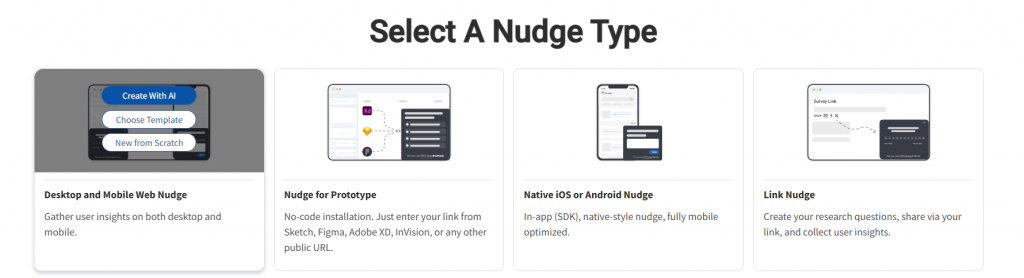
The script is asynchronous, so it will not slow the page down.
Next, open the AI Survey Creator instead of starting from a blank builder. Type a short prompt describing what you want to learn.
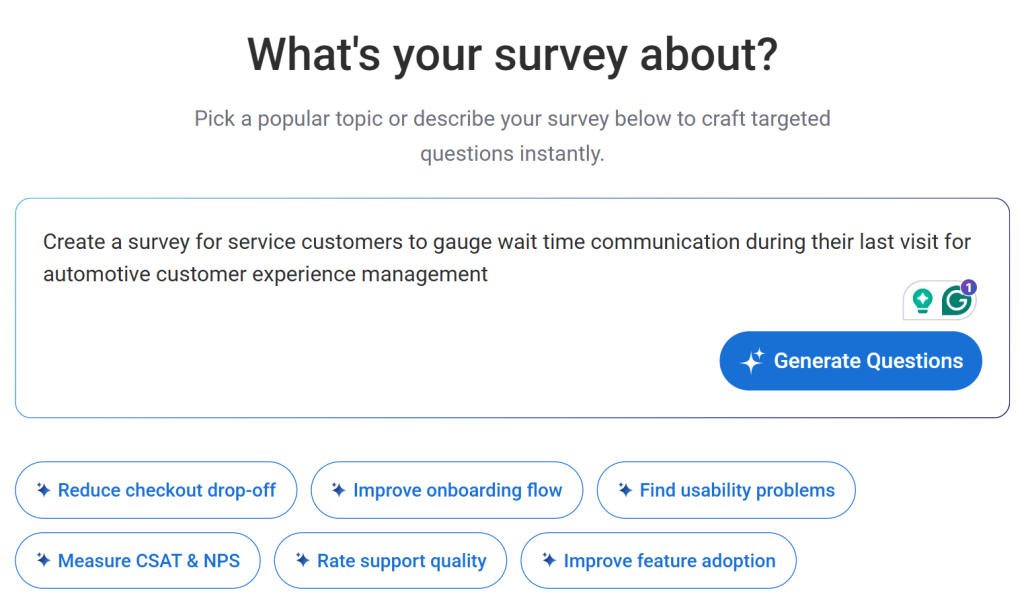
Example Prompt: Ask service customers how satisfied they were with wait time communication during their last visit.
The AI Survey Creator drafts a short question set based on that prompt. Review it and edit the wording so it matches how your team actually talks to customers, then click Publish.
Example Ready-to-Use Question: How clearly did we communicate updates during your recent service visit? (Very clearly, Somewhat clearly, Not clearly at all)
Step 3: Target the Right Segment With the Right Question
Open the Targeting tab on your Nudge™ and set the rule that fits your moment.
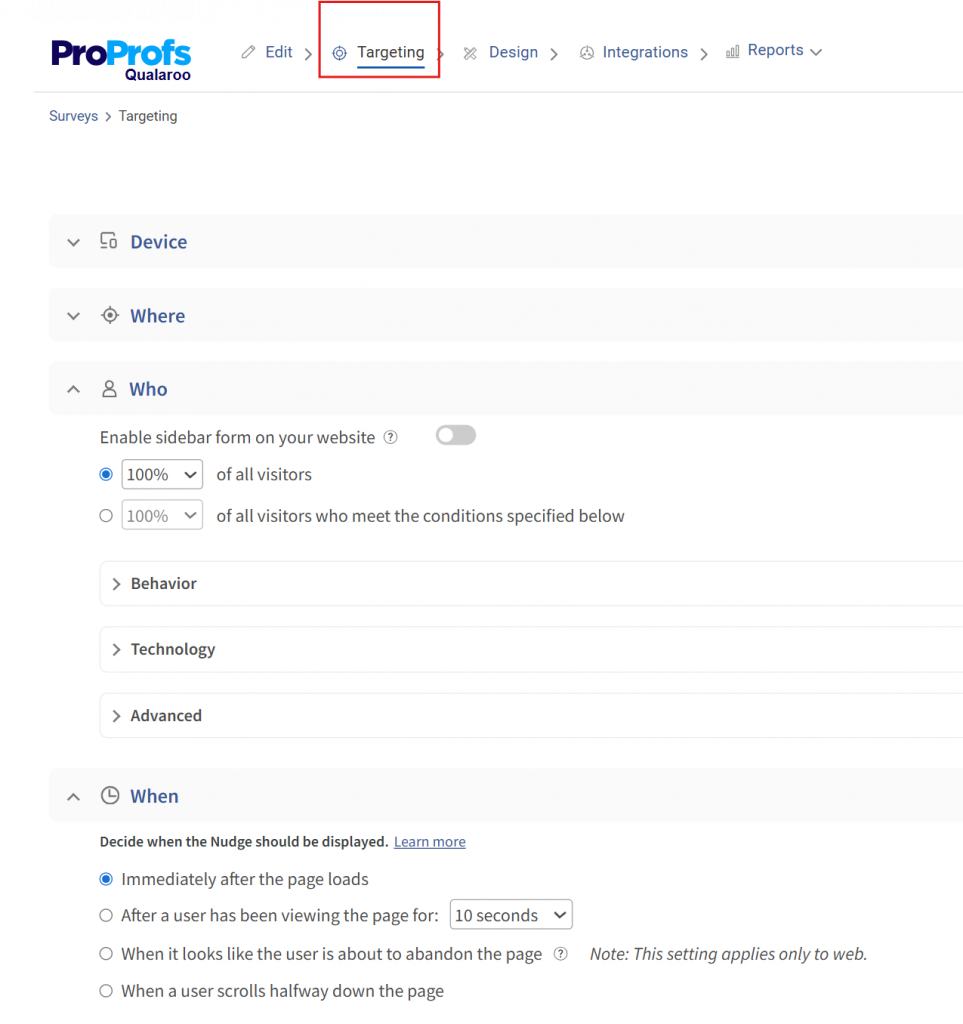
- For a service customer, target by page URL, such as showing the survey only on the appointment confirmation page.
- For a supplier account, target by behavior, such as showing the survey after a customer has spent more than 30 seconds on the parts order page.
Then open the Skip Logic tab to add branching. Set a rule so that a dissatisfied answer, such as Not Clearly At All, triggers a follow-up question asking what went wrong, while a satisfied answer skips straight to a short thank you. Here’s how it works:
This keeps the survey short for happy customers and useful for unhappy ones.
Step 4: Analyze for Patterns, Not Just Individual Comments
Go to the Reports tab and turn on AI Sentiment Analysis for the Nudge™ you just published.
Every open-text response gets scored and grouped automatically, so instead of reading a hundred comments one by one, you see clusters like Pricing Confusion or Long Wait Times ranked by volume.
Here’s how it works:
Check this view weekly at first. Once you see the same theme appear three or four times, you have a real pattern worth escalating, not a single frustrated customer.
Step 5: Attribute Every Response to a Real Account
Add one line of the Identify API to the page where a customer or account logs in, using their email address or customer ID: _kiq.push([“identify”, “customer@email.com”]);.
Once this is live, every survey response gets tied to that real account instead of showing up as an anonymous entry.
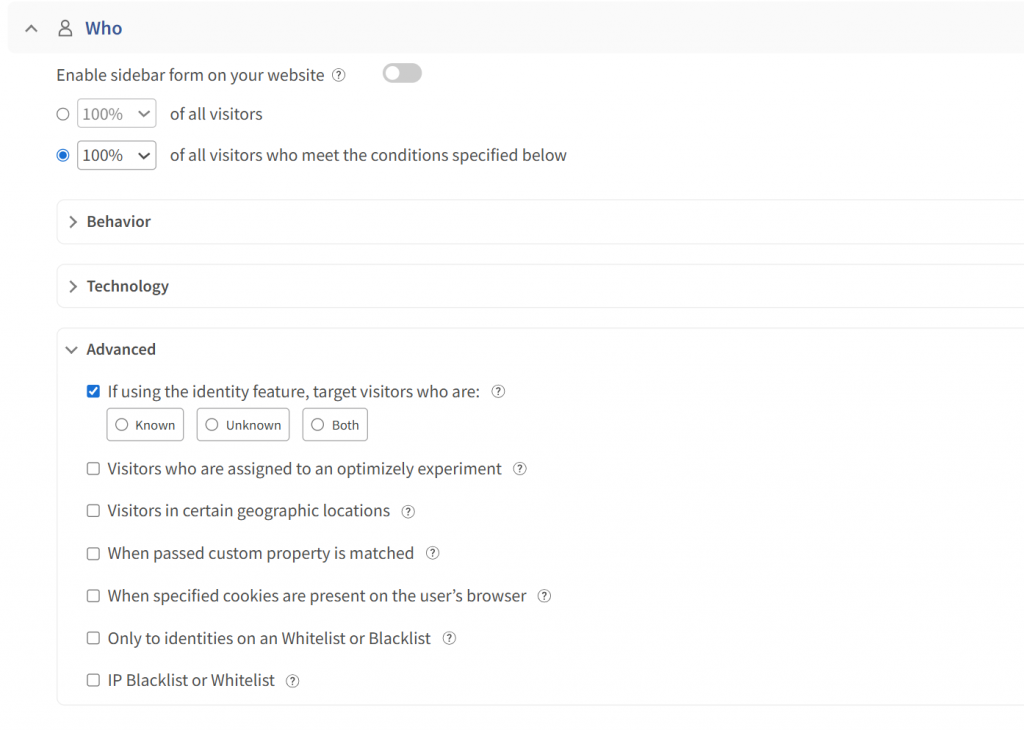
In your dashboard, you can now filter responses by customer name, plan type, or account ID.
This is the step that lets a Tier 1 supplier trace a complaint back to the exact dealer or fleet account it came from, instead of guessing.
Step 6: Route Findings to the Team That Owns the Fix
Open the Integrations tab and connect to Salesforce or HubSpot.
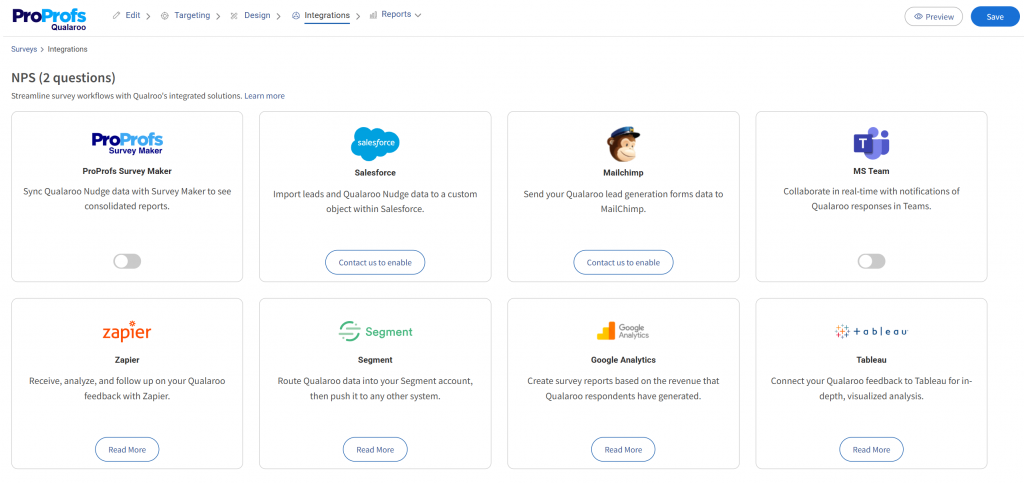
Map survey responses to the matching account or contact record, so feedback shows up next to the account history your team already checks daily.
If you use Slack, turn on alerts for low-sentiment responses so the account owner gets notified the same day, not at the next scheduled report.
Step 7: Review Flagged, Low-Sentiment Feedback on a Set Cadence
Set a recurring weekly time, ideally the same day and hour, to open your saved Negative Sentiment filter in the dashboard.
Assign one person to own this review, whether that is a service manager, account manager, or quality lead.
Their job is to follow up directly with any customer or account that flagged a real problem, before that account decides to switch.
How Do You Compare Customer Experience Management Tools for the Automotive Industry?
Comparing customer experience management tools for the automotive industry comes down to five capabilities that actually predict whether the tool gets used or abandoned after onboarding.
| Capability | What It Solves in Automotive | Why It Matters |
| Real-Time, In-Context Surveys | Captures feedback during service booking, checkout, or portal use | Higher response quality than email or kiosk-only tools |
| AI-Powered Feedback Analysis | Reads open-text complaints about wait times, pricing, or repairs at scale | Surfaces recurring issues without manual tagging |
| AI Survey Creation | Builds targeted questions from a prompt instead of a blank builder | Cuts setup time for teams without a dedicated research function |
| Behavior-Based Targeting | Triggers surveys by page, account status, or customer history | Ensures Tier 1 suppliers and multi-brand dealers ask the right segment |
| CRM and Analytics Integrations | Connects feedback to Salesforce, HubSpot, or existing dashboards | Keeps CX data out of a disconnected silo |
This platform covers all five of these directly, which is why it shows up throughout the step-by-step process above rather than as a single bolt-on feature.
Here’s a list of the top 5 customer feedback management tools, including Qualaroo:
FREE. All Features. FOREVER!
Try our Forever FREE account with all premium features!
What Customer Experience Challenges Do Automotive Companies and Suppliers Face?
Community discussions on forums and review sites, alongside recent industry research, point to the same four recurring breakdowns.
| Challenge | What It Looks Like | Why It Happens |
| Fragmented Data Across OEMs, Dealers, and Suppliers | A dealer, OEM, and supplier each hold a different piece of the same customer’s history, with no shared view | The automotive journey runs three to seven years across CRM, DMS, and service scheduler systems, and the OEM-dealer relationship adds an organizational split few other industries face |
| Slow or Inconsistent Service Communication | Pricing, scheduling, and repair status live in separate tools, so customers notice the handoffs even when they cannot name the cause | Customers judge dealerships and suppliers as one experience, not a set of disconnected systems |
| Generic Feedback That Misses the Moment | Post-visit surveys sent by email days later capture whatever the customer remembers, not what actually happened | By the time the survey lands, frustration has either faded or hardened into a decision to switch brands |
| A Gap Between Executive and Customer Perception | Programs get built around what leadership assumes matters, not what customers actually report | 73% of executives name brand reputation as the top loyalty factor compared to 48% of consumers (EY, 2025) |
Why Does Customer Experience Management Matter in the Automotive Industry?
Automotive companies chase customer experience management because the cost of ignoring it now shows up directly in revenue and retention, not just in review scores.
The automotive industry has notably lower customer experience performance than other consumer-facing industries, and there is a clear gap between how customers and executives see CX. That gap is not cosmetic.
Customer Loyalty Is Becoming Harder to Retain
The 2026 Reynolds Retention and Defection Report found nationwide brand retention held at 43.9% in 2025, with 20 of 38 tracked vehicle brands seeing a year-over-year decline.
Only five brands crossed the 50% retention mark, down from six the year before, a sign that even established players are losing ground on the loyalty they once took for granted.
Strong Customer Experience Delivers Measurable Business Value
The financial upside for closing that gap is real.
Capgemini’s research estimates that automotive brands prioritizing CX improvements could see gains between $20 million and $70 million annually at a scale of roughly 500,000 vehicles sold.
Yet only 18% of organizations report having a coherent CX strategy.
Customer Expectations Continue to Evolve
Deloitte’s 2026 Global Automotive Consumer Study found that consumers now prioritize service quality, trust, and transparency when choosing and evaluating vehicle service providers, with brand loyalty weakening fastest in markets with higher proportions of first-time owners.
Connected Vehicles Are Raising the CX Bar
Connectivity is about to raise the stakes further.
McKinsey’s 2024 study projected that more than 90% of vehicles sold by 2030 will be connected, making the experience layer an unavoidable part of the product itself.
Where Does Automotive Customer Experience Management Go From Here?
The gap between automotive brands that keep customers and the ones that lose them rarely comes down to a lack of data. It comes down to whether that data reaches someone who can act on it before the customer decides to leave.
You do not need a company-wide rollout to start closing that gap.
One targeted Nudge™ on your highest-friction touchpoint, reviewed weekly, tells you more about where you are losing customers than a quarterly report ever will.
Start with one touchpoint, prove the pattern works, then expand the same process to the next one on your list.
Ready to see where your customers are actually dropping off? Try Qualaroo and launch your first in-context survey today.
This runs on Qualaroo’s free plan, so there’s nothing stopping you from testing it on one touchpoint today.
Frequently Asked Questions
What is the difference between customer experience management and CRM in automotive?
A CRM stores customer and transaction data. Customer experience management tracks how customers feel at each touchpoint and whether that sentiment is improving. Automotive teams typically run both, with CX data feeding into CRM records for a fuller account view.
What metrics should automotive companies track for customer experience?
NPS, CSAT, and Customer Effort Score cover most needs. NPS signals long-term loyalty risk, CSAT measures satisfaction with a specific interaction like a service visit, and Customer Effort Score flags friction in processes like scheduling or financing.
How is automotive customer experience management different from other industries?
The ownership journey runs three to seven years, far longer than most consumer relationships, and the OEM-dealer-supplier structure splits customer data across separate organizations that rarely share systems. Few other industries manage a relationship this long across this many disconnected parties, which makes a single connected feedback view harder to build and more valuable once it exists.
Does AI play a role in automotive customer experience management now?
Yes. AI-powered sentiment analysis and AI-assisted survey creation are now standard expectations, not premium extras, especially as ownership relationships stretch across more touchpoints and organizations. They let smaller teams process open-text feedback at scale and turn a plain-language prompt into a usable survey without a dedicated research function.
How often should automotive companies survey customers?
Trigger surveys at moments that matter, such as right after a service appointment, a parts order, or a support interaction, rather than on a fixed monthly or quarterly schedule. Moment-based triggers produce more relevant, higher-response feedback than blanket outreach, since the experience is still fresh enough for the customer to describe accurately.
Can Tier 1 and Tier 2 suppliers use customer experience management tools directly?
Yes. Suppliers can survey dealer or fleet accounts directly through a portal or support channel instead of waiting for OEM-filtered feedback, which closes the visibility gap that usually delays quality issue detection by weeks. This is especially useful for Tier 1 and Tier 2 suppliers managing several accounts from a single login.
What causes most customer experience failures in automotive companies?
Data fragmentation, not a lack of tools. When sales, service, and support data live in separate systems, no one has a complete view of the customer, and problems get caught late, escalate further than they should have, or get missed entirely until a customer decides to switch brands.
How do you choose a customer experience management provider for automotive suppliers?
Shortlist providers the way Capterra buyers do: check industry fit, integration depth with your CRM or DMS, total cost of ownership, whether a response can be tied to a specific account, and support for a phased rollout across sites. Qualaroo fits suppliers managing several accounts from one login.
Is email survey feedback still useful for automotive customer experience programs?
It has a role, but response rates and relevance are lower since the moment has already passed and the details have faded from memory. In-context surveys triggered during an actual interaction, while the experience is still fresh, consistently produce more actionable and higher-quality responses for the same effort.
FREE. All Features. FOREVER!
Try our Forever FREE account with all premium features!

 We'd love your feedback!
What did you like & how can we make it even better?
 Thanks for your feedback!
 Ask Your Question
Have a question? Get expert help to make your decision easier.