
Healthcare organizations have more patient data than ever and still struggle to know what is actually going wrong.
A patient can rate their doctor a 10 out of 10 and still leave the practice over a billing error or a scheduling app that would not load.
That gap is the whole problem with customer experience management in healthcare: the feedback that would explain it usually shows up days too late, sitting in an inbox instead of catching the patient at the moment something broke.
This guide covers what the discipline actually means, what changed heading into 2026, and how to build a system that catches friction while it still matters.
What Is Customer Experience Management in Healthcare?
Customer experience management in healthcare is the ongoing practice of tracking, measuring, and improving every interaction a patient has with a provider, payer, or health platform, from scheduling and billing to clinical visits and follow-up care. It differs from patient satisfaction because it considers the full relationship over time, rather than a single-visit score.
A patient satisfaction score tells you how one appointment went.
Customer experience management tells you whether that patient trusts you enough to come back, refer a friend, or stay on a treatment plan.
Those are different questions, and healthcare organizations that only track the first one are missing the second.
Customer experience management in healthcare treats the entire journey as one connected system instead of a collection of separate departments:
- Access: How easily a patient can find, book, and reach care in the first place
- Communication: Whether patients feel informed and heard at every step, not just during the appointment itself
- Financial: Clarity and ease around costs, billing, and payment options
- Digital: How well portals, apps, and self-service tools actually work under real use
- Continuity: Whether the relationship holds together after the visit ends, through follow-up and ongoing care
A strong CX program does not try to perfect all five categories at once. It measures each one separately, identifies the biggest gap between expectation and reality, and fixes that gap first.
That prioritization is what separates a mature CX program from a stack of disconnected survey tools.
How Can Healthcare Teams Build a Real-Time Feedback System?
Most healthcare organizations already collect feedback.
The problem is not a lack of data; it is timing.
A survey that arrives three days after a billing error does not help the patient, who is already frustrated, and it does not give the care team a chance to fix the problem before the patient tells 10 other people about it.
The fix is not a better version of the same survey.
It is a way to ask a short, contextual question at the exact moment something happens, then tie that response to a real patient so someone on your team can follow up before the moment is gone.
This is where a non-intrusive, in-context survey tool changes the equation. Instead of emailing every patient a generic satisfaction form a week later, you place a short, targeted question directly on the page or screen where friction is likely to occur.
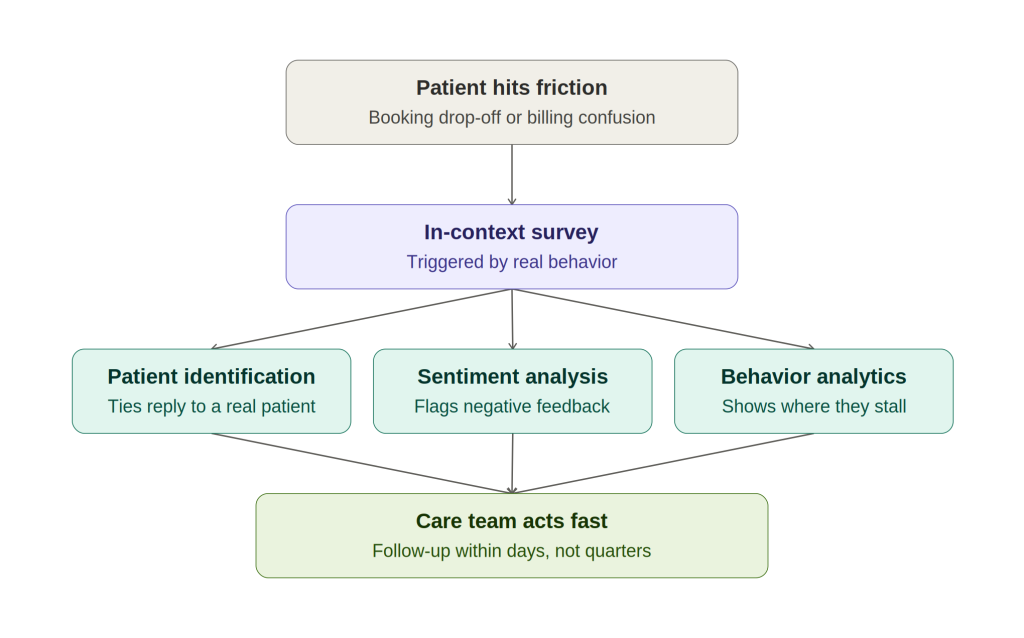
This is where a non-intrusive, in-context survey tool like Qualaroo changes the equation. The surveys sit on a webpage, patient portal, or mobile app and trigger based on real behavior.
For example, a patient abandoning an online booking form or spending an unusual time on a billing page, instead of waiting for a scheduled email blast that reaches everyone, regardless of what actually happened to them.
Mapping Journey Moments to the Right Kind of Trigger:
| Patient Moment | Trigger Type | What You Learn |
| Abandons Online Booking | Exit intent on scheduling page | Why the booking flow broke down |
| Lingers on a Billing Page | Time on page | Where cost or terminology confuses patients |
| Completes a Telehealth Visit | Post-interaction, in-app | Whether the virtual visit met expectations |
| Returns to the Portal Repeatedly in One Day | Behavior-based, repeat visit | Whether a task cannot be completed self-service |
| Opens a Discharge Instructions Page | Post-visit, on-page | Whether instructions are clear enough to follow |
Each row above is a place where a generic quarterly survey would never catch the problem, because by the time that survey goes out, the patient has already moved on, and the specific context of what went wrong is gone.
Problem to Solution Mapping:
Once you know where to ask, the next question is what to do with the answer. Here is how each common gap plays out, and what actually closes it:
1. A Patient Drops off Mid-Scheduling With No Explanation
This is one of the most common and least understood churn points in healthcare, because it never generates a support ticket or a complaint.
A targeted survey triggered on exit intent can ask a single question, such as what stopped them from completing the booking, right before they close the tab.
That single data point, repeated across hundreds of drop-offs, usually reveals a pattern: a missing insurance field, a confusing date picker, or an unexpected fee that only appears at the last step.
2. Feedback Comes in Anonymously, so No One Can Follow Up
An anonymous complaint about billing confusion is a data point. A complaint tied to a real patient is a chance to fix that patient’s bill and keep them.
The Identify API links every response to a real email or customer ID, so a care team can reach out to the specific person instead of guessing who might be affected.
3. Free-Text Complaints Pile up Unread
Open-ended questions produce the richest, least analyzed feedback, because reading hundreds of comments by hand does not scale.
Native AI feedback and sentiment analysis reads open-ended responses and automatically flags negative sentiment, so a team can triage the 10 most urgent comments instead of scrolling through all of them.
4. Teams Cannot Tell Where in the Patient Portal People Get Stuck
A survey response can tell you a patient was frustrated. It cannot show you where their cursor hovered before they gave up.
Heatmaps and Session Recordings show exactly where patients hesitate, rage click, or abandon a page, turning a vague complaint like “the portal is confusing” into a specific, fixable design problem.
In practice, most healthcare teams that adopt this model start with one high-traffic page, like online scheduling or the billing portal, run it for two to three weeks, and use what they learn to decide where to expand next.
You do not need to instrument the entire patient journey on day one.
How Do You Manage Customer Experience in Healthcare Using Qualaroo?
Building a healthcare experience survey does not require a developer team or weeks of setup. Here is the full process from a blank account to a live, working survey.
Step 1: Define the Moment
Before writing a single question, decide the exact point in the patient journey you want to ask about.
Vague goals like “understand patient satisfaction” produce vague surveys that nobody acts on. Specific goals like “find out why patients abandon the online scheduler” produce a survey with one clear job.
Good starting moments include:
- Right after a booking is confirmed
- After a billing statement page loads
- After a telehealth session ends
- When a patient tries to leave the scheduling page without finishing
Step 2: Use AI Survey Creator to Generate Questions
Once you know the moment, describe your goal in plain language.
For example: “Create a 3-question post-appointment survey for a cardiology clinic focused on wait time and clarity of next steps.”
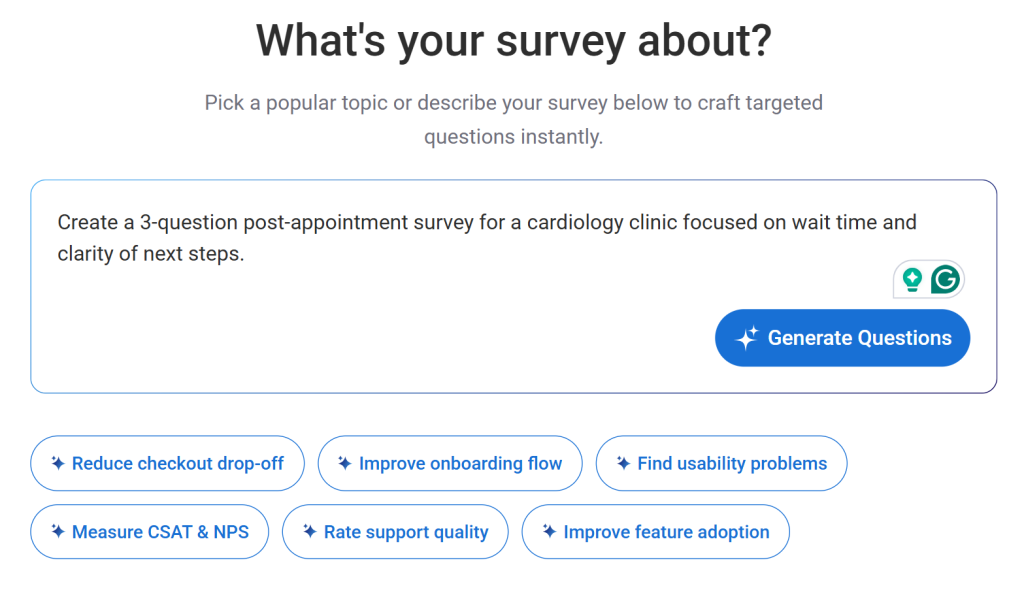
The AI Survey Creator drafts a full question set based on that description, which you can then edit, shorten, or reorder before publishing.
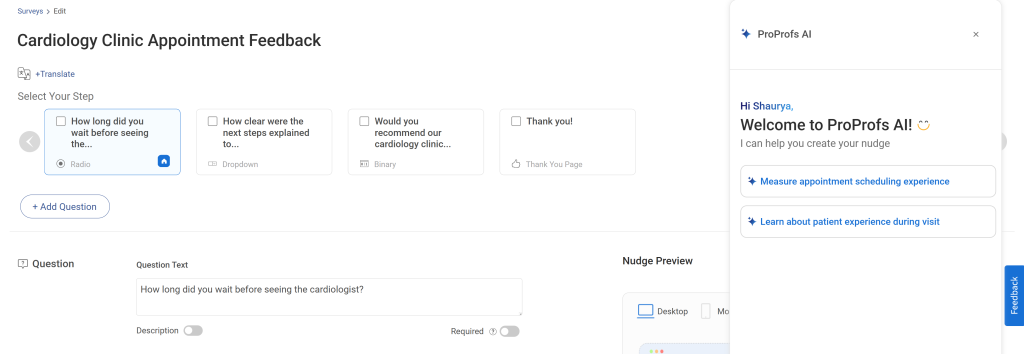
Ready-to-Use Question Templates
If you want to skip straight to testing, here are short, quick, ready-to-use templates mapped to the highest-friction moments covered in this guide. Each one is designed to take a patient less than 30 seconds to answer.
- Scheduling Drop-Off: “What stopped you from completing your booking today?”
- Post-Visit: “What’s one thing that would have made today’s visit easier?”
- Billing Page: “Was anything about your bill unclear or unexpected?”
- Portal Exit Intent: “Before you go, what were you trying to do here?”
- Post-Telehealth Visit: “How did the video visit compare to an in-person appointment?”
Start with one of these conversion templates on your highest-traffic page rather than launching all five at once.
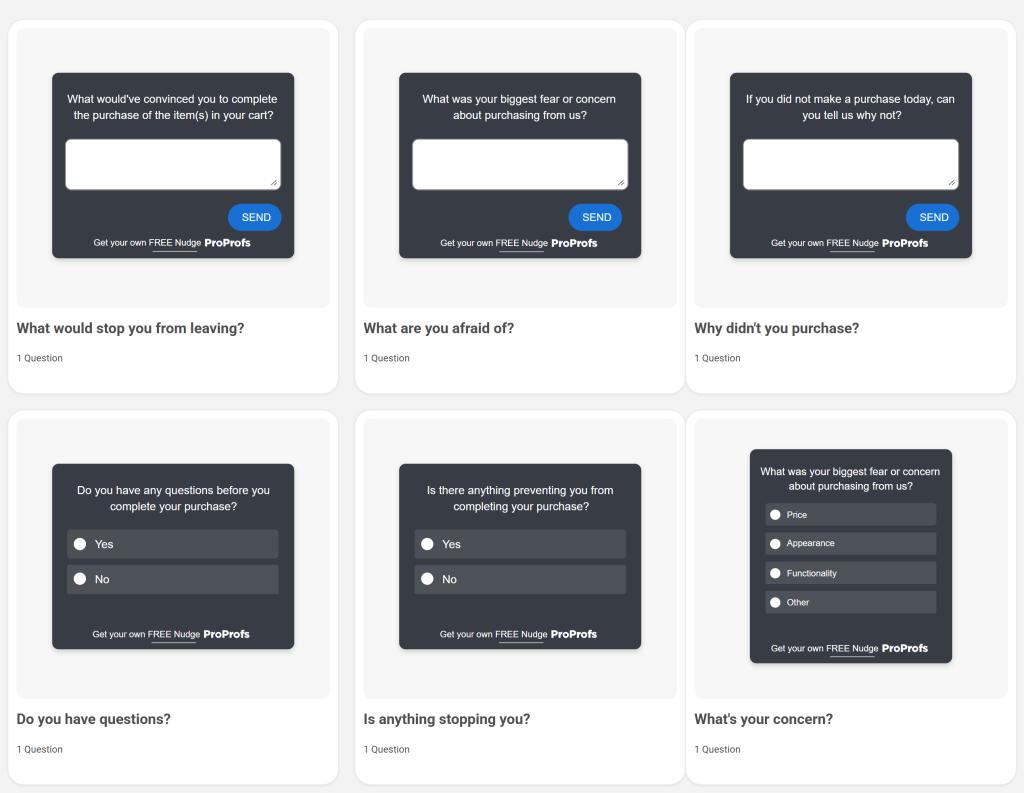
A single, well-placed question that gets answered consistently is worth more than five surveys that get ignored.
Step 3: Set Your Targeting Rules
Choose the exact URL, page, or in-app screen where the Nudge™ should appear, and layer on behavior triggers like time on page, scroll depth, or exit intent.
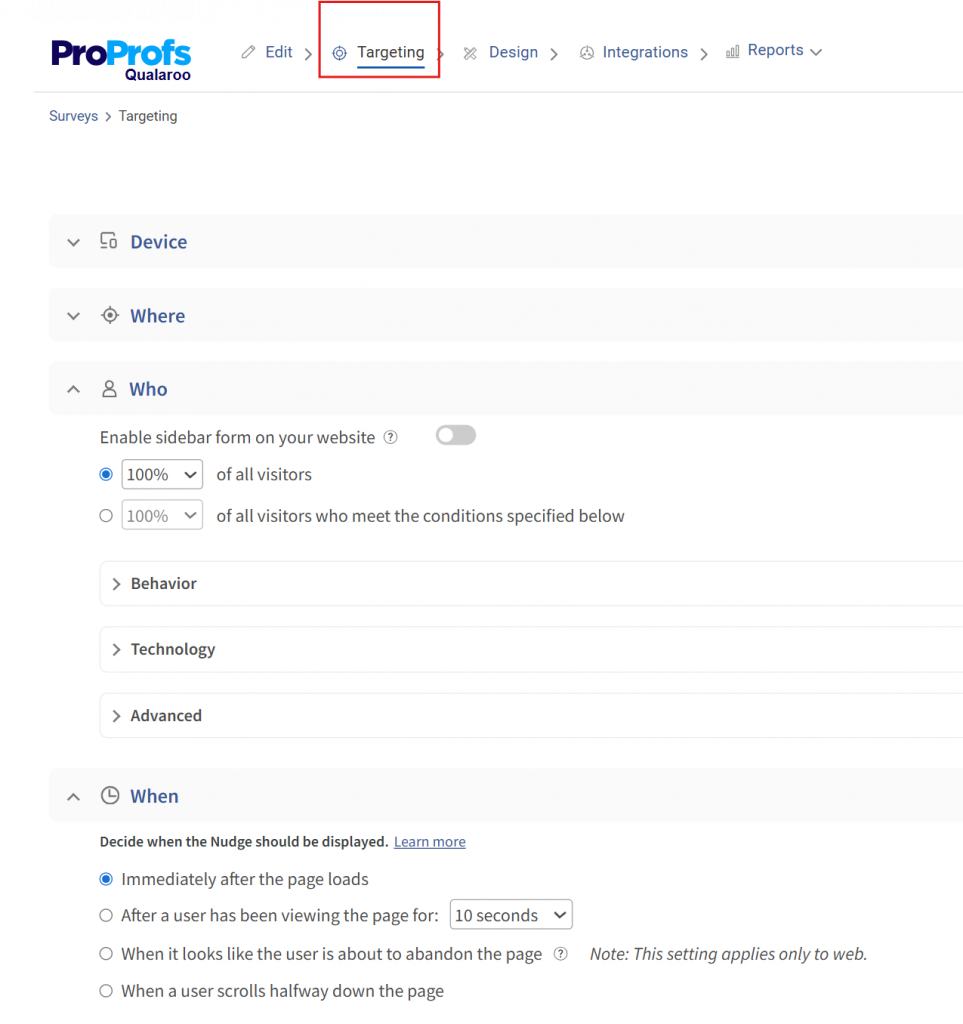
This is what makes the survey feel contextual instead of intrusive.
A patient who just finished booking an appointment should see a different question than one who has been stuck on the same billing page for two minutes.
Advanced targeting also supports user attributes, so you can show different questions to new patients versus returning ones, or to patients on a specific insurance plan versus self-pay, without building separate surveys from scratch.
Step 4: Connect Identity Where It Matters
Add the Identify API so responses are tied to a patient’s email or customer ID instead of arriving anonymously.
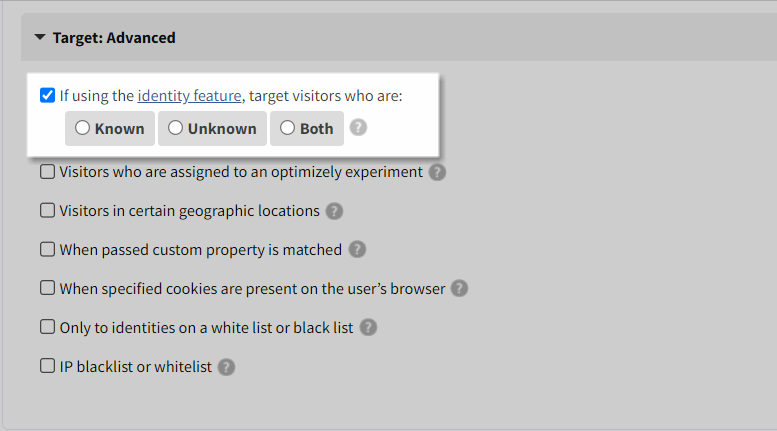
This single step turns a Nudge™ survey from a passive listening tool into an active retention tool, letting a care team follow up individually rather than only spot patterns after the fact.
Not every survey needs an identity attached.
- A general sentiment check on a public page can stay anonymous.
- A billing complaint or a scheduling failure should almost never occur.
Because the whole point is to reach that specific patient before they leave.
Step 5: Launch and Monitor Sentiment
Publish the survey and let native AI Sentiment Analysis flag negative open-text responses in real time.
Here’s how sentiment analysis works:
Set up your team’s workflow so that a strongly negative response triggers an alert, rather than sitting in a dashboard until someone happens to check it.
For high-stakes moments, like a billing complaint or a complaint about a delayed prior authorization, treat a negative flag the same way you would treat an urgent support ticket.
Speed here is what separates a saved patient from a lost one.
Step 6: Review and Iterate
Check response patterns weekly, not quarterly. Look for two things: recurring themes in the free-text answers, and whether the response rate itself is healthy.
A sudden drop in responses on a specific page often signals a new problem before a single patient files a complaint about it.
Adjust the trigger point, question wording, or targeting rules based on what you learn.
A survey that gets ignored after the first week usually needs a shorter question or a better-timed trigger, not a redesign of the entire program.
How Do You Measure Success in Healthcare Customer Experience Management?
Once feedback is flowing in, the next challenge is knowing which numbers actually matter. Healthcare teams often default to tracking everything, which produces a dashboard nobody checks.
A better approach is to track a small number of metrics that each answer a different question.
| Metric | What It Measures | Best Collected |
| Net Promoter Score | The likelihood that a patient refers others | Post-visit or quarterly |
| Customer Satisfaction Score | Satisfaction with a specific interaction | Immediately after the interaction |
| Customer Effort Score | How easy a task was to complete | Right after scheduling, billing, or portal use |
| Sentiment Trend | Emotional tone across open-text feedback | Continuous, via AI analysis |
No single metric tells the whole story.
Net Promoter Score
It answers a loyalty question: “Are you likely to recommend us to someone else?” It is useful as a long-term trend line, but it moves slowly and will not tell you which specific touchpoint is broken this week.
Customer Satisfaction Score
It answers a momentary question: “How did this one interaction go?” It is the fastest metric to collect and the easiest to tie to a specific page, call, or visit, which makes it the best starting point for a new CX program.
Customer Effort Score
It often predicts churn earlier than either of the other two, because patients notice friction before they consciously decide they are dissatisfied. A high-effort scheduling process or a confusing bill will show up in CES scores well before it shows up in an NPS decline.
Sentiment trend, pulled from open-text responses through AI analysis, is the metric most teams skip because it used to require manually reading every comment. Running it continuously in the background, rather than as a quarterly research project, is what lets a team catch a developing problem, like a confusing new intake form, within days instead of a full quarter later.
A Simple Rule of Thumb: Track CSAT and CES at the touchpoint level for anything you are actively trying to fix, and track NPS and sentiment trend at the organization level to see whether those individual fixes are adding up to real loyalty gains.
FREE. All Features. FOREVER!
Try our Forever FREE account with all premium features!
What Are the Biggest Challenges in Managing Healthcare Customer Experience?
Most healthcare organizations are not short on data. They are short on a way to see it in one place and act before a patient disengages. Here are the challenges that come up most often, and what actually fixes each one.
| Challenge | Why It Happens | What Fixes It |
| Feedback Arrives Too Late to Act On | Mailed or emailed surveys reach patients days after the problem happened, when the decision to leave is already made | Shorten the distance between friction and feedback with in-context, behavior-triggered surveys instead of scheduled ones |
| Scheduling, Billing, and Care Run as Separate Systems | Each department usually runs its own platform and its own feedback loop, so no one sees the full patient journey | Add a feedback layer that sits across all systems and tags every response with a consistent patient identity |
| Survey Response Rates Skew the Data | Standard outpatient surveys run as low as 16.5 percent response, and mostly the very satisfied or very dissatisfied respond | Use shorter, single-question surveys placed in context, which pull higher response rates than long, delayed forms |
| Compliance Adds Real Complexity to New Tools | Any tool touching identifiable patient data needs strong protections and often a signed business associate agreement | Involve compliance and IT early, and decide upfront which surveys need an identity attached and which can stay anonymous |
| Frontline Staff Rarely See the Feedback | Feedback often stops at a dashboard that a manager checks monthly, so the staff closest to the problem never sees it | Route real-time alerts on negative sentiment directly to the team closest to that touchpoint |
What Are the Latest Trends in Healthcare Customer Experience Management?
Heading into 2026, healthcare CX is being reshaped by AI adoption, rising patient impatience with digital friction, and a shift away from delayed, disconnected feedback loops.
AI Is Shifting from Answering Questions to Anticipating Them
According to Salesforce’s 2026 Connected Health Consumer Report, a large share of patients say they would rather get 24/7 AI assistance than wait on hold, and roughly one in four leave appointments confused about their next steps.
The same research found most patients want proactive AI check-ins between visits to help them stay on track, not just a chatbot that answers a scheduling question.
Patients Are Researching and Leaving Before They Ever Complain
A 2026 industry report from rater8 found that more than half of patients have walked away from a provider based on what they read online, a sharp jump from the prior year, and most say a provider’s response to reviews directly shapes their trust.
Patients are forming an opinion long before a receptionist or a survey ever hears about it.
Access Friction Is Now a Retention Problem, Not Just an Ops Problem
Experian Health’s 2026 State of Patient Access Survey found that while providers believe access has improved, patients largely disagree, and authorization delays and unclear costs remain the top complaints.
When a patient cannot get a straight answer on cost or scheduling, that friction shows up as churn, not a support ticket.
Where Does Healthcare CX Go from Here?
The organizations pulling ahead on healthcare CX are not the ones running the most surveys.
They are the ones who shortened the distance between a patient hitting friction and someone on their team knowing about it, then built a habit of acting on what they learned within days, not quarters.
Every trend and challenge covered in this guide points to the same fix: catch the moment, not the aftermath.
Ready to see where your patients are actually getting stuck? Start with Qualaroo and launch your first survey in a minute.
Frequently Asked Questions
Is customer experience management the same as patient satisfaction?
No. Patient satisfaction measures how one visit went. Customer experience management tracks the full relationship across scheduling, billing, care, and follow-up, and looks at whether that cumulative experience keeps a patient loyal over time, not just whether one appointment met expectations.
What is customer experience management for healthcare organizations without a big budget?
It does not require an enterprise platform. Start with one contextual survey at a high-friction point, like scheduling or billing, using a tool like Qualaroo's free plan. Focus on one moment, one question, and one action, then expand once you see results.
Why do patient satisfaction surveys have low response rates?
Mailed and post-visit email surveys arrive too late and require extra effort from patients who have already moved on. Peer-reviewed studies show response rates as low as 16 to 25 percent, and the patients who do respond tend to be the most or least satisfied, skewing results.
Does HIPAA affect how I collect customer experience feedback?
Yes. Any tool collecting or storing patient-identifiable feedback needs strong data protections and, in many cases, a signed business associate agreement. Choose a feedback platform built with compliance and secure data handling in mind before connecting it to identifiable patient data.
Can AI actually improve healthcare customer experience management?
Yes, when used to remove friction rather than replace human judgment. AI-powered sentiment analysis can flag a frustrated patient in seconds instead of days, and AI survey creation tools can turn a rough idea into a usable question set without a research team.
How is healthcare customer experience management different from customer service?
Customer service is one component: how requests and complaints get handled. Customer experience management is the broader discipline of designing, measuring, and improving every touchpoint, including scheduling, billing, and clinical interactions, so that customer service becomes one input among several.
What causes most patients to switch healthcare providers?
Recent research points to friction more than clinical dissatisfaction: confusing billing, long authorization delays, difficulty reaching someone by phone, and poor digital scheduling experiences. Many patients decide to leave before ever filing a formal complaint, based on cumulative frustration with non-clinical touchpoints.
What is the fastest way to start collecting real-time patient feedback?
Pick one high-friction page, such as your online scheduler or billing portal, and add a short, targeted Nudge™ survey triggered by behavior, such as exit intent or time on page. This single step captures real-time feedback while the patient is still present and reachable, rather than waiting for a delayed survey days later.
FREE. All Features. FOREVER!
Try our Forever FREE account with all premium features!

 We'd love your feedback!
What did you like & how can we make it even better?
 Thanks for your feedback!
 Ask Your Question
Have a question? Get expert help to make your decision easier.