
Your analytics show users dropping off at step three of onboarding. Your email surveys sit at a 9% response rate. You know something is wrong, but the data you have doesn’t tell you why.
That’s the gap most product teams hit. You have enough behavioral data to know where friction exists, but not enough feedback to know what’s causing it. App feedback, collected in-context at the right moment, is what closes that gap.
The difference is timing: in-app feedback reaches users at the moment of experience, not 48 hours after it.
This guide provides:
- A situation-based setup framework tailored to different contexts and needs, using tools like Qualaroo
- Bias-free question templates for every stage of the user journey
- A practical model for integrating feedback into your sprint cycle
The focus is on delivering actionable, ready-to-use tools and processes you can implement immediately.
What Is App Feedback, and Why Does It Matter More Than Reviews?
App feedback is the structured or unstructured input you collect from users while they are actively using your product. Unlike app store reviews, which are public, delayed, and filtered by extreme sentiment, in-app feedback is private, real-time, and tied to specific behaviors.
App store reviews skew toward users who are either very happy or very frustrated.
The silent majority in the middle, the users who could tell you exactly why they stopped using a feature or never upgraded their plan, rarely bother to write a review.
In-app feedback captures that middle.
A one-question nudge after a user abandons checkout, a two-tap NPS prompt after a completed onboarding flow, and a short feedback form embedded in your help section.
These all create a low-friction channel for the users who have something genuinely useful to say but wouldn’t take the time to say it elsewhere.
The business case is straightforward. You cannot fix what you cannot see. And the things that quietly drive churn, confusing navigation, an unexpected pricing step, a feature that never worked as intended, rarely show up in reviews until it’s too late.
How Do You Collect In-App Feedback?
Setting up in-app feedback with tools like Qualaroo means installing the SDK once, then deploying every future survey from a dashboard, no developer required after the initial setup. The entire first survey can be live within a day.
Here is the exact process from zero to collecting responses:
Step 1: Install the SDK (One Time Only)
Your developer adds the Qualaroo SDK to your iOS app, Android app, or web app. This is a single code snippet that takes under an hour to implement.
Every survey you run from this point forward deploys from Qualaroo’s dashboard, with no additional engineering work required.
If you are running a web app only, the JavaScript snippet installs the same way.

Step 2: Choose Your Survey Type and Template
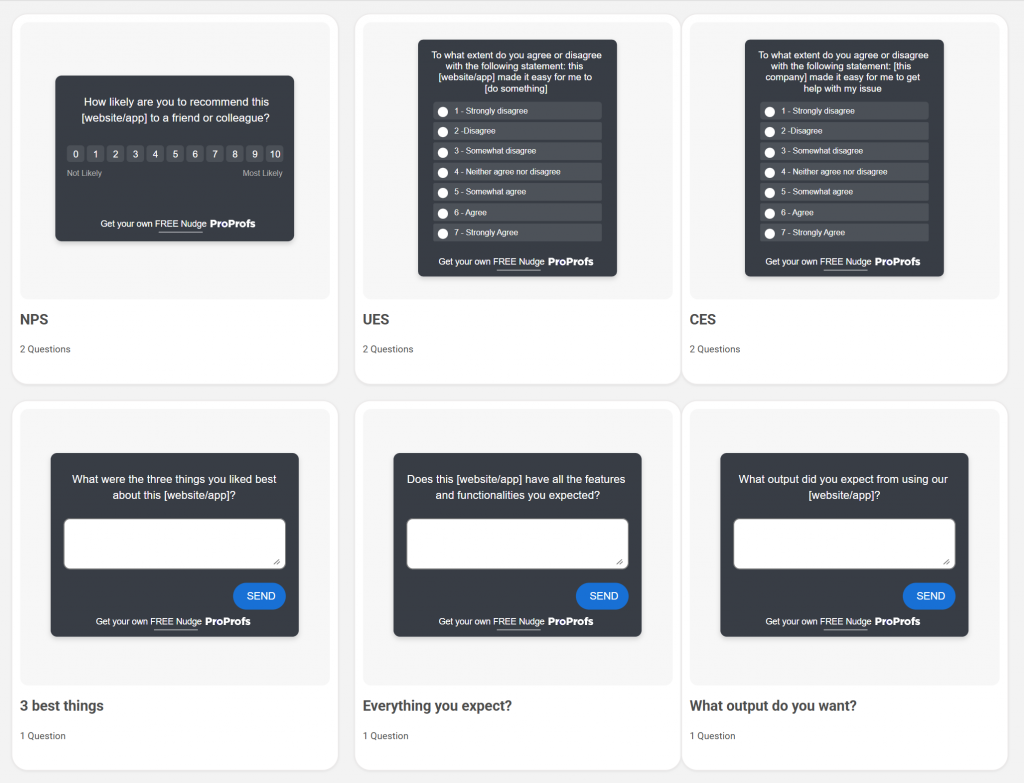
Inside the dashboard, click on “Create a Nudge,” and select a survey type: Desktop and mobile web nudge.
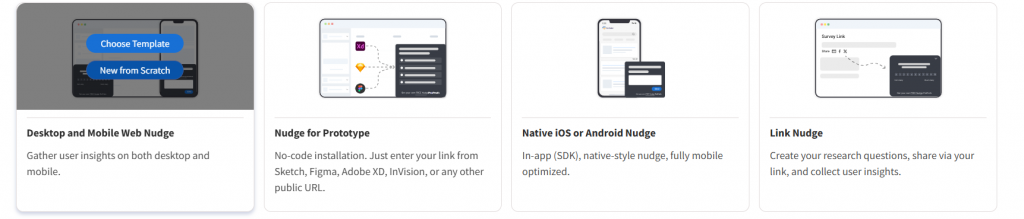
Qualaroo has pre-built templates for each. Start with a template rather than from scratch. You can always edit the question. The trigger logic is more important than the wording at this stage.
Step 3: Write Your Question
Keep it to one question for your first survey. For example, an NPS survey. If you need a follow-up, add one open-ended field: “What’s the main reason for your rating?”
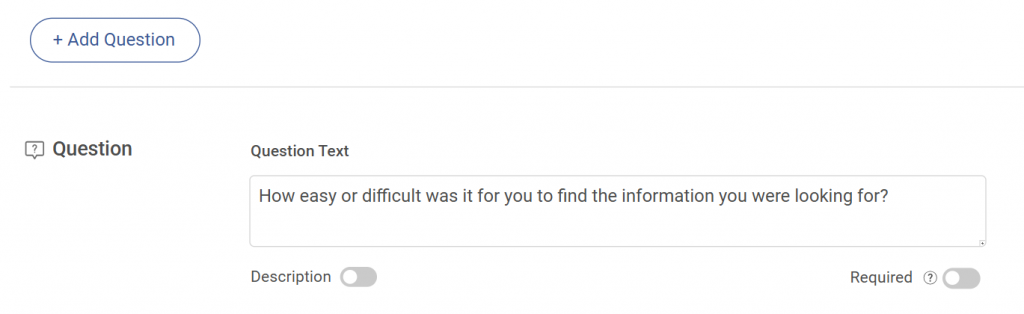
That is enough to get both a score and a diagnosis. Apply the bias rules from earlier in this guide: neutral phrasing, no leading language, no embedded assumptions.
Choose your answer type based on what you need from the response. A rating scale (0-10 for NPS, 1-5 for CSAT) gives you a quantifiable score you can track over time.
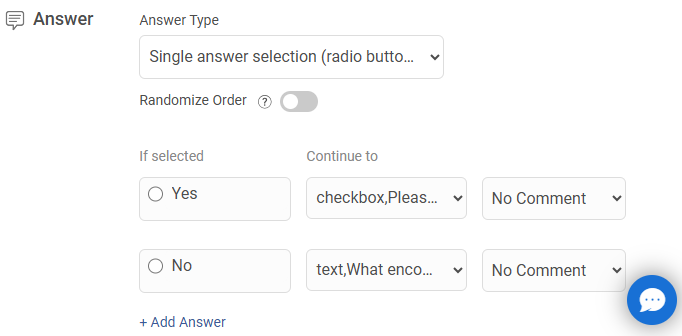
If your survey has more than one question, use Qualaroo’s branching and skip logic to show relevant follow-ups only.
Here’s a video for you to learn more about using Skip Logic:
Step 4: Set Your Trigger Conditions
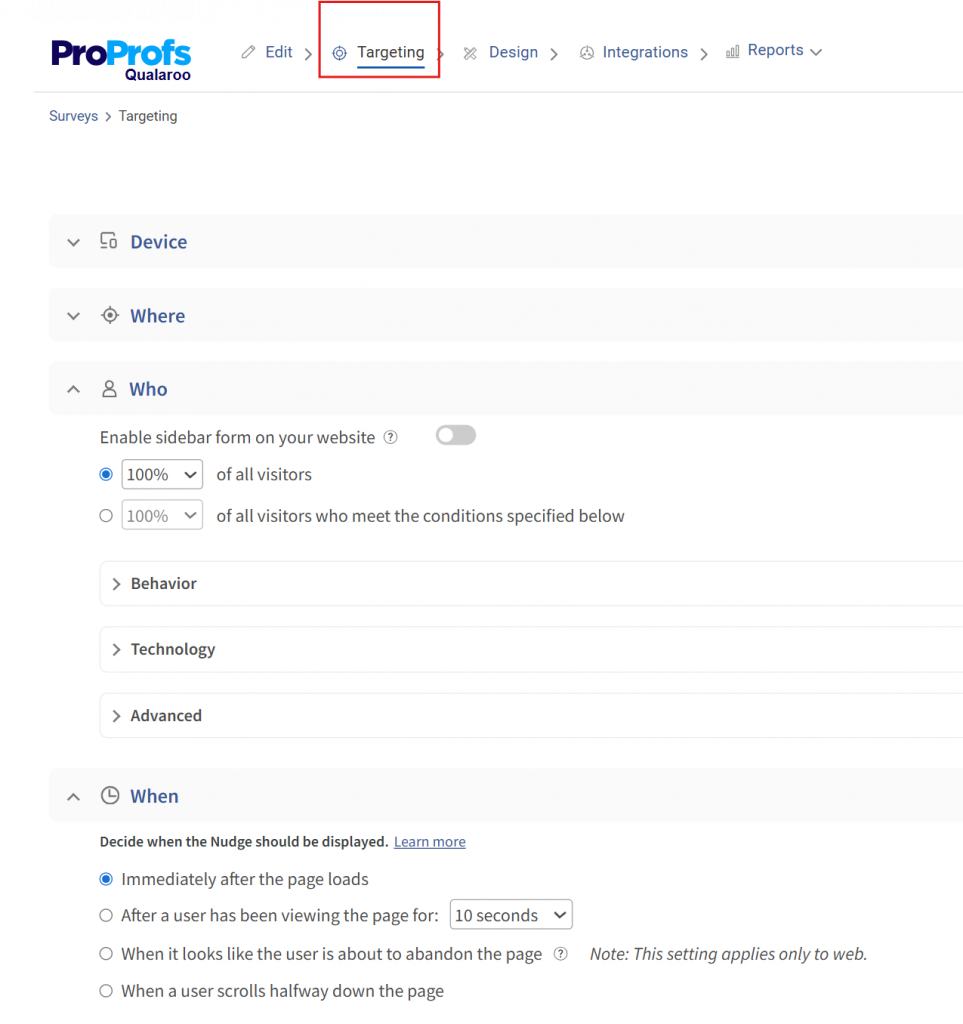
This is the most important step. In Qualaroo’s targeting panel, define exactly when and to whom the Nudge™ appears. The most effective triggers for SaaS products are:
| Trigger Type | Condition | Best Survey Type |
|---|---|---|
| Onboarding completion | User completes first core action | CSAT or open-ended |
| Feature adoption | User engages with a specific feature for the first time | Feature feedback or CES |
| Session threshold | User logs in for the 3rd or 5th time | NPS |
| Inactivity | User has not logged in for 14 days | Exit intent or churn risk |
| Pricing page visit | User visits pricing or upgrade page | Intent survey |
| Post-support | User resolves a support ticket | CSAT |
Set a suppression rule so the same user does not see the survey more than once every 30 days. Set a display delay of 5 to 10 seconds after the trigger fires, so the survey appears after the action, not during it.
Step 5: Publish and Monitor
Save and preview the in-app survey, and then activate it from the dashboard. The Nudge™ goes live immediately for users who match your trigger conditions.
You do not need to involve engineering again. Check the response dashboard after 48 hours. If your response rate is below 20%, the trigger timing is usually the problem, not the question. Adjust the trigger condition first before changing the survey content.
Step 6: Analyze With AI Sentiment Analysis
For surveys with open-ended questions, Qualaroo’s IBM Watson integration automatically tags responses by sentiment (positive, negative, neutral) and surfaces dominant themes across all replies.
Instead of reading 200 individual answers, you see a ranked list of what users are saying and how they feel about it. This is where a high volume of qualitative feedback becomes actionable without a dedicated research team.
Time to First Insight: SDK installation takes under an hour. Survey setup takes 15 minutes. First responses typically arrive within 24 to 48 hours of going live, depending on your active user volume. A SaaS product with 500 monthly active users will typically collect 50 to 100 responses in the first week from a well-timed trigger.
What Are the 15 Highest-Impact In-App Survey Questions to Ask?
The best in-app survey question is the one that directly answers the question your team is trying to resolve. Here are 15 high-signal questions organized by goal.
Onboarding and First Impressions
- How easy was it to complete your first [core action] in the app?
- Was there any step during setup that felt confusing or unclear?
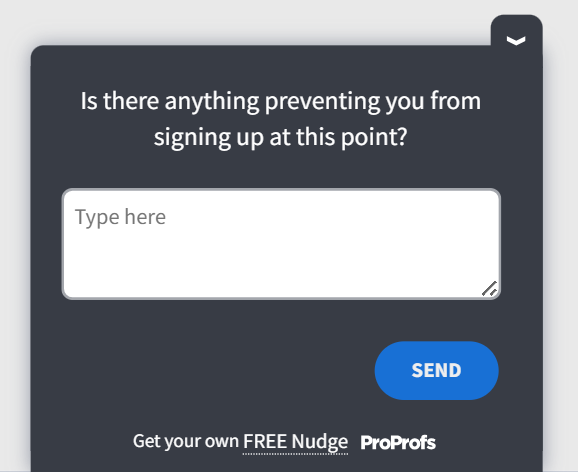
- What almost stopped you from completing the signup?
Here’s an onboarding app feedback survey template you can use:
Feature Adoption and Usage
- How useful is [specific feature] for what you’re trying to do?
- Did [feature] work the way you expected? If not, what happened?
- Is there something you expected this feature to do that it doesn’t?
Here’s a quick feature adoption app feedback survey template:

Retention and Churn Risk
- What keeps you coming back to this app?
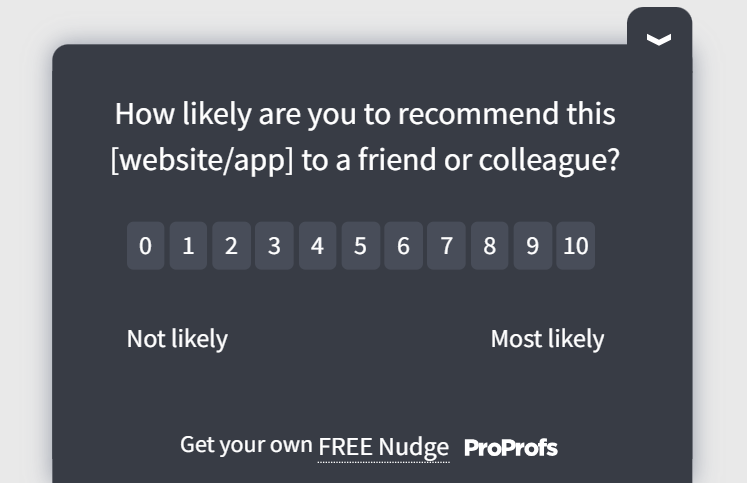
- On a scale of 0-10, how likely are you to recommend this app to a colleague? (NPS)
- Is there anything that would cause you to stop using the app?
Here’s an NPS app feedback survey template:
Conversion and Upgrade Moments
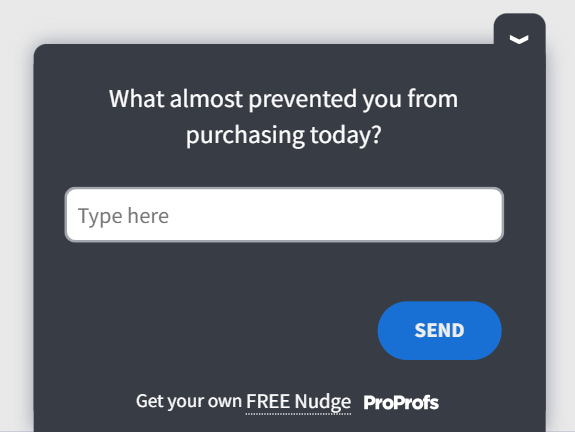
- What almost stopped you from completing this purchase?
- What would make you more likely to upgrade to a paid plan?
- How clear is the value difference between the free and paid tiers?
Use this conversion app feedback survey template:
Bug and Issue Discovery
- Did you experience any issues while completing this? If yes, please describe.
- What were you trying to do when you ran into a problem?
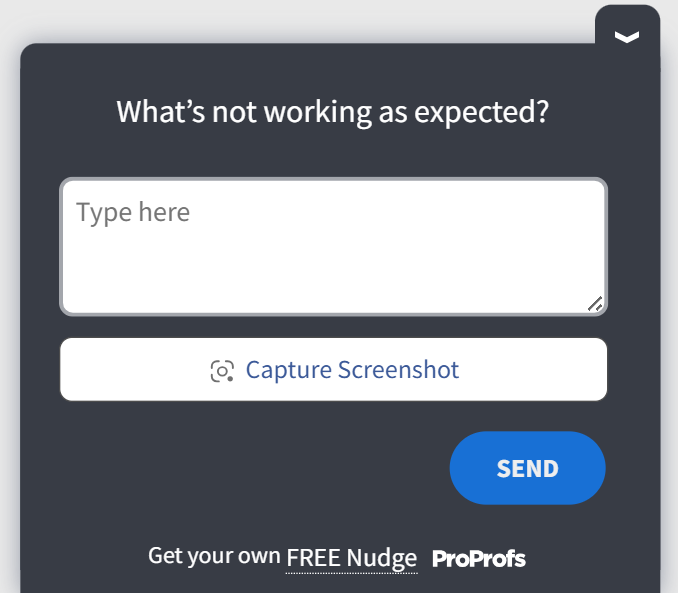
Here’s a screen-capture app feedback survey template:
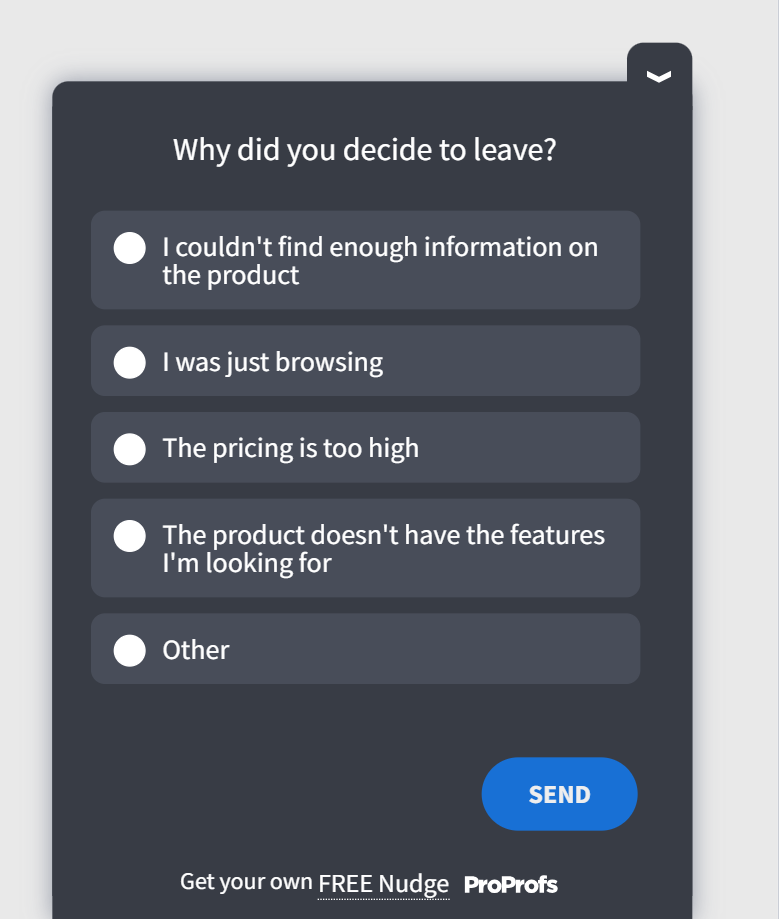
Exit Intent (Churn Prevention)
- What’s the main reason you’re thinking about leaving?
Here’s an exit-intent mobile app survey template:
Which App Feedback Setup Is Right for Your Situation?
Not every product team is starting from the same place. The right first move depends on where you are right now, not on a generic best-practices list. Use this table to find your entry point.
| Your Current Situation | What's Actually Wrong | Your First Move |
|---|---|---|
| No feedback system at all | You're making product decisions based on analytics and gut feel. Churn is happening, but you can't pinpoint why. | Start with one contextual survey at your highest drop-off moment. One question. Trigger it after a user completes (or abandons) the core action in your app. Get 50 responses before building anything else. |
| Email surveys with under 15% response rates | You're reaching users after the moment, with a passive channel, asking questions they can't remember the context for. | Switch to in-app triggers for the same survey. Mobile in-app surveys average 36% response rates vs. 6-15% for email. The question can stay the same. The timing is what changes everything. |
| Feedback coming in, but too vague to act on | You're asking broad questions ("How satisfied are you?") that produce average scores but no diagnosis. | Move from general to contextual. Trigger specific questions tied to specific actions: after onboarding completion, after first use of a feature, after a support interaction. The more specific the trigger, the more specific the answer. |
| Feedback not reaching the people who can act on it | Responses sit in a dashboard that no one checks. Issues take weeks to surface. | Wire feedback to where your team works. Route bug reports and NPS detractor responses to Slack or Jira in real time. Tag responses by user segment in your CRM. Feedback that reaches the right person within 24 hours gets fixed. Feedback that doesn't, doesn't. |
| Feedback disconnected from your analytics | You see satisfaction scores but can't connect them to specific product behavior or funnel stages. | Integrate your feedback tool with your analytics platform. Filter NPS responses by feature usage cohort or onboarding stage. When scores drop, cross-reference with session paths from the same period. You need both the "what" and the "why" to prioritize fixes confidently. |
If You’re Starting From Zero: Deploy one NPS survey triggered after your user’s third login. Keep it to two questions: the rating, and one open-ended follow-up asking why. You’ll have your first actionable signal within a week.
FREE. All Features. FOREVER!
Try our Forever FREE account with all premium features!
How Do You Integrate App Feedback Into a Sprint Cycle?
Feedback collected but not acted on is just noise. The goal is to build a feedback loop that informs your product roadmap at every sprint, not just quarterly.
Here’s how to wire it into your workflow.
1. Route urgent signals in real time. Connect your feedback tool to Slack or Jira. Bug reports and critical low NPS scores (detractor responses) should trigger an immediate notification to the relevant team. The faster a critical issue gets flagged, the faster it can be diagnosed before it causes churn at scale.
2. Aggregate responses weekly at sprint planning. Designate one person to pull the previous week’s feedback themes into your sprint planning meeting. Themes, not individual responses: “Seven users in the past week mentioned the export feature was confusing” is a prioritizable signal. “One user said they didn’t like the export” is not.
3. Weight feedback by segment. Not all user feedback carries equal strategic weight. Feedback from power users who are near renewal has a different urgency than feedback from users who signed up three days ago. Tag responses by user segment in your CRM so your team is prioritizing based on business impact, not just volume.
4. Publish a “you said, we did” update. After every sprint where a user-reported issue was fixed or a requested feature was shipped, add a brief note to your changelog or in-app notification: “Based on your feedback, we fixed [X].” This single habit increases response rates on future surveys because users see that their input leads to real outcomes.
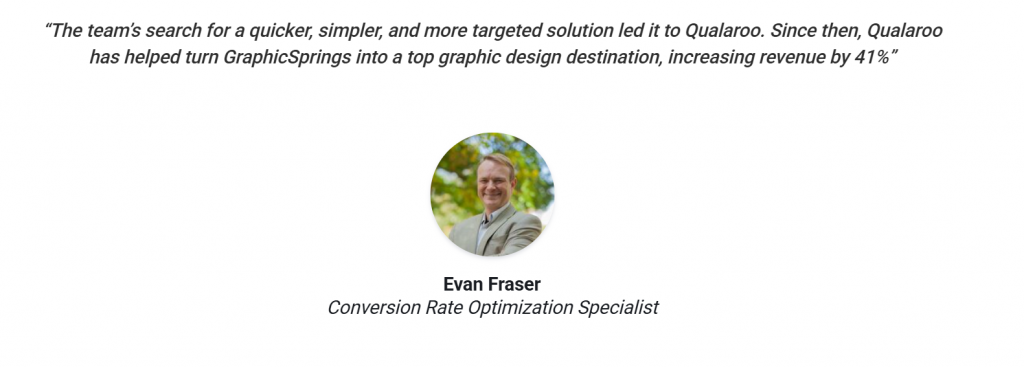
The GraphicSprings case study illustrates what a closed feedback loop can produce at scale. After using Qualaroo to systematically collect and act on UX feedback, GraphicSprings increased revenue by 41%.
What Are the Real Response Rate Benchmarks for In-App Surveys?
Before you set up your first survey, it helps to know what “good” looks like so you can honestly benchmark your own results.
According to Refiner’s 2025 In-App Survey Response Rate Report, which analyzed 1,382 in-app surveys with over 5 million views, mobile in-app surveys average around 27% response with ~25% completion when timing, targeting, and UI are taken care of.
For context, email NPS surveys typically have response rates of 6-15%. In-app surveys, when properly timed and targeted, consistently outperform them by a significant margin.
A 2018 PubMed study found that survey length has an outsized effect on completion.
As survey length increases, users abandon midway, and the quality of responses from those who do finish degrades because respondents rush through later questions.
Placement matters too. Center-screen modal surveys in web apps deliver a 42.6% response rate. Mobile surveys placed at the bottom of the screen consistently outperform other mobile placements.
The takeaway: keep it short, place it well, and trigger it at the right moment. Those three variables move the needle more than any other factor.
What Does a Full SaaS Feedback Loop Actually Look Like?
Most teams treat app feedback as a one-off tactic: run a survey, read the responses, maybe fix something.
What Qualaroo customers like Hootsuite, Udemy, and Twilio do differently is treat feedback as a repeatable system that runs across every stage of the product lifecycle. Here’s what that looks like in practice.
Onboarding (Sessions 1 to 3): Trigger a two-question survey the moment a user completes their first core action. Ask: “How easy was it to get started?” and “What, if anything, almost stopped you from completing this step?” Responses from this window identify friction in your onboarding flow before it compounds into churn.
Feature Releases (First Use of a New Feature): Trigger a one-question contextual survey immediately after a user first engages with a new feature. Ask: “Did this work the way you expected?” Yes/no with one open follow-up. This gives you a feature-specific signal within hours of release, not weeks.
Churn Risk (Day 14 Inactivity or Pricing Page Visit): Trigger an exit-intent survey for users who haven’t logged in for 14 days, or who visit your pricing or cancellation page. Ask one question: “What’s the main reason you’re thinking about leaving?” Route every response tagged as a detractor (NPS below 7) directly to your customer success team via Slack within the hour.
Quarterly NPS: Run a general NPS pulse every 90 days across your full active user base. Compare score trends across cohorts. Use the trend line to validate whether the sprint-level fixes from contextual feedback are moving the overall satisfaction number.
This system doesn’t require four different tools or a dedicated research team. It requires four survey triggers, clear routing rules, and a commitment to review themes weekly at sprint planning.
The teams that do this consistently ship fewer wasted features and catch churn signals weeks before they become cancellations.
Stop Guessing. Start Listening to Your App Feedback at the Right Moment
The difference between an app that improves and one that stagnates usually isn’t data. It’s whether that data is connected to real user experience at the moment it happens.
App feedback, when it’s contextual, unbiased, and wired into your sprint cycle, becomes the most reliable signal you have for what to build next, what to fix first, and who’s at risk of leaving.
Start with one microsurvey using Qualaroo. Pick the most important moment in your user journey right now. Onboarding, a key feature, checkout, wherever you already suspect friction.
Set a trigger, keep the survey to one or two questions, and see what comes back.
Frequently Asked Questions
How do you use behavioral data to make in-app feedback more accurate?
Identify where users drop off in a funnel, set a contextual survey trigger at that step, then cross-reference responses with session replay data from the same cohort. Feedback answers "why." Behavioral data answers "what." Qualaroo integrates with Google Analytics and Salesforce, so this cross-referencing works without custom pipelines.
What privacy and compliance rules apply to in-app feedback collection?
GDPR requires informed consent before collecting personally identifiable information from EU users. CCPA gives California residents the right to opt out and request deletion. Default to anonymous responses where possible and collect only what you need. Qualaroo is GDPR- and CCPA-compliant by default, with anonymization controls at the account level.
What should I look for in an in-app feedback tool for iOS and Android?
Native SDK support for iOS, Android, and web; behavior-based targeting by session count or custom event; and a no-code dashboard for deploying surveys after the initial install. AI sentiment analysis is critical for open-ended responses at scale. Qualaroo's SDK installs in under an hour. Pricing starts at $19.99/month with a free plan.
What's the most common bias in in-app surveys, and how do I prevent it?
Confirmation bias is the most common bias, in which the questions framed are to validate assumptions rather than surface honest reactions. Three others to watch: social desirability bias (users soften criticism: fix with anonymous options), recency bias (users rate based on their last interaction: fix with consistent survey cadence), and framing effect ("What did you enjoy?" vs. "What would you improve?" produce different answers; always use open-ended, assumption-free language).
How do you time in-app surveys for maximum accuracy?
Five rules: trigger after a key user action, not on a time delay; wait for at least three sessions before NPS; cap frequency at once every 30 days per user; never trigger during an active task; run quarterly NPS alongside contextual surveys.
What is a good response rate for an in-app survey?
Per Refiner's 2025 benchmark report, the average in-app response rate is 27.52%. Mobile app surveys average 36%. Web app surveys average 26.5%. A rate above 30% is top-quartile across digital feedback channels.
How often should I survey the same user?
No more than once every 30 days for general surveys. For contextual event-triggered surveys, frequency is naturally limited by how often the trigger fires. Always set a session-level suppression window so a user never sees more than one survey per visit.
Should I offer incentives to increase survey response rates?
Only if necessary. Incentives introduce selection bias, skewing results toward users motivated by rewards rather than genuine feedback. Fix timing and question length first. If you do use incentives, keep them small and apply them consistently so you're not skewing toward a specific user segment.
How is in-app feedback different from app store reviews?
App store reviews are public, delayed, and dominated by extreme sentiment. In-app feedback is private, real-time, and targeted to specific user segments or moments. Use in-app surveys for product improvement decisions. Prompt for app store reviews only after confirmed positive in-app interactions.
What's the difference between NPS, CSAT, and CES, and which should I use?
NPS measures long-term loyalty. Run it quarterly. CSAT measures satisfaction with a specific interaction. Use it after support resolutions or purchases. CES measures task effort. Use it to diagnose friction in specific workflows. Match the metric to the moment, not to a default preference.
How do I use in-app feedback to reduce churn?
Trigger an exit intent or inactivity survey when a user hasn't logged in for 14 days or visits your cancellation page. Ask one question: "What's the main reason you're considering leaving?" Route detractor NPS responses (below 7) to customer success within the hour. Exit feedback patterns directly map to your highest-impact retention fixes.
Can I correlate in-app feedback with my existing analytics?
Yes. Connect your feedback tool to Google Analytics or your product analytics platform. Filter NPS responses by user segment, feature cohort, or funnel stage. When scores drop, cross-reference with session replay data from the same period. Stated feedback plus observed behavior gives you the diagnostic precision to act with confidence.
FREE. All Features. FOREVER!
Try our Forever FREE account with all premium features!

 We'd love your feedback!
What did you like & how can we make it even better?
 Thanks for your feedback!
 Ask Your Question
Have a question? Get expert help to make your decision easier.