
I’ve spoken to enough product managers and CS leads making this switch to know the pattern. Nobody leaves Wootric because the in-app surveys didn’t work.
They leave because the tool they signed up for isn’t the tool they’re renewing with.
Here’s the four-year arc in plain terms. Wootric launched as a lean, B2B SaaS-first micro-survey tool: in-app NPS, transparent pricing, self-serve setup.
Product teams at companies like Zoom, HubSpot, and DocuSign used it precisely because it was lightweight and fast.
Then, Press Ganey Forsta acquired InMoment in May 2025, creating an enterprise CX entity with 43,000 clients across healthcare, finance, retail, and hospitality. Wootric.com now redirects to InMoment.
No public pricing. Sales-led onboarding only.
That’s not a product evolving. That’s a product being absorbed into something built for a completely different buyer.
So if you’re a product manager or CS lead at a SaaS company who needs in-app NPS without a six-figure enterprise contract, I’ve put together this list for you. These are the ten Wootric alternatives I’d actually evaluate, mapped to the specific constraint each one fixes best.
Why Are Teams Looking for Wootric Alternatives?
The acquisition timeline explains most of it. But beyond the ownership changes, the specific pain points driving teams out follow a consistent pattern.
The Product They Chose No Longer Exists: Wootric’s original appeal was its product-led simplicity: small in-app surveys, fast setup, and clear pricing. The InMoment XI Platform is enterprise software with a consulting-heavy implementation model. That’s a different product for a different buyer.
No Public Pricing: Teams evaluating or renewing can no longer see pricing without going through a sales cycle. For fast-moving SaaS teams used to self-serve tools, that friction alone is a reason to look elsewhere.
Two Acquisitions Created Roadmap Uncertainty: With InMoment now under Press Ganey Forsta, and a potential Qualtrics acquisition of Press Ganey Forsta announced in late 2025, the platform’s roadmap is consolidated under layers of enterprise ownership. For teams that need a tool that iterates quickly on SaaS feedback use cases, that pace is a mismatch.
In-App Targeting Became More Complex: As Wootric was absorbed into InMoment’s broader platform, setup and targeting options that were once self-serve now require implementation support in many cases. That’s a structural shift for teams without dedicated CX operations.
The SaaS Feedback Gap: Some teams were using Wootric specifically for product-led growth feedback: churn intent surveys, onboarding friction, and feature adoption. That use case doesn’t sit naturally inside an enterprise CX suite.
11 Wootric Competitors That Fix What Teams Actually Miss
Here’s the full comparison before the detailed breakdowns. Use this to identify your shortlist based on your primary use case.
| Tool | Best For | Key Strength | Capterra Rating | Starting Price |
| Qualaroo | In-App and Behavioral Feedback | Behavior-based Nudge™ surveys, AI survey creator, product feedback, NPS, and AI feedback analysis | 4.7/5 | Free plan available. Paid from $19.99/month |
| ProProfs Survey Maker | General-Purpose NPS and Survey Volume Without Per-Seat Fees | AI Survey Maker, scored surveys with result pages, 1M+ question library | 4.8/5 | Free plan available. Paid from $19.99 per 100 responses/month |
| Survicate | In-Product and Website Feedback for SaaS | In-product NPS/CSAT targeting, 70+ integrations, AI insights | 4.6/5 | Free plan; paid from $114/month |
| Refiner | In-App Micro-Surveys for SaaS Teams | Native in-app widgets, fine-grained targeting, NPS/CSAT/CES | 4.6/5 | Paid from $99/month |
| Zonka Feedback | Omnichannel CX With AI Insights | NPS/CSAT/CES across email, SMS, WhatsApp, and in-app | 4.8/5 | Custom quote |
| Hotjar | Behavioral Analytics Combined With On-Site Feedback | Heatmaps, session recordings, and on-page surveys in one tool | 4.6/5 | Free plan; paid from $79/month |
| SurveySparrow | Conversational NPS and Recurring Pulses | Chat-style surveys, recurring automation, 360-degree feedback | 4.4/5 | Paid from $19/month |
| Medallia | Enterprise VoC and Journey Analytics | AI-powered omnichannel VoC at global scale | 4.5/5 | Custom quote |
| Typeform | Conversational, High-Completion Surveys | One-question-at-a-time design for higher engagement | 4.7/5 | Free plan; paid from $28/month |
| Jotform | Multi-Purpose Forms With Payments | Versatile form-survey hybrid with 10,000+ templates | 4.7/5 | Free plan; paid from $19/month |
| SurveyMonkey | General-Purpose Survey Volume | Broad template library, strong brand recognition | 4.6/5 | Individual plans from $30/month |
The breakdowns below go further: what each tool does well, where it falls short, and how it maps to the specific gap Wootric left open.
1. Qualaroo: Best for Capturing Real-Time User Insights In-App & on Your Website Using Contextual, AI-Powered Micro-Surveys
If Wootric’s core appeal was in-context surveys that catch users while they’re inside the product, Qualaroo is the closest match, with a meaningfully more capable targeting and analytics layer on top.
Triggers can be set based on scroll depth, time on page, specific URLs, user segments, behavior events, or exit intent.
That last trigger matters specifically for Wootric users. One of Wootric’s strengths was catching users at the right moment rather than blasting a survey link by email. Qualaroo does the same, with additional precision on what “the right moment” looks like.
Native AI Sentiment Analysis automatically scores open-ended responses, and Automated Tagging categorizes them by theme.
Instead of reading hundreds of free-text NPS follow-ups manually, the AI Response Summarizer gives you a signal within minutes. The Identify API lets you link every response to a known user record by email or customer ID, so your NPS data is user-attributed, not anonymous.
For product teams running in-app, in-product, or website feedback workflows, Qualaroo also bundles Heatmaps and Session Recordings, so you can pair what users said with what they actually did on the page.
Pros:
- Advanced targeting based on user behavior and specific URLs, with no ongoing developer work after setup
- AI analysis of sentiment in open-ended feedback
- AI Survey Creator builds a survey from a prompt, so there’s no starting from scratch
- Full user identity integration ensures every response is linked to actual accounts (fully attributed)
- Native mobile SDKs for iOS and Android deliver smooth in-app surveys
- Includes heatmaps and session replays alongside survey insights
- Supports 100+ languages and smart branching for personalized feedback flows
Cons:
- Fully cloud-dependent; no support for offline data collection
- The free plan does not include a dedicated account manager
How Qualaroo Compares to Wootric: Wootric delivers in-app micro-surveys with AI text analysis. Qualaroo does the same with more precise behavioral targeting, a stronger AI layer, and the behavioral context (heatmaps and recordings) that Wootric never had. For teams that want Wootric’s original philosophy in a tool that’s actually iterating, Qualaroo is the clearest fit.
Pricing: Free plan available. Paid plans from $19.99/month.
Rating: 4.7/5
2.
3. Survicate: Best for In-Product and Website Feedback for SaaS Teams
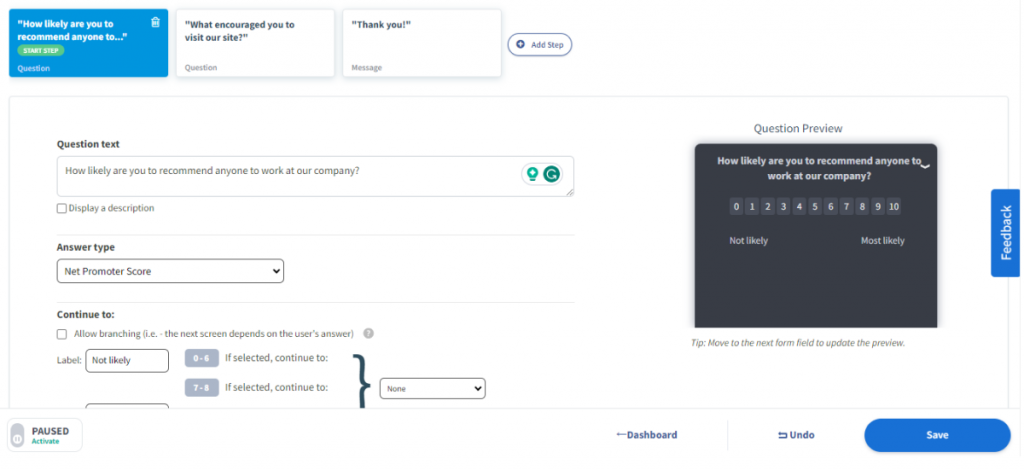
Survicate is one of the most direct operational replacements for Wootric’s core use case: in-product NPS, CSAT, and CES surveys targeted by user segment, behavior, or product lifecycle stage.
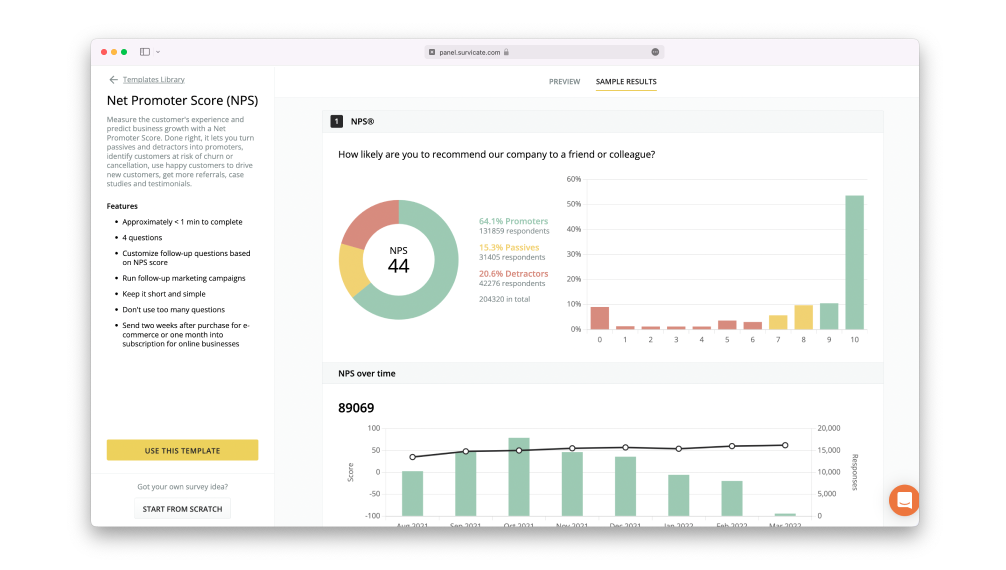
It runs surveys across websites, mobile apps, email, and shareable links, with 70+ native integrations covering the tools SaaS teams already use: Intercom, Salesforce, HubSpot, Amplitude, Braze, and Freshdesk, among others.
For teams that need survey data to flow into their existing CRM or analytics stack automatically, that integration breadth is a real differentiator.
The AI insights layer surfaces patterns across open-ended responses, and the 360-view dashboard lets teams monitor NPS trends, response rates, and segment breakdowns in one place.
The free plan covers unlimited surveys. Paid plans start at $114/month.
Pros:
- In-product survey targeting by user segment, behavior, or lifecycle stage
- 70+ native integrations across CRM, analytics, support, and marketing tools
- AI insights layer for open-ended response pattern detection
- Free plan with unlimited surveys; paid from $114/month
- 360-view dashboard for NPS, CSAT, and CES trend monitoring
Cons:
- Some reviewers flag audience targeting issues with multilingual sites (surveys occasionally appearing in the wrong language on specific pages)
- The Starter plan’s 100-response monthly cap is limiting for teams with higher survey volume
- UI/UX has room for improvement relative to more polished tools like Typeform or Qualaroo
How Survicate Compares to Wootric: For teams that used Wootric specifically for in-product NPS and CSAT and need a like-for-like replacement that plugs into their existing stack, Survicate covers the core use case at a transparent price point. It’s the most direct mid-market replacement for what Wootric originally was.
Pricing: Free plan available; paid from $114/month.
Rating: 4.6/5
4. Refiner: Best for In-App Micro-Surveys Designed Specifically for SaaS
Refiner was built with one buyer in mind: SaaS product teams that need NPS, CSAT, and CES surveys to feel native inside their application, not bolted on.
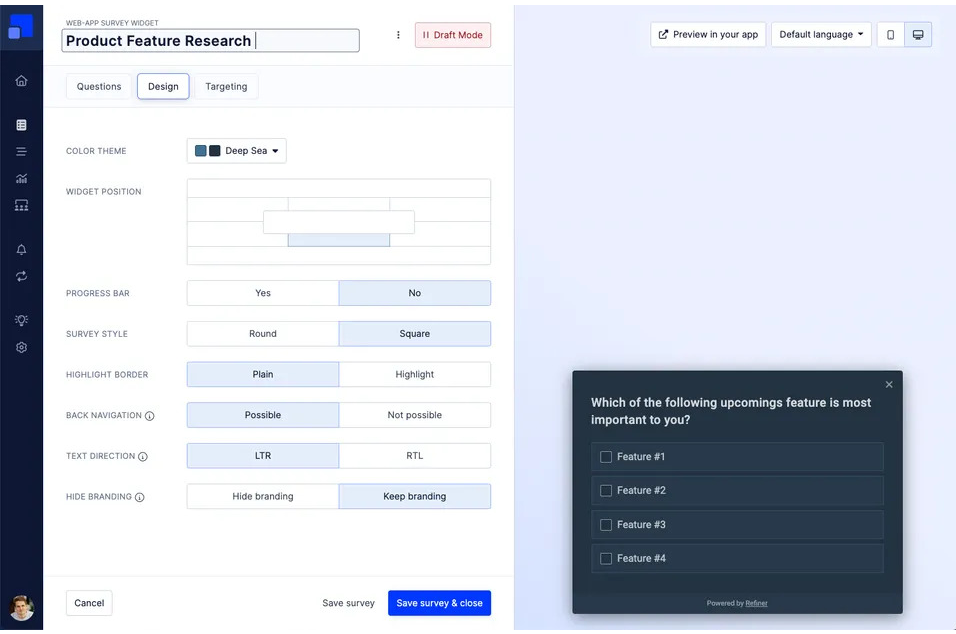
Capterra reviewers describe the in-app survey widget as “beautifully designed” with response rates that consistently outperform email surveys at the same cadence.
The targeting logic is fine-grained. Surveys are triggered based on user traits (plan type, account age, feature usage) and behavioral events (action completed, page visited, session count).
That precision is what made Wootric valuable for SaaS teams, and Refiner reproduces it while adding a cleaner widget design and more transparent pricing.
The reporting dashboard tracks NPS, CSAT, and CES trends with segmented breakdowns. AI-powered tagging surfaces patterns in open-ended responses automatically. Refiner integrates with Zapier, Segment, Slack, and major CRM tools for workflow automation.
Pricing runs from $99/month for up to 5,000 monthly active users on the Essentials plan. Capterra reviewers give it 4.6/5.
Pros:
- Native-feeling in-app widget with pixel-perfect brand control
- Fine-grained behavioral and trait-based targeting
- NPS, CSAT, CES, and custom survey types in one platform
- AI-powered tagging for open-ended response analysis
- Integrations with Segment, Zapier, Slack, and CRM tools
Cons:
- Email survey capability is limited; in-app is the primary delivery channel
- Designed for micro-surveys of 1-5 questions; not suitable for long-form questionnaires
How Refiner Compares to Wootric: Refiner is arguably the closest match to Wootric’s original DNA: in-app, SaaS-first, transparent pricing, and behavioral targeting. Where Wootric was absorbed into an enterprise platform, Refiner stayed narrow. If your team used Wootric as a lightweight in-app NPS tool and wants exactly that without the enterprise wrapper, Refiner is the most direct substitute.
Pricing: Paid plans from $99/month for up to 5,000 monthly active users.
Rating: 4.6/5
5. Zonka Feedback: Best for Omnichannel CX With AI-Powered Insights
Zonka Feedback is the strongest option on this list for teams that have outgrown in-app-only feedback and need to measure NPS, CSAT, and CES across email, SMS, WhatsApp, in-app, and kiosk channels from a single platform.
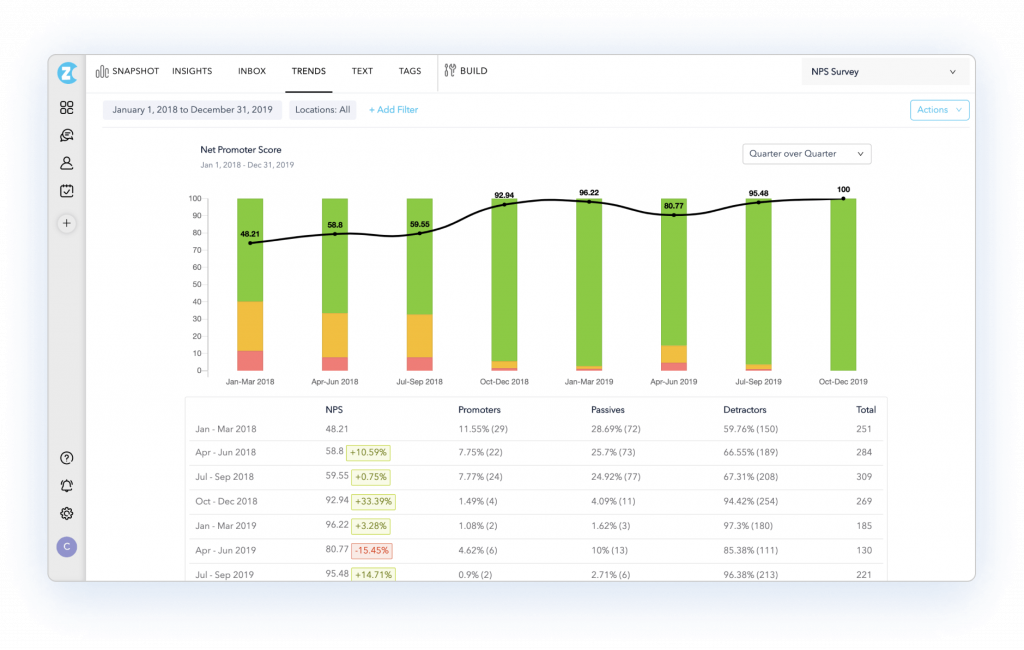
Where Wootric focuses tightly on in-app SaaS feedback, Zonka covers the full omnichannel CX loop: feedback collection across touchpoints, AI text analytics for open-ended responses, closed-loop workflow automation, and customizable dashboards.
Pricing is a custom quote, positioning it for mid-market and enterprise teams.
For organizations running CX programs across multiple channels and seeking Qualtrics-level analytics without the Qualtrics price tag, Zonka Feedback is often cited as a more practical alternative.
Pros:
- Omnichannel feedback across email, SMS, WhatsApp, in-app, web, and kiosk in one platform
- AI text analytics for open-ended response categorization and sentiment scoring
- Closed-loop workflow automation for routing and following up on detractor responses
- HIPAA-compliant plans available for healthcare and regulated industries
- Strong support quality ratings on Capterra
Cons:
- Custom quote pricing adds a sales step before you can evaluate cost fit
- Interface can feel overwhelming during initial setup, given the breadth of channels and configuration options
How Zonka Feedback Compares to Wootric: Wootric was intentionally narrow; Zonka is intentionally broad. If your team has grown beyond in-app NPS and needs to run feedback programs across multiple customer touchpoints without stitching together separate tools, Zonka Feedback closes that gap at a scale Wootric never addressed.
Pricing: Custom quote.
Rating: 4.8/5
6. Hotjar: Best for Behavioral Analytics Combined With On-Site Feedback
Hotjar is the right choice when the question isn’t just “what do users think?” but “what are users actually doing, and does the feedback explain the behavior?”
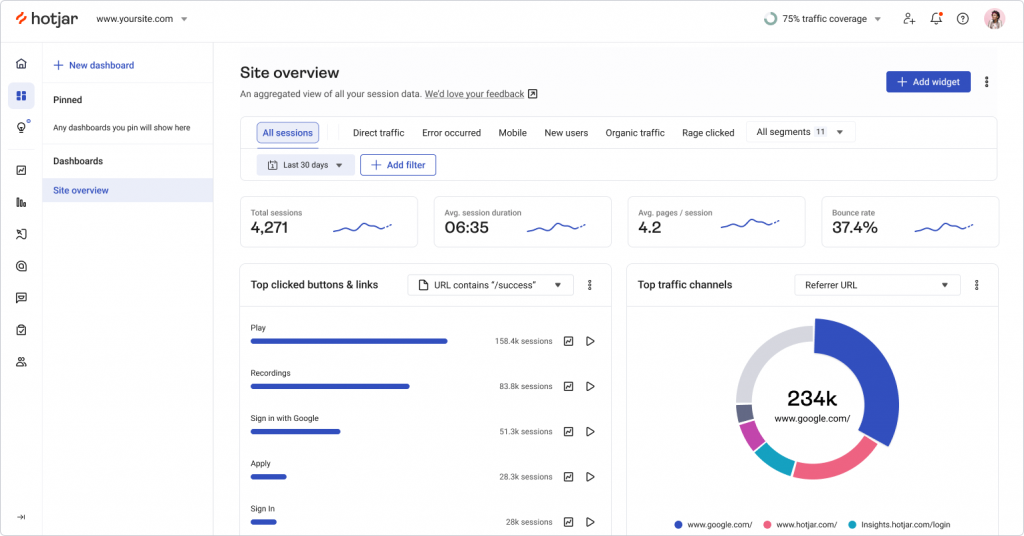
It combines heatmaps, session recordings, and on-page feedback surveys in one platform.
For product and CRO teams that want to understand why users drop off a pricing page or abandon an onboarding flow, the behavioral context around the feedback is as important as the feedback itself.
The feedback survey layer supports NPS, open-ended prompts, and on-page rating widgets. It’s not as deep as a dedicated feedback platform like Qualaroo or Survicate, but it covers the core NPS and satisfaction signals for teams that primarily need behavioral data and want feedback as a supplement.
The free plan covers 35 daily sessions. Paid plans start at $79/month.
Pros:
- Heatmaps, session recordings, and on-page surveys in one integrated platform
- Free plan available with 35 daily sessions
- On-page feedback prompts, including NPS and open-ended questions
- Strong CRO and UX research use cases
- Integrates with Google Analytics, Slack, HubSpot, and Zapier
Cons:
- Feedback survey depth is limited compared to dedicated NPS platforms
- Not suitable as a primary NPS or CSAT program tool at scale
- Heatmap data volume can become expensive as session limits scale up
How Hotjar Compares to Wootric: Wootric was purpose-built for NPS and CSAT. Hotjar is purpose-built for behavior analytics, with feedback as a supporting layer. If you were using Wootric for CX metrics and want to add behavioral context to your feedback program, Hotjar complements rather than replaces. If NPS is your primary deliverable, Hotjar is not the right primary tool.
Pricing: Free plan available; paid from $79/month.
Rating: 4.6/5
7. SurveySparrow: Best for Conversational NPS and Recurring Survey Automation
SurveySparrow’s chat-style survey format consistently improves completion rates on mobile, which is where most in-app NPS surveys are actually completed.
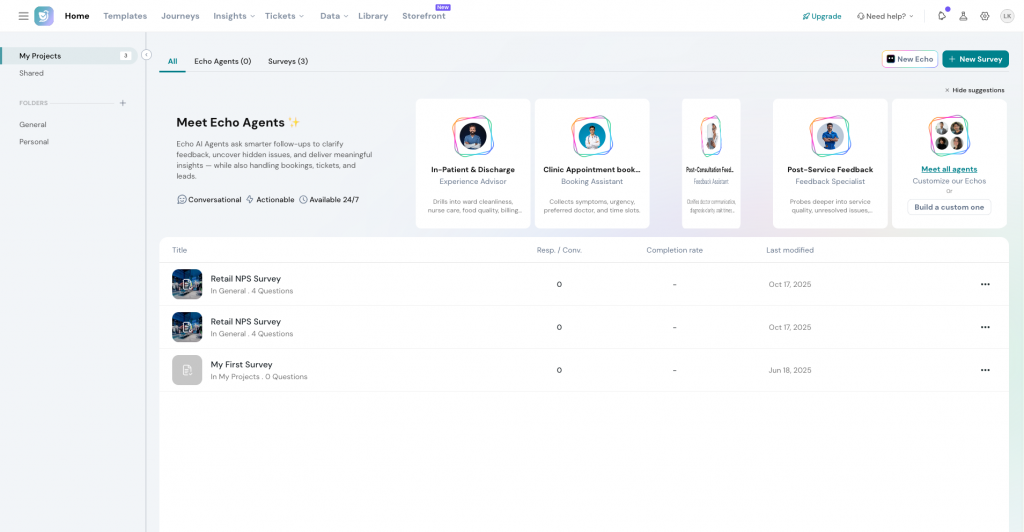
The conversational interface reduces the cognitive load of a traditional grid survey and performs particularly well for recurring NPS programs that run on a quarterly or monthly cadence.
The recurring automation is the standout feature for teams replacing Wootric’s automated NPS scheduling.
You set the cadence, define the segment, and SurveySparrow handles the send and follow-up without manual intervention. The 360-degree feedback module extends the tool’s usefulness to employee experience workflows.
Paid plans start at $19/month, with no free plan available, though a 14-day trial is offered. Multilingual surveys require a paid tier.
Pros:
- Chat-style format improves completion rates on mobile-first audiences
- Recurring survey automation for NPS, CSAT, and pulse programs
- 360-degree feedback module for employee experience use cases
- Offline survey collection for field research
- Salesforce AppExchange integration for CRM-connected NPS workflows
Cons:
- No free plan; 14-day trial only
- Advanced analytics require higher-tier plans
- Multilingual survey support is gated behind paid tiers
How SurveySparrow Compares to Wootric: Both tools share the lightweight, recurring NPS philosophy. SurveySparrow adds a conversational format and recurring automation that Wootric’s original product didn’t have. For teams that want to maintain a self-serve NPS program without the InMoment enterprise structure, SurveySparrow is the most accessible mid-market option.
Pricing: Paid from $19/month.
Rating: 4.4/5
8. Medallia: Best for Enterprise-Scale VoC Programs
Medallia is where the conversation goes when a team has outgrown every other tool on this list. It’s an AI-powered omnichannel VoC platform used by global enterprises to capture feedback from customers, employees, and contact centers simultaneously.
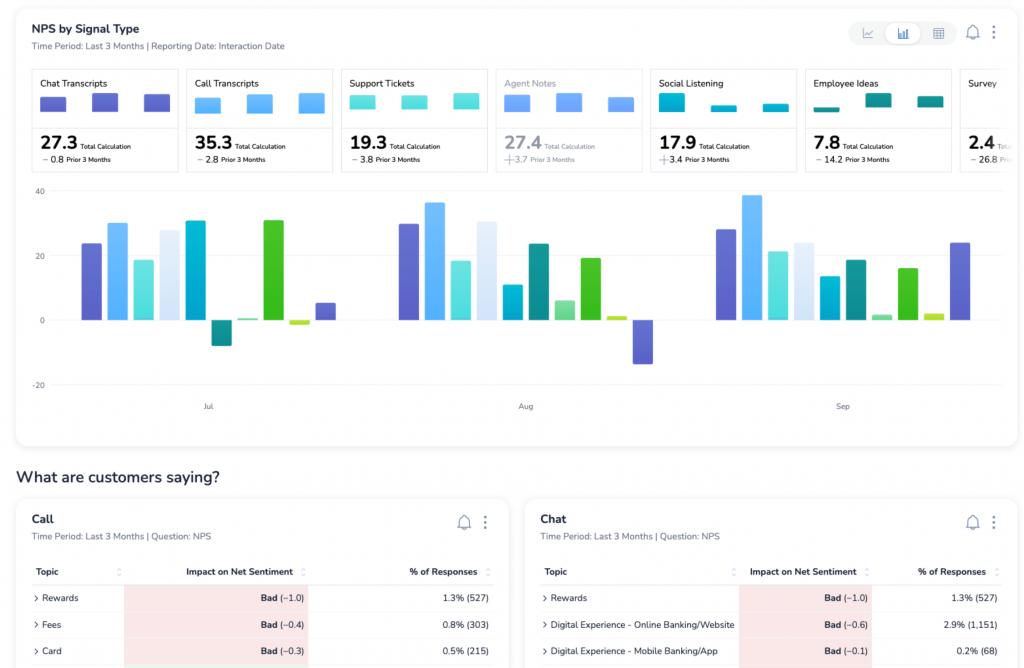
The capabilities are substantial: predictive analytics, multi-touchpoint journey tracking, text analytics across millions of responses, and closed-loop case management.
For organizations running experience programs at scale across dozens of markets, Medallia is genuinely in a different tier.
The trade-off is equally substantial. Medallia requires dedicated implementation resources, has enterprise-grade pricing (typically well into five figures annually), and is built for CX programs with full operations teams behind them.
It is not self-serve and is not positioned for small or mid-market SaaS teams.
Pros:
- AI-powered text analytics across millions of open-ended responses
- Omnichannel feedback across digital, contact center, and in-store touchpoints
- Predictive intelligence for churn and satisfaction trend forecasting
- Closed-loop case management for large CX operations teams
- Trusted by Fortune 500 companies across retail, finance, healthcare, and hospitality
Cons:
- Enterprise pricing with no public starting point; implementations run five figures or higher annually
- Requires a dedicated CX operations team to extract full value
- Implementation timelines are measured in months, not days
- Overkill for SaaS teams that need lightweight NPS and in-app feedback
How Medallia Compares to Wootric: These tools were never competing for the same buyer. Wootric was lightweight and SaaS-first. Medallia is enterprise and industry-agnostic. If you’re evaluating Medallia as one of Wootric alternatives, you’ve grown into a different category of tool entirely. For most teams making this search in 2026, Medallia is the ceiling, not the starting point.
Pricing: Custom enterprise quote.
Rating: 4.5/5
9. Typeform: Best for High-Completion Conversational Surveys
Typeform’s one-question-at-a-time format reduces survey abandonment by removing the wall of questions users face in standard form-based tools.
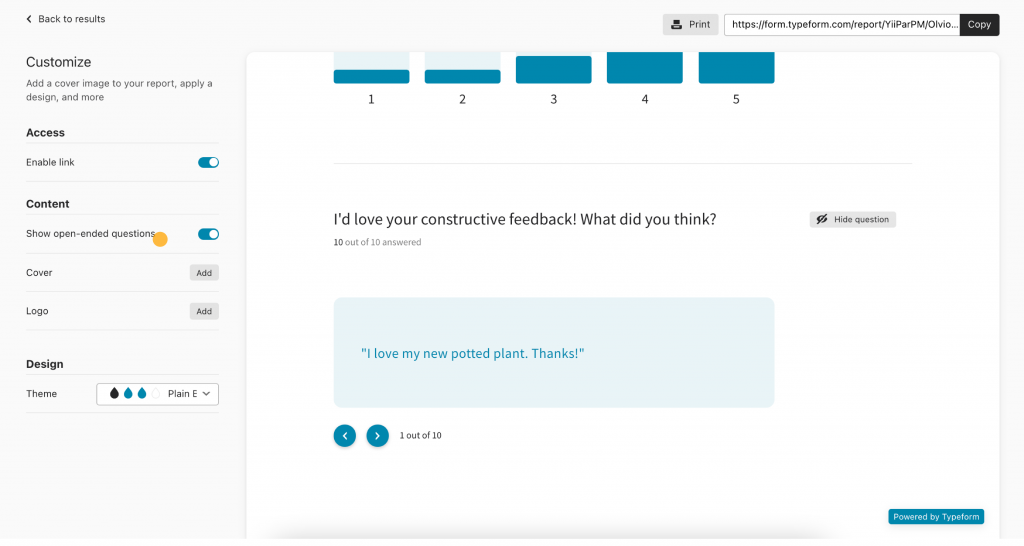
It’s the go-to for teams where low completion rate is the primary pain: NPS follow-up surveys, onboarding satisfaction prompts, and post-session feedback links.
Capterra reviewers give it 4.7/5. The free plan limits responses to 10 per month, which isn’t workable for production NPS programs. Paid Core plans start at $28/month.
The analytics layer is conversational rather than research-grade. Typeform is strong on the collection side; for deep NPS trend analysis or behavioral segmentation, a dedicated CX platform serves better.
Pros:
- One-question format reduces cognitive load and improves completion rates
- 140+ templates across NPS, HR, research, and customer feedback use cases
- Clean brand kit support for survey design consistency
- Integrates with HubSpot, Slack, Salesforce, and Zapier
Cons:
- Free plan limited to 10 responses per month
- Analytics depth is limited for teams tracking NPS trends over time
- Pricing scales steeply with response volume at higher tiers
How Typeform Compares to Wootric: Wootric was in-app and behavioral. Typeform is link-based and conversational. They solve different parts of the feedback problem. If your NPS surveys are going out by email or survey link and completion rates are low, Typeform improves that specific metric. For in-app targeting and in-context feedback, a dedicated tool does more.
Pricing: Free plan; paid from $28/month.
Rating: 4.7/5
10. Jotform: Best for Multi-Purpose Feedback and Intake Forms
Jotform’s value is its breadth. With over 10,000 templates spanning surveys, registration forms, payment collection, file uploads, and HIPAA-compliant healthcare forms, it’s the most versatile data collection platform on this list.
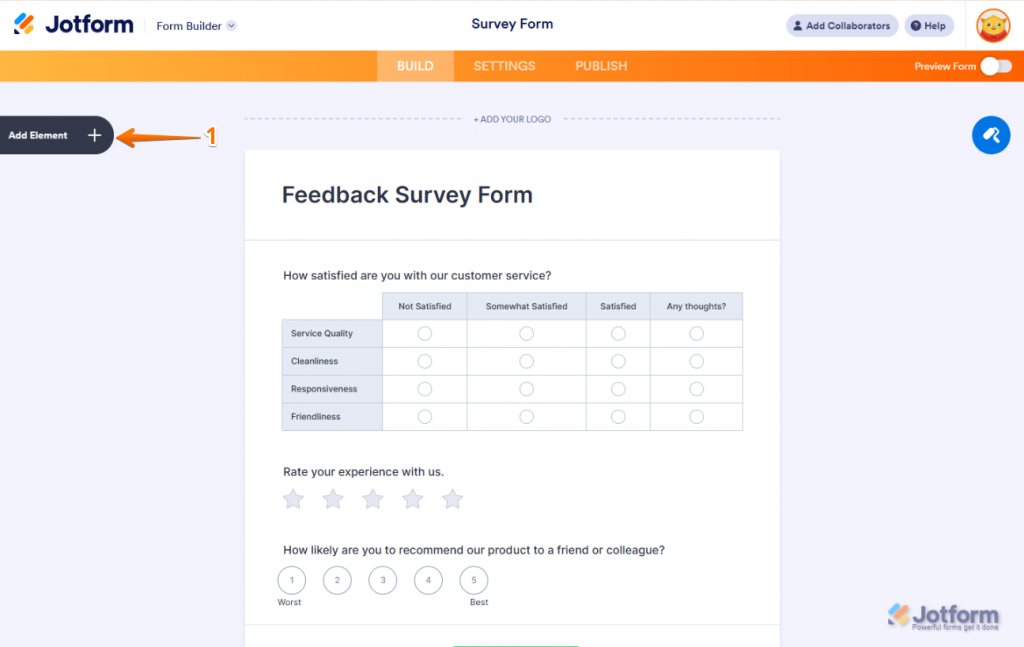
For teams that need more than NPS and CSAT, Jotform offers customer success intake forms, event registration flows, and feedback forms alongside payment collection, all without additional tools.
The trade-off is depth. For dedicated in-app NPS or behavioral feedback workflows, a purpose-built tool goes further. Jotform is the right choice when survey capability is one of several data collection needs, not the primary one.
Pros:
- 10,000+ templates across surveys, payments, registrations, and healthcare forms
- HIPAA-compliant plans for medical and health data collection
- Payment integration is available on the free plan
- Conditional logic, branching, and multi-page form support
Cons:
- Analytics depth is limited relative to dedicated NPS or CX platforms
- Per-user pricing model becomes expensive for larger teams
- No behavioral targeting or in-app trigger capability
How Jotform Compares to Wootric: Jotform doesn’t replicate Wootric’s in-app NPS positioning. It serves a different need: teams that want a flexible, multi-purpose data collection tool with surveys as one capability among many. If replacing Wootric’s in-app micro-survey functionality is the primary goal, Jotform is not the closest match.
Pricing: Free plan; paid from $19/month per user.
Rating: 4.7/5
11. SurveyMonkey: Best for General-Purpose NPS and Survey Volume
SurveyMonkey is the most broadly deployed survey platform in this category.
Its 400+ templates, guided question bank, and 200+ native integrations make it the fastest path to a live survey for teams that don’t need in-app triggering or behavioral targeting.
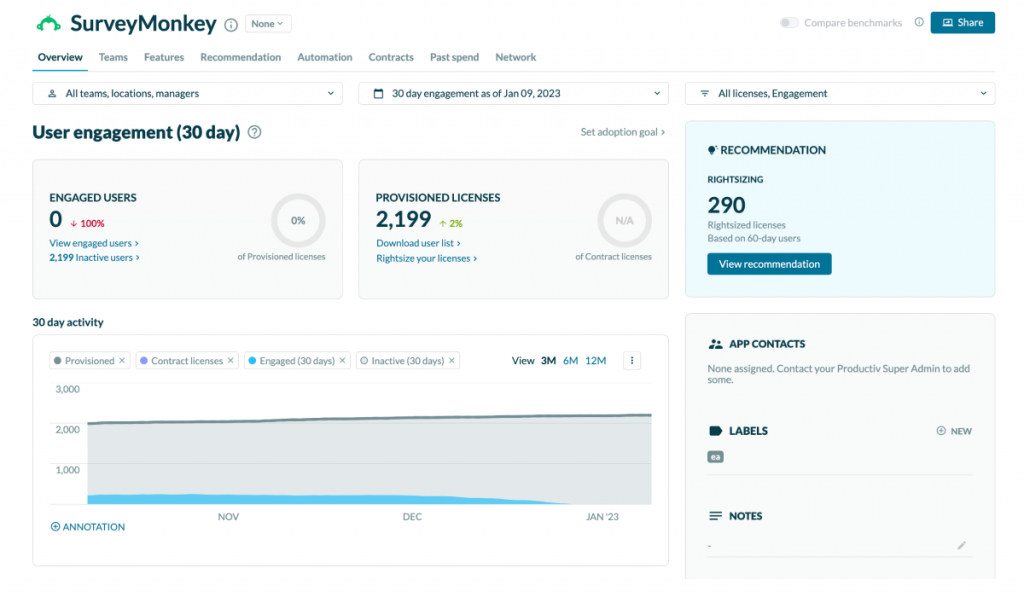
For NPS programs distributed via email or link, SurveyMonkey covers the basics well. The analytics are sufficient for tracking trends and exporting data. Team plans require a 3-seat minimum.
It won’t replicate Wootric’s in-app or behavioral targeting. But for general-purpose NPS and CSAT programs at volume, it’s the most universally recognized option.
Pros:
- 400+ templates and a guided question bank for fast survey creation
- 200+ native integrations with CRM, analytics, and communication tools
- A/B testing and custom branding on paid plans
- Well-documented and widely used across most industries
Cons:
- No behavioral triggering or in-app targeting capability
- Individual plans start at $30/month; team pricing requires minimums
- Analytics depth is basic without paid add-ons
How SurveyMonkey Compares to Wootric: SurveyMonkey covers general-purpose survey distribution. It doesn’t replace Wootric’s in-context, behavior-triggered feedback capability. If in-app targeting was the reason you chose Wootric, SurveyMonkey doesn’t solve that. If you primarily used Wootric for email-distributed NPS, SurveyMonkey is a workable and widely-integrated replacement.
Pricing: Individual plans from $30/month.
Rating: 4.6/5
My Top 3 Picks Among the Best Wootric Alternatives
After working through each tool in detail and mapping them against what Wootric originally did well, here’s where I land.
1. Qualaroo
For teams that want Wootric’s in-context, in-product feedback philosophy in a tool that’s actively evolving.
The Nudge™ targeting is more precise than what Wootric offered, the IBM Watson Sentiment Analysis handles open-ended responses at scale, and the Identity API gives you user-attributed feedback instead of anonymous NPS.
It’s the alternative that replicates Wootric’s original design intent while adding meaningful capabilities on top.
2. Refiner
For B2B SaaS product teams that specifically need Wootric’s micro-survey DNA without the enterprise wrapper.
Refiner was built for exactly the use case Wootric served at launch: lightweight, in-app NPS and CSAT surveys with fine-grained behavioral targeting and transparent pricing. If your team is product-led and your gap is mobile in-app or web-app feedback, Refiner is the closest like-for-like.
3. Survicate
For teams that need a Wootric replacement that plugs directly into their existing stack. Survicate’s 70+ native integrations, in-product survey targeting, and AI insight layer cover the core feedback workflow at a price point teams can evaluate without a sales call.
For CS and product teams managing feedback across the website and in-product touchpoints, it’s the most balanced mid-market option.
How Did I Evaluate These Wootric Alternatives?
The evaluation followed the same criteria applied consistently across all Wootric alternatives.
User Reviews and Ratings: Ratings and qualitative feedback were pulled from Capterra, community forums, and independent review discussions. Patterns in negative reviews — particularly around implementation complexity and pricing post-acquisition — were weighted alongside star ratings.
Core Features and Functionality: Each tool was assessed for in-app targeting capability, NPS/CSAT/CES support, AI analysis of open-ended responses, integration depth, and pricing transparency. For a Wootric replacement specifically, those four criteria from Wootric’s original value proposition were given the highest weight.
Ease of Use: How quickly can a product or CS team get a survey live? Wootric alternatives requiring multi-week implementation timelines scored lower regardless of feature depth, because the original Wootric appeal was self-serve speed.
Customer Support: Support quality matters more in this category than in most, because feedback tools are often set up by non-technical teams. Response patterns, onboarding support, and documented complaint resolution were all factored in.
Value for Money: Pricing transparency was treated as a feature. Wootric alternatives with self-serve pricing pages scored higher than those requiring a sales call for a quote. Hidden costs (response volume caps, per-channel add-ons, feature paywalls) were factored into the effective price assessment.
Personal Experience and Reputable Sources: Where Wootric alternatives were used directly or assessed through documented conversations with teams running them in production, that context is noted. No fabricated reviews or unnamed composite sources.
FREE. All Features. FOREVER!
Try our Forever FREE account with all premium features!
Which Wootric Alternatives Should You Choose?
The right choice of Wootric alternatives depends on your specific constraints. Here’s a direct framework.
| If Your Primary Problem Is | Start Here |
| You need in-app surveys that trigger based on user behavior | Qualaroo |
| You want Wootric’s SaaS micro-survey DNA at a transparent price | Refiner |
| You need in-product NPS that connects directly to your CRM stack | Survicate |
| You need NPS across email, SMS, WhatsApp, and in-app | Zonka Feedback |
| You want behavioral context alongside feedback (heatmaps + recordings) | Hotjar |
| You need a recurring NPS program to run on autopilot | SurveySparrow |
| You’re running enterprise VoC across global touchpoints | Medallia |
| You want high-completion surveys via conversational format | Typeform |
| You need surveys alongside payments, registrations, and intake forms | Jotform |
| You need a general-purpose survey volume without behavioral targeting | SurveyMonkey |
What Makes Good Wootric Alternatives?
Not every team is replacing Wootric for the same reason. But across the Wootric alternatives evaluated here, the ones that actually solve the problem share a few characteristics worth checking before you commit.
Transparent Self-Serve Pricing: One of the reasons teams chose Wootric originally was that pricing was visible and self-serve. The best Wootric alternatives reproduce that. If you’re back on a sales call to get a quote, you’ve recreated the problem you’re trying to escape.
In-App or In-Context Delivery: Wootric’s core advantage over email surveys was its ability to reach users within the product. Any replacement that only supports email distribution or survey links is missing the mechanism that made Wootric’s response rates competitive.
AI-Powered Open-Text Analysis: Manual tagging of NPS follow-up comments doesn’t scale. Wootric’s CXInsight™ text analytics was a genuine strength. Look for alternatives that handle this automatically: Qualaroo, Survicate, and Zonka Feedback all offer automated response categorization at varying levels of depth.
Integration With Your Existing Stack: A feedback tool that generates insight your team can’t act on is a reporting exercise, not a workflow. The best Wootric alternatives connect to your CRM, helpdesk, or product analytics tool so responses trigger actions automatically.
Stop Paying Enterprise Prices for a Use Case That Doesn’t Need Them
Wootric was built for product-led SaaS teams. Two acquisitions later, the platform serving those teams is now part of an enterprise CX suite designed for healthcare systems, retailers, and global financial institutions.
The Wootric alternatives you need still exist. It just isn’t called Wootric anymore.
If your primary gap is in-context, behavioral feedback with AI-powered analysis, Qualaroo is built for exactly that.
If you want the closest match to Wootric’s original SaaS micro-survey approach, Refiner picks up where it left off.
Frequently Asked Questions
What is the closest alternative to the original Wootric?
For B2B SaaS product teams, Refiner is the most direct, like-for-like solution: in-app micro-surveys, SaaS-first targeting, transparent pricing, and behavioral triggers, without enterprise overhead. Qualaroo covers the same in-context philosophy with more advanced behavioral targeting and AI sentiment analysis on top. Survicate is the strongest option for teams that need in-product NPS connected to a broad integration stack.
Which Wootric alternative has the best in-app targeting?
Qualaroo offers the most precise behavioral targeting in this category: scroll depth, time on page, exit intent, URL-specific triggers, user segment, session count, and custom variables via the Identity API, all without developer involvement after the initial code snippet is installed.
Is there a free Wootric alternative?
Yes. Qualaroo offers a free plan. Survicate offers a free plan with unlimited surveys. Hotjar has a free plan covering 35 daily sessions. Typeform's free plan covers 10 responses per month. For a fully functional free NPS workflow, Qualaroo and Survicate are the most capable free-tier options.
Which Wootric alternative is best for Salesforce integration?
Survicate and Qualaroo both offer native Salesforce integrations for pushing NPS and CSAT data into CRM records. Survicate supports bidirectional sync and field-level mapping. Zonka Feedback also integrates with Salesforce for omnichannel feedback programs.
How long does it take to switch from Wootric to an alternative?
For tools with self-serve onboarding (Qualaroo, Survicate, Refiner, SurveySparrow), most teams are live within 1-2 days. Historical Wootric response data is typically not portable across platforms, so the migration involves rebuilding active surveys in the new tool. Enterprise tools like Medallia require multi-week implementation timelines.
Which Wootric alternatives offer AI text analysis for open-ended NPS responses?
Qualaroo (AI Sentiment Analysis), Survicate (AI insights layer), Zonka Feedback (AI text analytics), and Medallia (enterprise-grade text analytics at scale) all automatically handle open-ended response categorization.
FREE. All Features. FOREVER!
Try our Forever FREE account with all premium features!

 We'd love your feedback!
What did you like & how can we make it even better?
 Thanks for your feedback!
 Ask Your Question
Have a question? Get expert help to make your decision easier.