

Most candidate experience surveys fail before they’re even sent.
They are built as a single long form and mailed weeks after the last touchpoint to every candidate, regardless of where they dropped out.
The result is low response rates and data nobody trusts enough to act on.
This guide gives you a candidate experience survey sample and template you can copy today, broken out by funnel stage, plus the questions, timing, and best practices that actually get candidates to respond honestly.
If you’re already running product or website surveys with a tool like Qualaroo, you’ll notice the same principle applies here: ask in the moment, not weeks later.
What Is a Candidate Experience Survey?
A candidate experience survey is a short questionnaire sent to job applicants at specific points in the hiring process to measure how they felt about the application, interview, offer, or onboarding stage they just went through. It captures perception data, not hiring decisions, and is used to find and fix friction points that cause qualified candidates to disengage or reject offers.
The gap between what companies assume and what candidates report is wide.
A 2026 RecruitBPM analysis found that only 26% of North American job seekers say they had a great candidate experience, and two in three (65%) say they didn’t get consistent communication along the way.
Meanwhile, 65% of talent say a single good or bad experience can change their mind about a role or the company entirely, according to 2025 Deloitte research.
Despite that, according to a 2026 RecruitBPM study, only 11% of organizations currently survey candidates to check satisfaction, and just 21% of candidates have ever been asked to share their thoughts on a hiring process.
That gap between impact and measurement is the opportunity this guide addresses.
15+ Candidate Experience Survey Questions You Should Ask by Stage
Not every candidate should get the same survey.
A candidate rejected after a resume screen has almost nothing to say about your interview panel, and a candidate you just hired has opinions your rejected candidates never will.
Split your questions by stages:
Post-Application and Screening Questions
Send these within 24 to 48 hours of application submission or rejection at the resume stage. Keep it to three or four questions maximum.
| Question | Format | What It Gauges |
| How easy was it to find and understand this job posting | Rating scale, 1 to 5 | Job Posting Clarity |
| How long did the application take to complete | Multiple choice: under 5 min, 5 to 15 min, 15 to 30 min, over 30 min | Application Length And Effort |
| Did you run into any technical issues while applying | Yes or no | Technical Friction |
| What is one thing we could improve about the application process | Open text | Unstructured Process Feedback |
This is also the stage where most candidates quietly abandon a form without ever hitting submit, a drop-off email surveys can’t catch because there’s no email to send.
Placing an intercept survey directly on the career site or application page, the way an in-context Nudge™ does on product pages, catches that abandonment in the moment instead of guessing at it later from application-start-to-finish rates.
Post-Interview Questions
Send within 24 to 48 hours of the interview, whether the candidate advances or is rejected.
| Question | Format | What It Gauges |
| Rate your overall experience with the interview team | Rating scale, 1 to 5 | Overall Interview Satisfaction |
| The interviewer was well prepared and asked relevant questions | Agree or disagree | Interviewer Preparedness |
| I received a clear explanation of the role and what a typical day looks like | Agree or disagree | Role Clarity |
| I was given a clear timeline for the next steps | Agree or disagree | Communication And Expectation Setting |
| What is one thing that would have made this interview better | Open text | Specific Improvement Areas |
Here’s a readymade post-interview candidate experience survey template you can use:
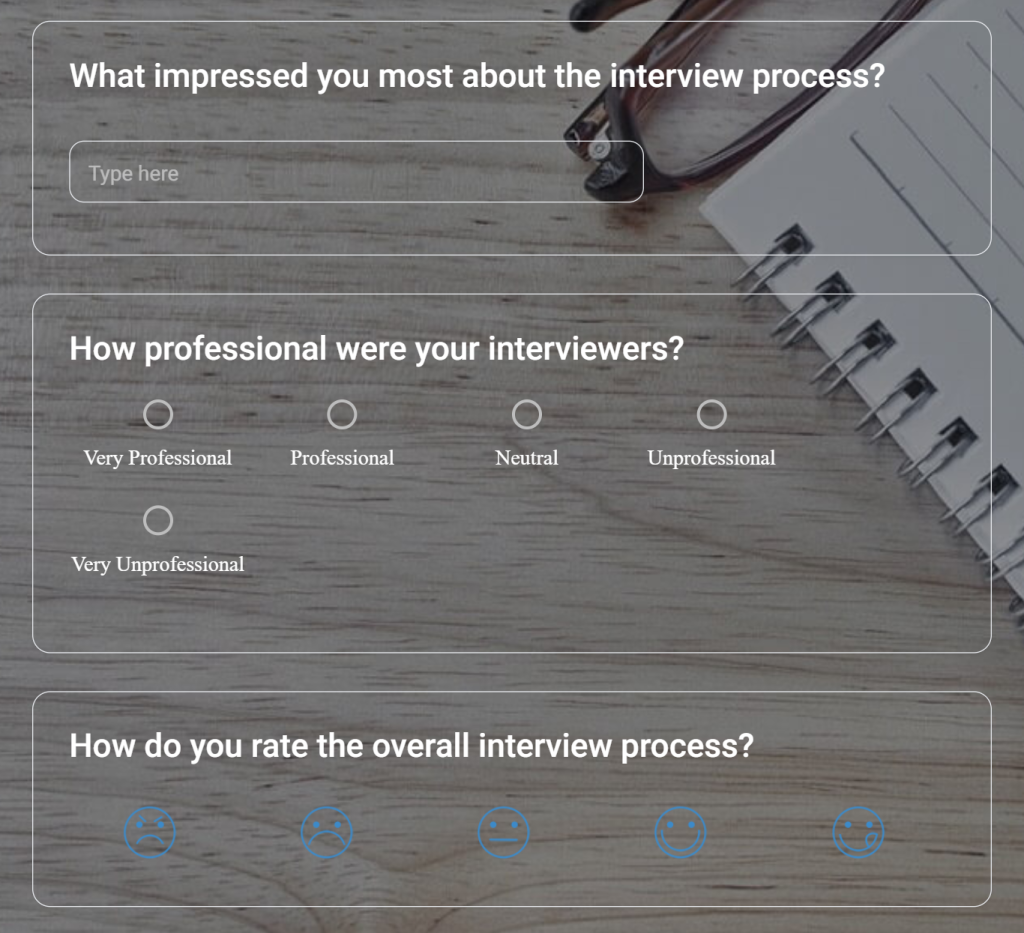
According to CareerPlug’s 2025 Candidate Experience Report, 66% of candidates said a positive overall experience directly influenced their decision to accept a job offer, and communication gaps were the single biggest reason candidates walked away.
Pairing this survey with a short, specific rejection note, rather than a form letter, is what actually moves that number.
Offer and Withdrawal Questions
Two very different groups sit at this stage, and each needs its own short survey.
For candidates who declined an offer:
| Question | Format | What It Gauges |
| What was the primary reason you decided not to accept this offer | Multiple choice with open “other” field | Primary Decline Driver |
| How did our offer compare to others you received | Better, worse, or about the same | Competitive Offer Positioning |
| Was there anything about the process itself, not the offer terms, that influenced your decision | Open text | Process-Related Decline Factors |
For candidates who withdrew mid-process:
| Question | Format | What It Gauges |
| At what point did you decide to withdraw | Multiple choice: application, screening, interview, or offer stage | Drop-Off Point |
| What was the main reason for withdrawing | Open text | Root Cause Of Withdrawal |
| Would you consider applying to this company again in the future | Yes, no, or maybe | Employer Brand Recovery |
Post-Hire Onboarding Questions
Send 30 to 90 days after the start date, once the new hire has enough experience to compare expectations against reality.
| Question | Format | What It Gauges |
| How accurately did the interview process represent the actual role | Scale: very accurately to not at all | Expectation Versus Reality Gap |
| What made you choose to accept the offer over other options | Open text | Decision Drivers And Employer Brand Strengths |
| How likely are you to recommend our hiring process to a friend or colleague | Scale, 0 to 10 | Candidate Net Promoter Score |
| What is one thing we should keep doing, and one thing we should change | Open text | Process Strengths And Gaps |
Here’s a post-hiring candidate experience survey template:
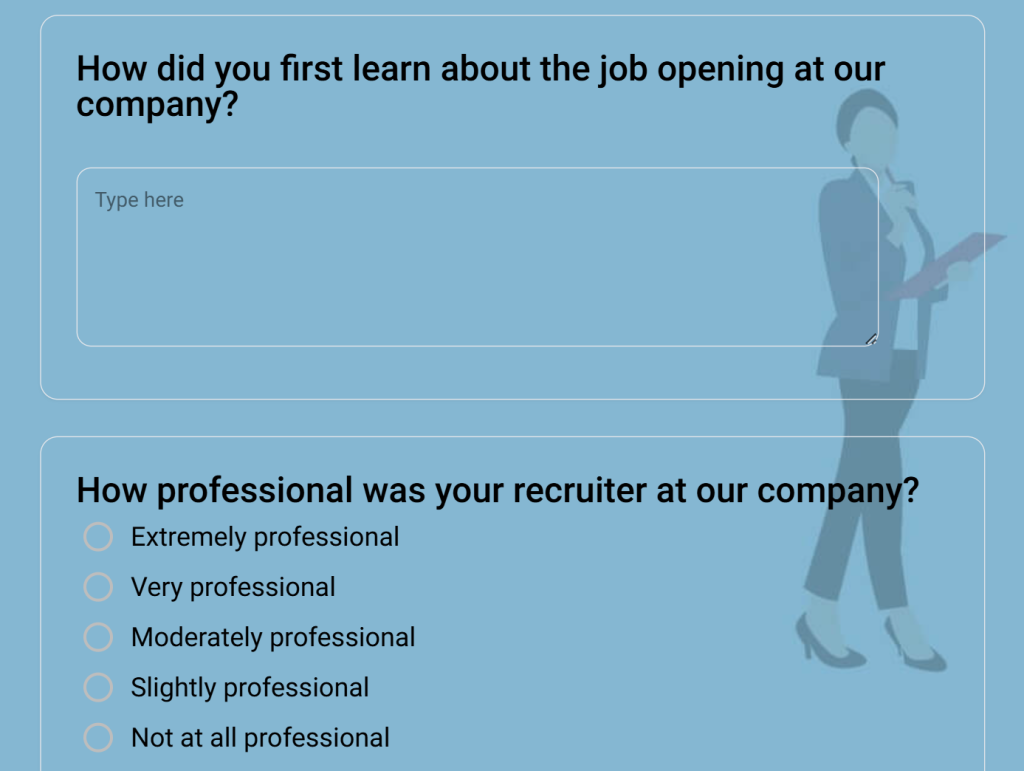
Because this group is identifiable and already inside your systems, this is the one stage where tying a response back to a specific candidate record adds value instead of chilling honesty.
The Identify API lets you link a response to an existing employee or candidate record with one line of code, so you can segment onboarding feedback by department or hiring manager without asking the new hire to re-identify themselves.
What Does a Candidate Experience Survey Sample and Template Look Like?
Here’s a ready-to-use candidate experience survey sample you can drop into any tool.
It uses a mix of rating scales and open-text questions, keeping the total under eight, which is the range that maintains high completion rates.
Candidate Experience Survey Template
| Question | Format | What It Gauges |
| Overall, how would you rate your experience with our hiring team | Scale, 1 to 5 | Overall Interview Satisfaction |
| The recruiter kept me informed at every stage | Strongly agree to strongly disagree | Communication Consistency |
| The interview process felt relevant to the role I applied for | Strongly agree to strongly disagree | Interview Relevance |
| How likely are you to recommend our hiring process to a friend | Scale, 0 to 10 | Candidate Net Promoter Score |
| What is one thing we did well | Open text | Process Strengths |
| What is one thing we should improve | Open text | Process Gaps |
That template works as a single-stage survey, but most teams need one sample question per funnel stage to build out a full program. Here’s what that looks like across the candidate journey.
| Funnel Stage | Sample Question | Format |
| Application | How long did the application take to complete | Multiple choice |
| Screening | How clear was the job description compared to what you experienced | Rating scale |
| Interview | The interviewer was well prepared | Agree or disagree |
| Offer Decline | What influenced your decision not to accept | Open text |
| Post-Hire | How accurately did the process represent the role | Rating scale |
Treat this table as a starting template, not a fixed script.
Swap in role-specific or department-specific language before sending, since a generic template applied to every job title is one of the most common reasons response rates stay low.
When Should You Send a Candidate Experience Survey?
Timing affects data quality more than question wording does. A candidate answering three weeks after an interview is reconstructing memory, not reporting a real-time reaction.
| Candidate Stage | Send Within | Why This Window |
| Application Drop-Off or Submission | Immediately or same day | Friction is still fresh, and abandoners are easiest to lose if you wait |
| Rejected at Screening | 24 to 48 hours | Short survey, low emotional stakes, fast turnaround keeps it relevant |
| Rejected After Interview | 24 to 48 hours | Detail decays fast; specific feedback still matters most here |
| Declined Offer | Within 24 hours of decline | Reasoning is clearest before the candidate moves on mentally |
| Hired, Post-Onboarding | 30 to 90 days after start | Enough experience to compare expectation to reality |
FREE. All Features. FOREVER!
Try our Forever FREE account with all premium features!
How Do You Create a Candidate Experience Survey Using Qualaroo?
Here’s how to go from a blank canvas to a live, in-context candidate experience survey in Qualaroo, from selecting the trigger point to reviewing response sentiment.
Step 1: Pick Your Trigger Point
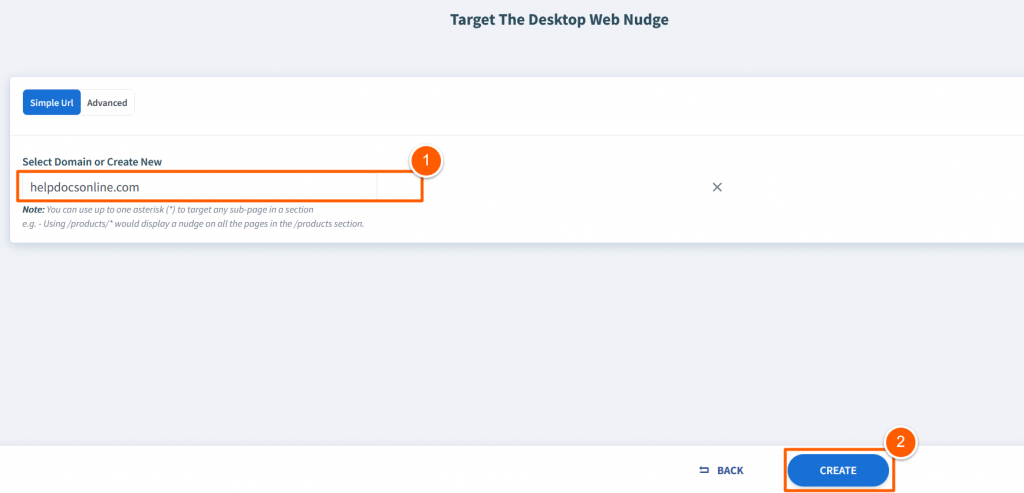
Set a Nudge to fire on your careers page, application form, or a specific URL, such as an exit-intent trigger when a candidate starts closing the application tab before submitting.
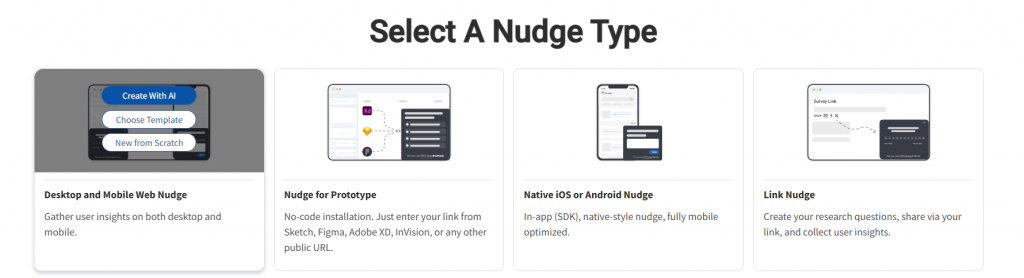
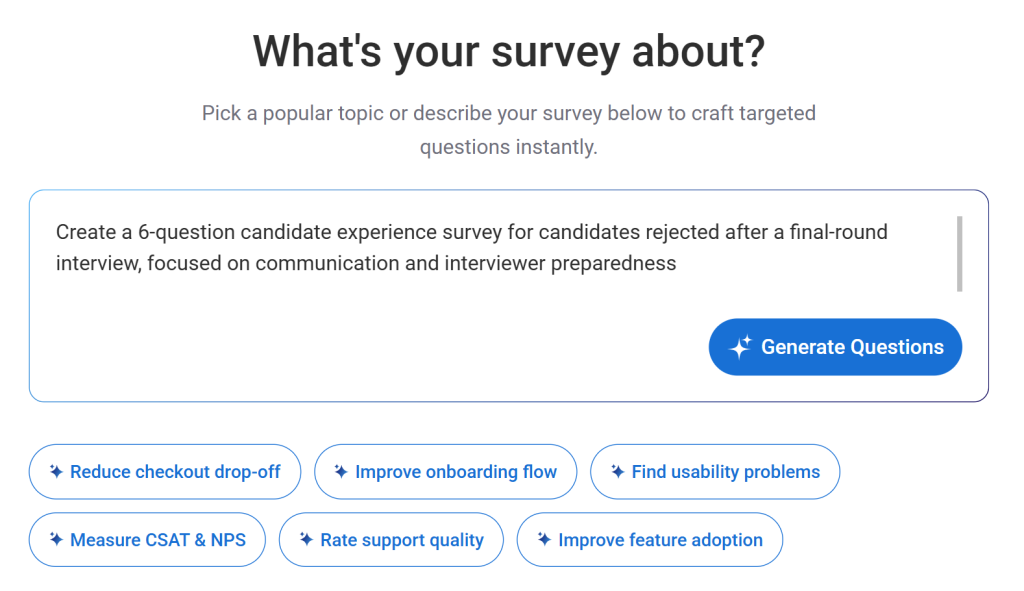
Step 2: Generate Your Questions With AI Survey Creator
Describe the stage you’re surveying, post-interview or post-offer, for example, and the AI Survey Creator drafts a relevant question set you can edit before publishing.
A prompt like “Create a 6-question candidate experience survey for candidates rejected after a final-round interview, focused on communication and interviewer preparedness” is enough to get a usable draft.
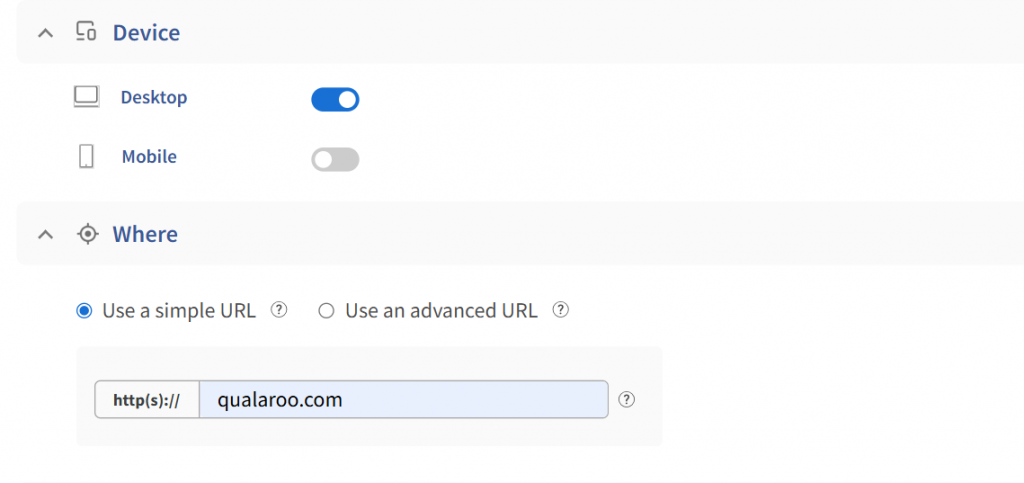
Step 3: Set Your Targeting Rules
Target by URL or page path so only candidates on the application or careers section see the survey, not your regular website visitors.
Step 4: Add Branching Logic
Use question branching so a candidate who rates their experience poorly is routed to an open-text follow-up asking what went wrong, while a positive rating skips straight to a referral question.
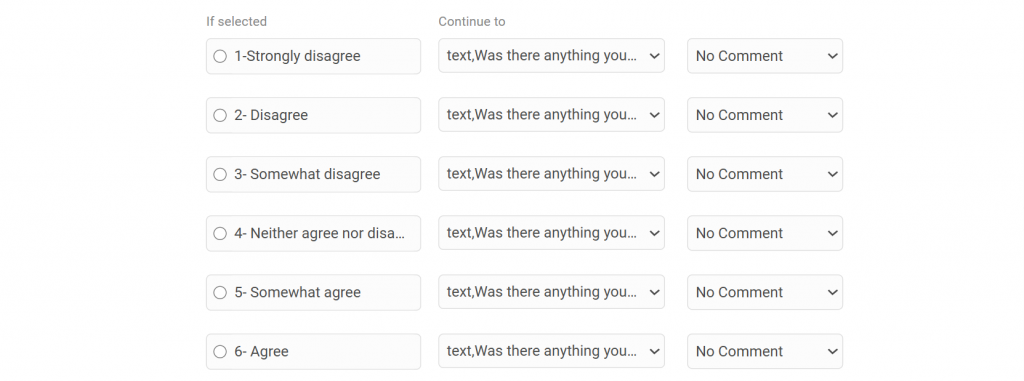
Here’s how skip logic and branching work:
Step 5: Turn On Multilingual Support if Needed
If you hire across regions, Qualaroo supports over 70 languages, so the survey automatically matches the candidate’s application language.
Step 6: Review Responses as They Come In
Open-text answers run through Qualaroo’s native AI Sentiment Analysis, which flags negative sentiment clusters so you can spot a recurring interviewer or process issue without reading every response manually.
Here’s how it works:
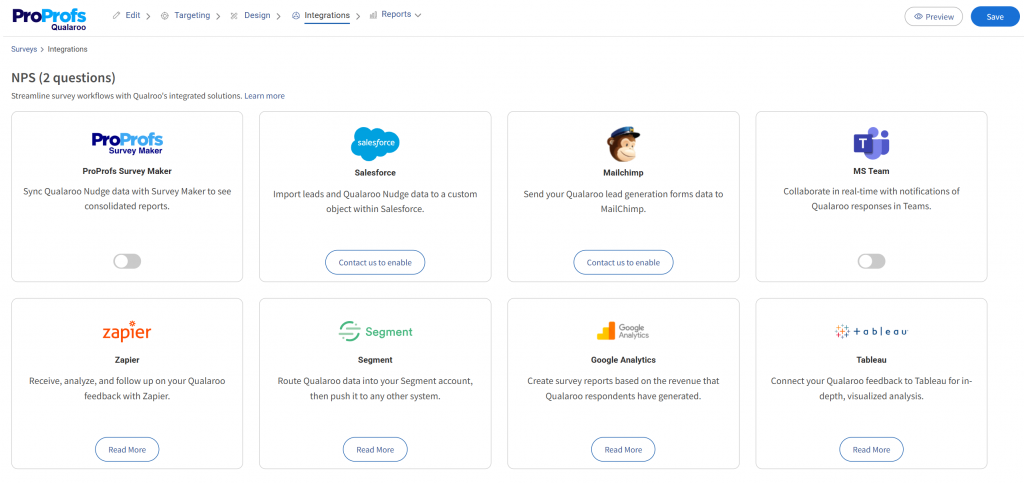
Step 7: Export or Connect to Your ATS
Route completed responses into your existing recruiting applicant tracking system (ATS) workflow using built-in integrations, so hiring managers see the feedback tied to the stage they own.
Alternatively, you can use ProProfs Survey Maker for longer, more in-depth surveys. Create your surveys with AI (the same way you did using Qualaroo). Here’s how:
What Are Candidate Experience Survey Best Practices?
Question wording rarely makes or breaks a candidate experience survey. These six practices do, and they’re the ones most teams skip.
Keep It Anonymous for Rejected and Withdrawn Candidates: Respondents give softer, less useful answers the moment they suspect a response could be traced back to them. Candidates facing a company they may apply to again are even more cautious.
Cap It at 5 to 8 Questions: Longer surveys see steep drop-off past the halfway mark, and a candidate who already invested hours in your application process has little patience left for a 20-question form.
Mix Rating Scales With One Open-Text Question: Scales give you trend data across candidates; the open field gives you the specific detail that explains why a score is low.
Survey Every Outcome, Not Just Hires: Rejected and withdrawn candidates are the group most likely to talk publicly about a bad process, and they’re also the group companies survey the least.
Close the Loop Internally: A survey nobody reviews is worse than no survey. Route responses to whoever owns that stage, recruiter, hiring manager, or interviewer, on a recurring basis.
Trigger the Survey at the Moment of Drop-Off, Not After: An email sent days later misses candidates who never finished the application. A contextual nudge placed directly on the careers page or application form captures that moment as it happens.
Turn Candidate Feedback Into a Better Hiring Process
Most companies still treat the candidate experience survey as an afterthought, something to send once and forget.
The teams’ winning talent is doing the opposite: catching drop-off in the moment, closing the loop on every rejection, and treating each stage of the funnel as its own measurable checkpoint.
The template and questions above provide a starting point.
The habit of actually reviewing and acting on what comes back is what turns that data into fewer ghosted candidates, faster offer acceptance, and a hiring process people are willing to recommend, even when they don’t get the job.
Ready to stop guessing where candidates drop off? Try Qualaroo and set up your first in-context candidate survey today.
This runs on Qualaroo’s free plan, so there’s no reason to keep guessing where candidates are dropping off.
Frequently Asked Questions
How many questions should a candidate experience survey have?
Keep it to 5 to 8 questions per stage, since completion rates drop sharply past that range for a candidate who's already invested time in your process. Application and rejection-stage surveys should stay closer to 3 to 5 questions, while post-hire onboarding surveys can run slightly longer since the candidate is more invested and has more to say.
Should candidate experience surveys be anonymous?
Yes, for rejected and withdrawn candidates. Anonymity is the biggest driver of honest responses in this context, given the power imbalance between an applicant and a potential employer who might review their application again someday. Identified surveys work better only at the post-hire stage, once that imbalance has largely resolved.
What is a good candidate experience survey response rate?
Response rates vary by industry, but short, well-timed surveys sent within 48 hours of the relevant event consistently outperform delayed, generic ones sent weeks later. Fewer questions, mobile-friendly formats, and a clear sense of why the feedback matters all lift completion further, especially for candidates who didn't get the job.
Do I need to survey candidates who were rejected early in the process?
It's optional, but valuable. Even a 2-question survey after a resume screen tells you if the job posting or application itself is confusing before a candidate ever reaches an interview, which is often cheaper to fix than a problem discovered later in the funnel.
Should I offer an incentive for completing the survey?
It can help, especially for longer post-interview or post-hire surveys where candidates have less remaining patience. A small gift card or company swag is common and typically raises completion rates without meaningfully skewing responses, unlike incentives tied to specific answer choices.
What is the difference between a candidate experience survey and an exit interview?
An exit interview is for departing employees, capturing why someone chose to leave after already working there. A candidate experience survey covers anyone in your hiring funnel, whether they were hired, rejected, or withdrew before a decision was made, and it happens before employment even starts.
Is GDPR compliance necessary for candidate surveys?
Yes, if you're collecting responses from candidates in the EU or UK. Make sure your survey tool supports anonymized or consent-based data collection, and clearly disclose how responses will be used and stored before the candidate submits anything.
How is a candidate experience survey different from an employee engagement survey?
A candidate experience survey measures perception of the hiring process itself, before someone joins the company. An employee engagement survey measures ongoing sentiment among employees who are already on staff, tracking a completely different relationship stage with a different set of concerns.
FREE. All Features. FOREVER!
Try our Forever FREE account with all premium features!

 We'd love your feedback!
What did you like & how can we make it even better?
 Thanks for your feedback!
 Ask Your Question
Have a question? Get expert help to make your decision easier.