

Most employee benefits surveys go out once a year, land in a crowded inbox, and come back with answers so vague they are hard to act on.
That is rarely because employees have nothing to say. It is because the survey appears at the wrong time, feels risky to answer honestly, and asks generic questions that do not map to real decisions.
The fix starts with better employee benefits survey questions, organized by the categories that actually drive retention: health, money, time, family, and career growth.
Below you will find 45+ ready-to-use questions, a repeatable process for running the survey with Qualaroo, and the mistakes that quietly wreck response quality.
What Is an Employee Benefits Survey?
An employee benefits survey is a structured set of questions that measures how satisfied, informed, and supported employees feel about the benefits they receive, including health insurance, retirement plans, paid time off, and family or wellness perks. It captures usage, understanding, and preference data that HR and total rewards teams use to redesign, expand, or better communicate a benefits package.
A benefits survey is narrower than a general engagement survey on purpose. Engagement surveys ask how people feel about their manager, workload, and culture.
A benefits survey isolates one variable: whether the money a company spends on benefits actually adds value to employees’ lives.
That distinction matters because benefits problems are usually fixable in ways culture problems are not.
According to MetLife’s 2026 U.S. Employee Benefit Trends Study, employers are investing more in benefits than ever, yet health and well-being outcomes have stayed flat, a gap MetLife attributes to employees not understanding or knowing how to use what’s already available to them.
A 2026 Selerix survey of US employees found that 82 percent of employees who describe themselves as “very likely to stay” are also “very satisfied” with their benefits, and the biggest reaction among employees likely to leave wasn’t dissatisfaction; it was disengagement.
Companies that personalized their open enrollment experience saw a 56-point satisfaction gap versus those that didn’t.
Often, the gap is not the plan design. It is the question you never asked.
Which Employee Benefits Survey Questions Should You Ask by Category?
Pick questions from the categories below based on what you are trying to decide. If you are renewing your health plan next quarter, pull from the health and satisfaction sections.
If you are building a retention case for leadership, pull from satisfaction and communication. You do not need to ask all 48 in one sitting.
Twelve to fifteen well-chosen questions, sent twice a year, will outperform one 40-question survey sent once.
Employee Health Benefits Survey Questions
| Question | What It Gauges |
| How satisfied are you with your current health insurance plan? | Baseline satisfaction with the core health plan, the number you track quarter over quarter |
| Does your health plan cover the specialists and providers you actually use? | Whether the network actually matches how employees use healthcare, not just how it looks on paper |
| How would you rate the affordability of your monthly premium? | Whether cost, not coverage quality, is the real driver of dissatisfaction |
| Do you understand what your plan covers before you need to use it? | Benefits literacy, since employees who don’t understand coverage can’t judge it fairly |
| How easy is it to find an in-network doctor near you? | Real-world access friction that plan documents alone will never reveal |
| Would you use a mental health benefit if one were available or expanded? | Unmet demand for a benefit you may be under-investing in |
| How satisfied are you with your dental and vision coverage? | Satisfaction with ancillary benefits that often get overlooked next to medical |
| Do you feel your health benefits meet your family’s needs? | Whether dependent coverage is a blind spot for employees with families |
Financial and Retirement Benefits Questions
| Question | What It Gauges |
| How satisfied are you with the employer match on your retirement plan? | Satisfaction with a benefit that directly shapes long-term financial trust in the company |
| Do you feel confident about your long-term financial security at this company? | Whether employees see this job as part of a stable financial future, a strong retention signal |
| Would you value access to financial planning or coaching as a benefit? | Unmet demand for guidance, not just contributions, around their money |
| How clear is the information you received about your retirement plan options? | Whether poor communication, not the plan itself, is the real source of dissatisfaction |
| Do you understand how much your company contributes to your retirement account? | Basic benefits literacy around what the company is actually putting in |
| Would a student loan repayment benefit influence your decision to stay? | Whether a specific financial benefit could move the needle on a retention decision |
| How satisfied are you with your life and disability insurance coverage? | Satisfaction with safety-net benefits employees rarely think about until they need them |
Work-Life Balance and Flexibility Questions
| Question | What It Gauges |
| How satisfied are you with your paid time off policy? | Core satisfaction with the benefit employees judge a company by most visibly |
| Do you feel comfortable taking time off when you need it? | Whether the policy on paper actually translates into permission to use it |
| How would you rate the flexibility of your work schedule? | How much control employees feel they have over when and how they work |
| Does your remote or hybrid work policy meet your needs? | Whether your current work model still fits how employees actually want to work |
| Would additional flexible scheduling options improve your day to day work? | Unmet demand for more control over the workday |
| How satisfied are you with your sick leave policy? | Whether sick leave feels adequate when employees actually need to use it |
| Do unused PTO or rollover rules affect how you use your time off? | Whether policy design, like use-it-or-lose-it rules, is quietly discouraging time off |
Family and Caregiving Benefits Questions
| Question | What It Gauges |
| How satisfied are you with your parental leave policy? | Satisfaction with a benefit that heavily influences whether new parents stay or leave |
| Would expanded childcare support influence your satisfaction at this company? | Unmet demand for support that directly affects whether parents can stay in the workforce |
| Do you feel supported as a caregiver for a family member? | Whether employees caring for aging or ill family members feel supported or invisible |
| How valuable would a dependent care flexible spending account be to you? | Perceived value of a specific, often underused benefit |
| Does your benefits package support employees at different life stages? | Whether the package flexes across life stages or only fits one profile |
| Would fertility or adoption assistance be a benefit you would use? | Unmet demand for a benefit that matters disproportionately to a smaller but high-stakes group |
Professional Development Benefits Questions
| Question | What It Gauges |
| How satisfied are you with tuition reimbursement or education benefits? | Satisfaction with the benefit most tied to long-term career growth |
| Do you use the professional development resources currently available to you? | Actual usage rate, since a benefit nobody uses isn’t delivering value regardless of design |
| Would you value a stipend for courses, certifications, or conferences? | Unmet demand for a lighter-weight, more flexible development benefit |
| How clear is the path to use your learning and development budget? | Whether a confusing process, not lack of interest, is limiting usage |
| Does your current benefits package support your long-term career goals? | Whether employees see a real career path here or just a paycheck |
| Would mentorship or coaching be a benefit you would use? | Unmet demand for guidance beyond formal training programs |
Employee Benefits Satisfaction Survey Questions
| Question | What It Gauges |
| Overall, how satisfied are you with your current benefits package? | The single number you’ll track over time as your core benefits health metric |
| How well do your benefits compare to what you expected when you joined? | Whether the package is living up to what was promised during hiring |
| Which three benefits matter most to you personally? | A forced-ranking view of what actually matters, not just what employees say they like |
| Which benefit do you use the least, and why? | Where budget may be going to waste on a benefit that isn’t landing |
| Would you recommend this company’s benefits to a friend considering a job here? | Employer brand strength, since employees rarely recommend benefits they don’t believe in |
| How likely are you to stay at this company partly because of your benefits? | How directly is satisfaction tied to retention risk |
| What is one benefit you wish we offered that we currently do not? | The clearest, most direct way to surface a coverage gap |
| How well do our benefits reflect the needs of employees like you? | Whether the package feels built for this workforce or copied from a generic template |
Benefits Communication and Awareness Questions
| Question | What It Gauges |
| How clear is the communication you receive about your benefits? | Whether communication, not the benefit itself, is the real point of failure |
| Do you know where to go if you have a question about your benefits? | Support accessibility, since a great benefit nobody can get help with functions like no benefit at all |
| Did you feel supported during your last open enrollment period? | The quality of the enrollment experience itself, separate from the benefits chosen |
| How confident are you in the choices you made during enrollment? | Decision confidence, a strong predictor of regret and repeat questions later in the year |
| Would you use a tool that helps you compare benefit options before choosing? | Unmet demand for better decision support during enrollment |
| How helpful were the resources provided to explain your benefits this year? | Whether this year’s communication effort actually worked, not just whether it existed |
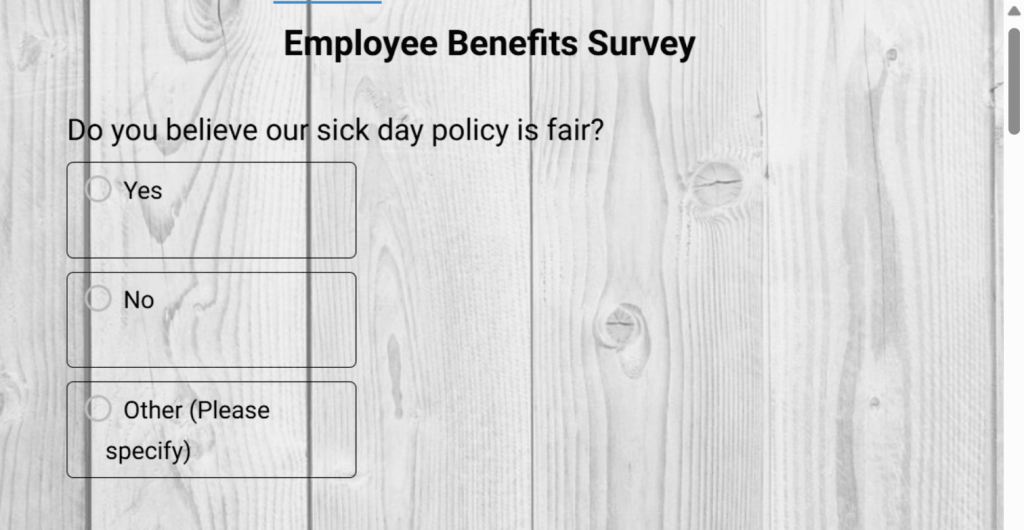
Here’s a benefits survey template you can use:
How Do You Create an Employee Benefits Survey Using Qualaroo?
Writing good questions is half the job. The other half is getting them in front of employees at a moment when they will actually answer honestly.
Here is the process, built around how Qualaroo works in practice.
Step 1: Generate a First Draft With AI Survey Creation
Instead of writing 12 to 15 questions from scratch, describe your goal in plain English, such as “a benefits satisfaction survey for a 300-person software company,” and let the AI Survey Creator generate a first draft.
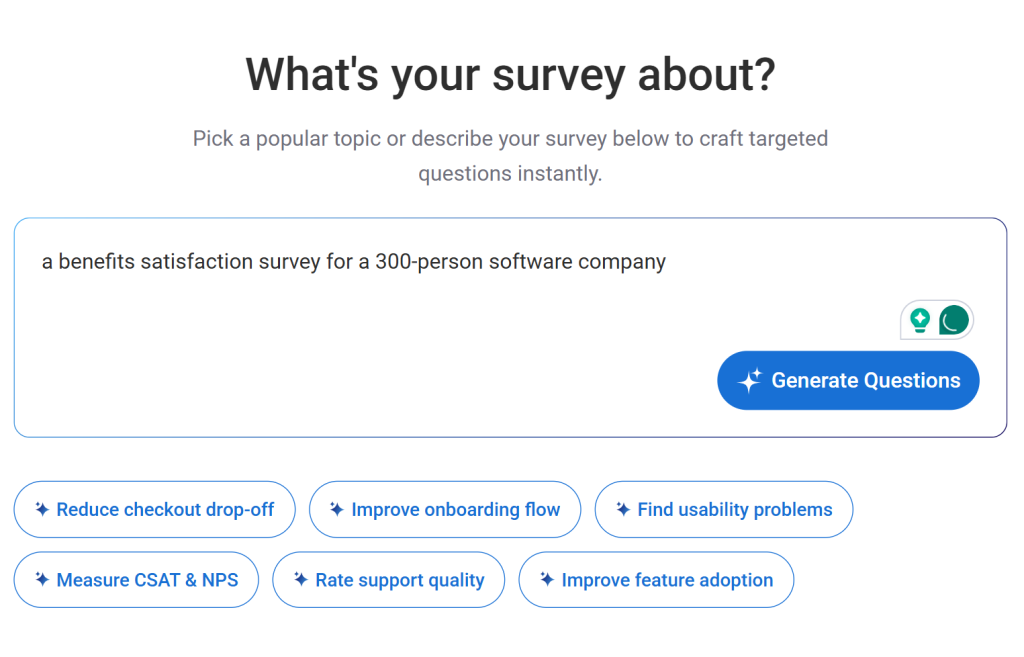
It gives you a structured starting point in seconds, which you then trim and reorder using the categories in this guide rather than staring at a blank page.
Step 2: Refine the Draft Into a Reusable Template
Once the AI draft edits down to your final question set, save it as a template so next year’s survey does not start from zero either.
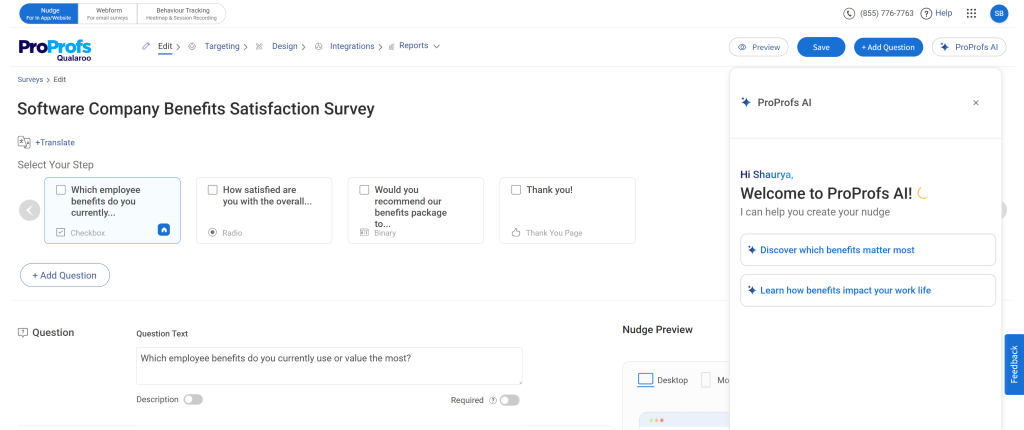
A saved template also keeps question order consistent year over year, which matters more than most HR teams expect since a confusing order is one of the fastest ways to lose a respondent halfway through.
Step 3: Trigger the Survey Where Employees Already Work
An annual email link competes with every other unread message in an inbox.
Set the survey to trigger as a Nudge™ inside your intranet, HRIS portal, or internal tool right after a relevant moment, such as the day after open enrollment closes or a week after a new hire’s benefits go live, so the context is still fresh.
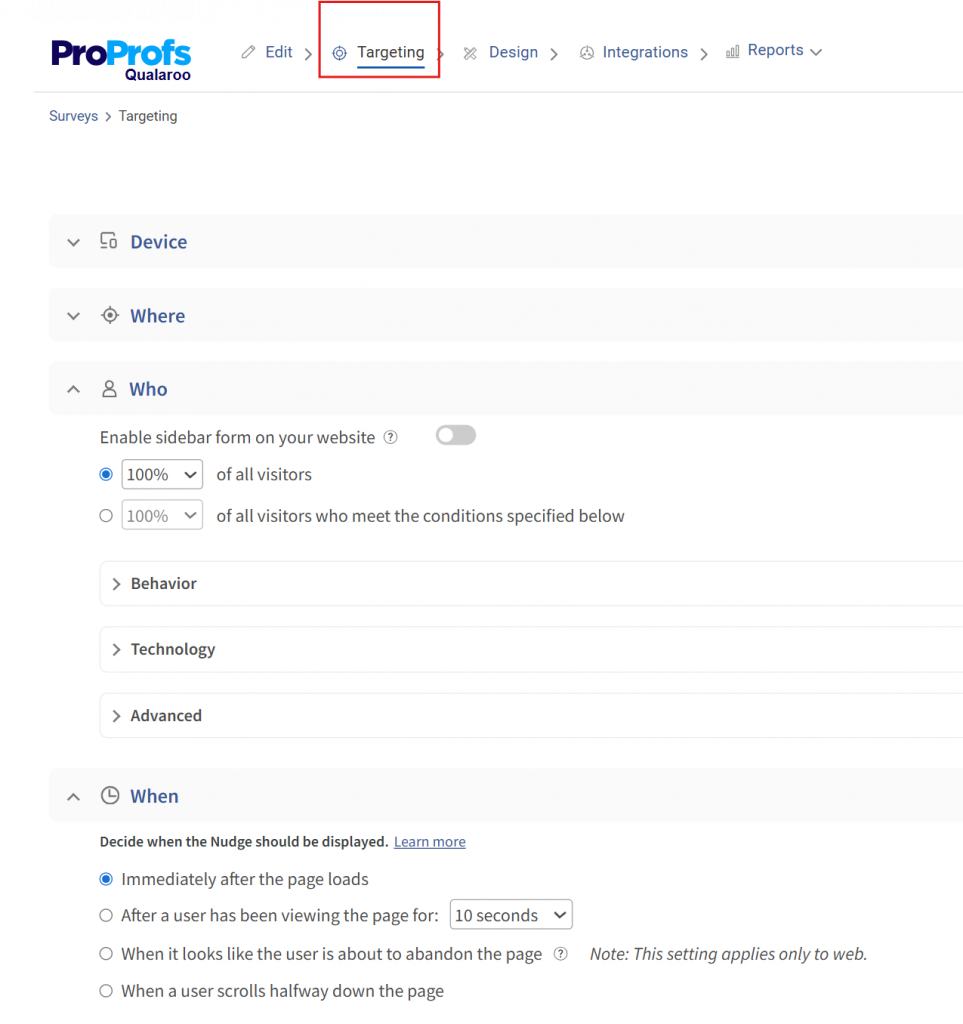
Step 4: Segment Responses by Department or Tenure
Generic, company-wide results hide the real story. A new parent and a five-year veteran do not care about the same three benefits.
Use Identify API to tie responses to attributes such as department, tenure, or location without exposing individual responses to managers, so you can compare segments while still protecting anonymity.
Step 5: Keep It Short and Branch Only When Needed
Twelve to fifteen questions is the sweet spot for a standalone benefits survey.
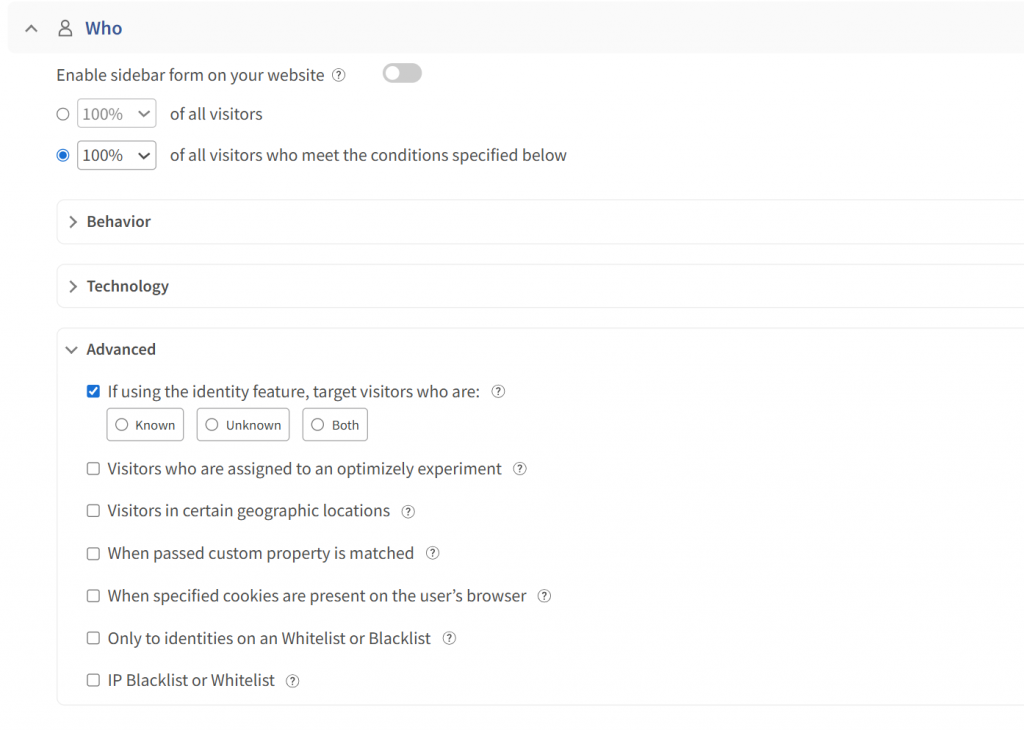
Use question branching so an employee who says they never use the dependent care FSA is not asked three follow-up questions about it, and instead gets routed straight to a question that applies to them.
Here’s how you can use skip logic:
Step 6: Read Open-Ended Comments With AI Sentiment Analysis
Open-ended questions like “What is one benefit you wish we offered?” produce the most useful answers and the most text to read.
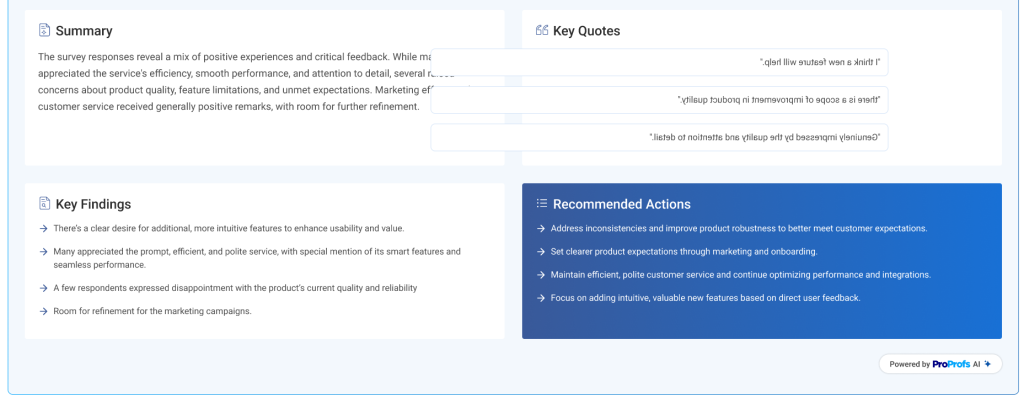
The AI Sentiment Analysis groups free-text responses by sentiment automatically, so a few hundred comments become a handful of themes instead of an afternoon of manual tagging.
Here’s how it works:
Step 7: Share What Changed
Send a short summary back to employees within two to three weeks: what you heard, what you are changing, and what you are not changing and why.
This single step is the biggest lever for response rates on your next survey, because people stop answering surveys they believe go nowhere.
What Mistakes Should You Avoid When Surveying Employees About Benefits?
Discussions on forums like Blind make one thing clear: many employees already suspect that “anonymous” HR surveys are not really anonymous, and that suspicion alone is enough to make them either skip the survey or answer dishonestly.
Every mistake below either causes or compounds that trust gap.
| Mistake | Why It Backfires | Fix |
| Sending It Once a Year by Email Only | Low visibility, low urgency, easy to ignore | Trigger it in context, at a relevant moment, inside tools employees already use |
| Asking 30 or More Questions in One Sitting | Fatigue sets in, and later answers get careless or blank | Cap standalone surveys at 12 to 15 questions and use branching |
| Promising Anonymity You Cannot Deliver | Employees who suspect it is fake will disengage or self-censor | Only promise what your tool and process can actually guarantee, and say so plainly |
| Letting Managers See or Administer the Survey | Employees soften or hide honest feedback out of fear of retaliation | Route results through HR or People Ops, not direct managers |
| Asking Only Satisfaction Questions | Misses whether employees understand or even use the benefit | Mix satisfaction, usage, and understanding questions in every survey |
| Never Reporting Back What Changed | Employees conclude the survey is theater | Close the loop within a few weeks, every time |
FREE. All Features. FOREVER!
Try our Forever FREE account with all premium features!
How Do You Turn Benefits Survey Responses Into Action?
Not every low-satisfaction score deserves the same urgency. The fastest way to prioritize is to plot each benefit on two dimensions: how many employees use it, and how satisfied those users are.
A benefit with high usage and low satisfaction, such as a health plan with a strong network but a confusing claims process, is your first fix.
A benefit with low usage and low satisfaction may not need a redesign at all. It may just need better communication, since employees who do not understand a benefit cannot rate it fairly in the first place.
Quick Framework: High use, low satisfaction: fix the plan or process first. Low use, low satisfaction: fix the communication first, then re-survey before changing the plan. High use, high satisfaction: protect this benefit in future budget cuts. Low use, high satisfaction: promote it more; employees who know about it already like it.
Benchmark your results against your own history rather than industry averages, since your survey response rate and satisfaction baseline will differ by company size and industry.
If you already run pulse checks between annual surveys, pull comparable questions from your employee pulse survey questions so the two data sets can be read side by side.
Ready to Ask Better Employee Benefits Survey Questions?
You now have the questions, the categories, and the process.
What is left is removing the friction between asking and answering, which is exactly what a contextual, in-the-moment survey does better than a link buried in an email.
Qualaroo lets you trigger the right benefits question at the right moment, segment responses without breaking trust, and read hundreds of open-ended comments in minutes instead of hours.
If you are also tracking why people leave once benefits stop being enough to keep them, pair this survey with a look at your exit survey questions to see whether the same gaps show up on the way out.
Frequently Asked Questions
How many questions should an employee benefits survey have?
Twelve to fifteen questions works best for a standalone employee benefits survey, since that range covers every major category without triggering fatigue. Shorter surveys sent more often, twice a year instead of once, produce more reliable data than one long annual survey where later answers get rushed or skipped once employees hit question twenty or twenty five.
How often should you run an employee benefits survey?
Run a full survey once a year, ideally the week after open enrollment closes while the experience is still fresh, and add a shorter pulse check midyear. The midyear check catches emerging problems, such as a new insurance network gap or a benefit nobody understands, before the next enrollment cycle locks employees into another year of the same choice.
Should employee benefits surveys be anonymous or confidential?
An anonymous survey is stronger for honesty, since confidential surveys still tie every answer to an identity that someone in HR, and sometimes a manager, can eventually see. If you need to compare results by department or tenure, use aggregated attributes rather than individual identifiers, so you can segment the data without ever exposing who said what to anyone.
What is a good response rate for an employee benefits survey?
Sixty to seventy percent is a strong response rate for an internal benefits survey triggered in context, right where employees already work. Email-only distribution typically lands closer to 30 to 40 percent, which is one more reason to trigger surveys inside tools employees already use daily instead of relying on a link buried in a crowded inbox.
What employee survey questions about benefits work best for small teams?
Stick to satisfaction and usage questions rather than granular segmentation, since small teams make it much easier to guess who said what based on department or tenure alone. Focus on three or four high-impact questions, such as overall satisfaction, the benefit employees value most, and one clear gap you could realistically close this year.
Should you offer an incentive for completing a benefits survey?
A small incentive can lift response rates, but it will not fix a trust problem underneath. If employees doubt that the survey is really anonymous, or believe past feedback went nowhere, an incentive only gets you more responses without making those responses any more honest, which leaves you with a fuller but still unreliable data set.
What rating scale works best for benefits satisfaction questions?
A five-point scale from very dissatisfied to very satisfied is easiest for employees to answer quickly, and easiest for HR to compare consistently year over year. Reserve a 1 to 10 scale for questions like recommendation likelihood, where more granularity is genuinely useful, and avoid mixing scale types across the same survey since it confuses respondents.
How do you get honest answers about benefits from employees?
Guarantee anonymity you can actually deliver, keep managers out of individual results, and show employees exactly what changed after the last survey closed. Trust, not question wording, is usually the biggest factor separating honest answers from safe, guarded ones, so fix the trust gap first and the wording problem mostly takes care of itself.
FREE. All Features. FOREVER!
Try our Forever FREE account with all premium features!

 We'd love your feedback!
What did you like & how can we make it even better?
 Thanks for your feedback!
 Ask Your Question
Have a question? Get expert help to make your decision easier.