

Written and contributed by Michael Nadelman, Customer Success @ Qualaroo
As a business with an E-Commerce presence, one of your top priorities is to provide your customers with an online environment that is both informative and easy to navigate.
In other words, your goal is to optimize your website’s conversion rate. This task often requires businesses to identify elements of their website that act as barriers to purchase, and a successful method to accomplish this is to simply talk to your customers!
The merits to this approach are well-documented: by asking your customers for feedback, you eliminate the guesswork and gain actionable insights that help you make informed changes to your website.
How do we get our visitors to agree to give us feedback?
In an environment with so many distractions and calls to action monopolizing our visitor’s attention, how are we going to make an impact?
Let’s focus on the role personalization has in connecting with our customers, backed by psychology.
This isn’t just a hunch. A Cochrane systematic review of 292 randomized controlled trials on postal questionnaire response found that personalizing questionnaires and letters measurably increased response rates, and a separate meta-analysis of hand-signed versus printed letters found the effect holds up even in more recent studies; it hasn’t faded as personalization has become more common.
Worth being precise about the size of the effect, though. These studies show a modest, consistent lift, not a dramatic one. Personalization is one lever worth pulling, not a silver bullet that overrides poor timing or an irrelevant question.
The research is decades old and offline, so what does it mean for a website popup or an in-product survey? The underlying mechanism, that people respond better when a request feels directed at them specifically rather than broadcast to everyone, translates directly. What changes is the mechanism of personalization: instead of a handwritten signature, you’re using behavioral and lifecycle data to make the question itself feel specific to what the person just did.
If personalized questions help collect more feedback, how do you bring that experience to your customers? Focus on who you want to target. By segmenting your audience the right way, you can ask questions catered to their unique experiences.
Here are two effective ways to ask the right question to the right person at the right time:
1. Use Custom Properties to segment your audience and ask the right people, at the right time.
While keeping your goal in mind, think about who from whom you want feedback from. Are you curious as to why certain visitors do not make a repeat purchase?
Create a Custom Property that tracks all visitors who have actually made a purchase, and avoid asking any visitor who hasn’t made it as far as your confirmation page. Want to take it a step further and only ask customers whose purchase is fresh on their minds? Create another custom property that tracks how long ago your customers made a purchase, and ask only customers that made a purchase within the last 30 days.
With Custom Property targeting by Qualaroo, you can ask “How was your experience purchasing with us today?” rather than “How was your experience today?” Although the difference seems small, this personal touch may be the difference between successfully capturing their response and losing their valuable feedback.
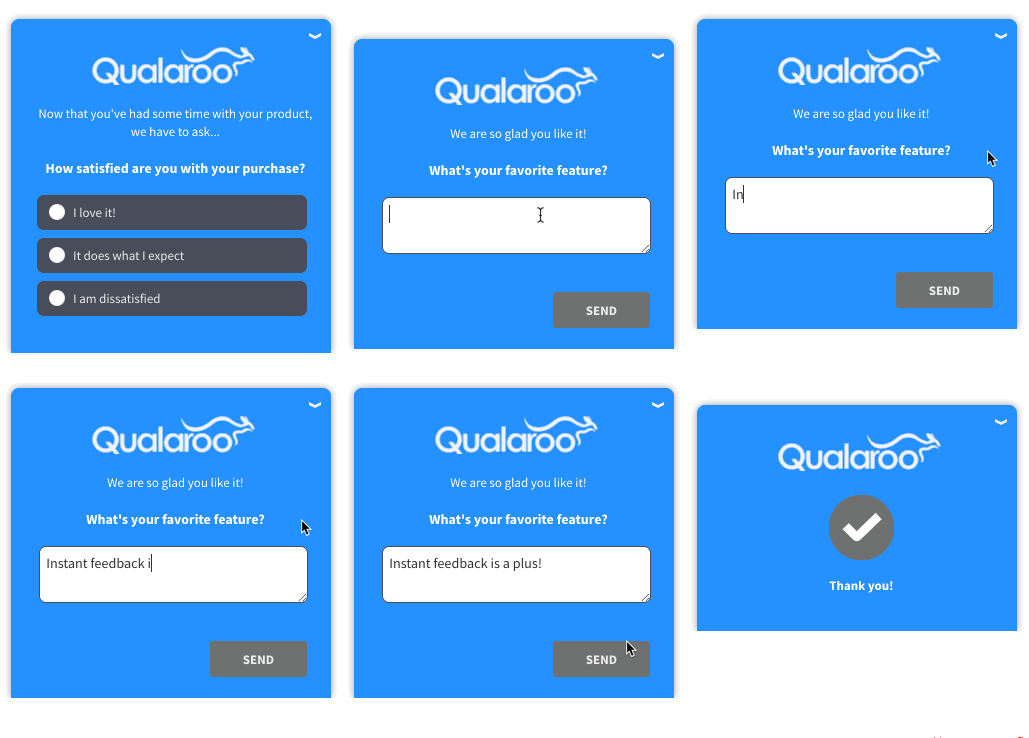
2. Use the Identity API Call to differentiate between Known and Unknown Users
Are you seeking to understand why certain visitors do not sign up before leaving your site? Use the Identify API call to target a survey to visitors who aren’t already logged in, but narrow further before you ask.
Bounces after 3 seconds on your homepage is different from someone who spends several minutes on your pricing page or adds. Not every anonymous visitor has purchase intent. Someone who bounced after three seconds on your homepage is a different case than someone who spent several minutes on your pricing page or added something to a cart.
Layer a behavioral condition, time on site, pages viewed, or an exit-intent trigger, on top of the logged-out status so you’re reaching people who actually had a reason to convert, not just anyone who happened to visit.
For this narrower group, you can focus your questioning on why they didn’t make a purchase.
You might learn that the steps to sign up aren’t intuitive, or that your homepage does not provide enough information to warrant a sign-up. Conversely, you can target more specific and in-depth questions to signed-in users who have had more experience with your website. You can ask these users if a specific product page has enough information, or gauge if they are a promoter, passive, or detractor with an unobtrusive NPS survey.
With Qualaroo’s Identify API, you don’t have to ask unnecessary questions to the wrong audience.
Think about who your customers are, and how you can communicate with them to create a more meaningful interaction.
Not All Segments Are Equally Useful
Known versus unknown is a starting point, not the whole strategy. The segments that actually improve your feedback quality are the ones tied to a specific behavior or lifecycle stage, not just a binary status.
A few examples worth layering in beyond logged-in state:
- Recency: Someone who purchased yesterday has a different, fresher perspective than someone who purchased six months ago. Segment by time since the action, not just whether the action happened.
- Depth of Engagement: A visitor who viewed one page answers a different question than one who viewed ten. Match the specificity of your question to the amount of experience they actually have to draw on.
- Repeat Versus First-Time Status: A returning customer can speak to consistency and whether their experience improved or declined. A first-time visitor can only speak to their first impression.
- Where They Are in a Journey: Someone mid-checkout has a different, more time-sensitive concern than someone browsing a blog post.
The test for any segment: does it change the actual question you’d ask? If a “high value” segment and a “new visitor” segment would get the same survey question, the segmentation isn’t doing anything yet.
Personalization Runs on Data, So Handle It Accordingly
Every tactic in this piece, custom properties, the Identity API, purchase history, and recency tracking, depends on collecting and storing behavioral and identity data. That’s worth being upfront about.
Disclose in your privacy policy what you’re tracking and why, and get consent where regulations like GDPR or CCPA apply, particularly once you’re linking survey responses to an identified user rather than an anonymous session.
Set a retention policy for how long you keep purchase history and behavioral properties tied to an individual, and limit who on your team can access identified response data.
None of this has to slow your targeting down. It does mean treating “we know this visitor bought three days ago” as something you’re responsible for handling carefully, not just a targeting convenience.
Personalization works because it signals that you’re asking about something specific to the person, not broadcasting the same question to everyone. That only holds up if the segment behind the message is meaningful, and if you’re handling the data behind it responsibly.
Get those two things right, and a more specific, better-timed question will consistently outperform a generic one.
FREE. All Features. FOREVER!
Try our Forever FREE account with all premium features!

 We'd love your feedback!
What did you like & how can we make it even better?
 Thanks for your feedback!
 Ask Your Question
Have a question? Get expert help to make your decision easier.