
Medallia alternatives are usually the second search, not the first. A team picks an enterprise customer experience platform because it promises everything, and then the contract, the rollout, and the first quarter of configuration arrive.
By the time the dashboards are live, the question has changed from what the platform can do to what it takes to keep it running.
The signals are consistent. Capterra tells buyers to contact Medallia for pricing; the platform is described as enterprise-grade with a months-long implementation, and the Capterra listing sits on only 33 reviews. That is a lot of commitment on limited public evidence.
So I compared ten tools against those specific frustrations, Qualaroo among them. I checked how quickly a team can launch a first survey, how far the analysis goes, and how much of the price shows up before anyone books a demo.
My shortcut: write down the three Medallia features your team uses every month, since the shortlist usually centers on them.
Why Are Teams Looking for Medallia Alternatives?
Medallia is a serious enterprise platform, and I am not suggesting otherwise. These are the spots where it’s listing, its reputation, and the switching I see around me point some teams elsewhere. Each one is a question of fit: price, time to go live, and the share of the platform a program actually uses.
Enterprise Pricing Sits Behind a Sales Call
Capterra’s pricing details for Medallia say to contact the company, so there is no number to check before a conversation. One transaction data tracker estimates the average contract at nearly $64,000 per year, though that is an estimate, and your quote will differ. Several tools in this list offer comparable survey and CX features for roughly half the price. Paying enterprise rates for a program that mostly runs surveys is the most common reason I see for looking around.
Implementation Is Long and Complicated
Medallia is described as an enterprise-grade platform with a months-long rollout, and that matches the complaint about a complicated implementation. Teams often need consultants or a dedicated owner before a single survey goes live. Every integration and workflow adds to the project. A program that needs answers this quarter cannot wait for a rollout that finishes next year.
Advanced Analytics and Sampling Fall Short
Limitations in advanced analytics are a recurring complaint, as is the need for advanced sampling to occur outside the system. If you need to cut results by segment or draw a sample precisely, working around the platform defeats the purpose of paying for it. Teams that run frequent surveys feel this most. I would rather analyze inside the tool than export and rebuild.
Integrations and Survey Tooling Feel Thin
Poor integration capabilities often come up, along with a lack of specialized survey tools. Medallia is built around the experience program, not around the survey itself, so building and targeting a short survey can feel indirect. Some key touchpoints in the customer’s journey end up uncovered, too. A 4.5 across 33 Capterra reviews says it is liked, so this is a fair question, not a verdict on quality.
The Top 10 Medallia Alternatives
Every contender is shown here with its entry price and Capterra rating, and my notes come next. Open the ones that resemble your real program first, because some are enterprise suites and others are much lighter.
| Tool | Best For | Starting Price | Capterra Rating |
| Qualaroo | Capturing Real-Time User Insights In-App & on Your Website Using Contextual, AI-Powered Micro-Surveys | Free plan; from $19.99/mo | 4.7/5 |
| Qualtrics (XM for CX) | Enterprise experience management and in-depth analytics | Quote-only | 4.6/5 |
| InMoment | Voice of the customer and experience orchestration | Quote-only | 4.4/5 |
| SurveyMonkey | Comprehensive online surveys and feedback collection | $30/mo per user | 4.6/5 |
| AskNicely | NPS feedback and closed-loop follow-up | Quote-only | 4.6/5 |
| Birdeye | Reviews, surveys, and customer feedback in one place | Quote-only | 4.7/5 |
| Zonka Feedback | Omnichannel CX with native AI feedback intelligence | Quote-only | 4.8/5 |
| Survicate | Multichannel surveys with a centralized research hub | Free plan; from $114/mo | 4.6/5 |
| Sogolytics | Detailed reports, cross-tabs, and panel services | Quote-only | 4.7/5 |
| Alchemer | Flexible survey logic and workflow automation | Quote-only | 4.5/5 |
1. Qualaroo: Best for Capturing Real-Time User Insights In-App & on Your Website Using Contextual, AI-Powered Micro-Surveys
Medallia alternatives that hand me an answer in days, not after a rollout, are what I look for, and Qualaroo is the tool I trust for it. Built-in templates and the AI Survey Creator, which drafts a survey from a prompt, get a first Nudge™ live in minutes, with no consultant involved.
It gathers the voice of the customer across websites, mobile apps, email, SaaS products, and prototypes, with more than a dozen question types including NPS, CSAT, and CES. Branching and skip logic remove irrelevant questions, and targeting reaches the right people, down to a named individual through the Identify API.
Written feedback is read by AI Customer Feedback Analysis and AI Sentiment Analysis, sorted by Automated Tagging, boiled down by the AI Response Summarizer, and custom reports plus integrations pass the findings along. That is the specialized survey tooling I missed in a platform built around programs.
Pros
- AI Survey Creator drafts a full Nudge from a prompt, no manual setup required
- Question branching and skip logic so respondents only see relevant follow-ups
- Native AI Customer Feedback Analysis, including AI Sentiment Analysis and word cloud generation for open-text responses
- Heatmaps and Session Recordings show what a user was doing right before they responded
- Advanced targeting by behavior, URL, exit intent, and custom user properties
- Identify API ties responses back to a real user by email or customer ID
- Nudge for Prototype works on Figma, Adobe XD, and InVision before a product ships
- Multilingual surveys in 100+ languages
- iOS and Android SDK for native in-app surveys
- Salesforce, HubSpot, and Slack integrations for CRM-connected feedback workflows
Cons
- A dedicated account manager and hands-on onboarding come with the paid plans, and the free tier does not include them
- Qualaroo is delivered only as a hosted service, which rules out downloadable or on-premise installs and any use without internet
How Qualaroo Compares to Medallia: Medallia runs an enterprise-wide experience program, with a lengthy rollout and a quoted price. Qualaroo is narrower: an in-context survey and feedback tool that can be live within minutes on a free plan, with no review management or enterprise program tooling.
Pricing: Free plan available, up to 50 responses with all premium features. Essentials at $19.99/month, Business at $49.99/month, and Enterprise from $149.99/month.
User Rating: 4.7/5 (Capterra)
Lalamove, a logistics company operating across many cities, uses Qualaroo surveys to learn which product features satisfy customers and which acquisition channels perform best. The company reports growth rates of 20 to 30 percent across 110 cities, which it ties to those insights.

2. Qualtrics (XM for CX): Best for Teams Whose Complaint Is Analytics
Qualtrics is where I would look if analytics were the reason you were leaving Medallia. Its iQ engine applies text analytics, predictive analytics, and sentiment analysis to every data point, and behavior analytics help spot trends in customer experience before they show up in churn.
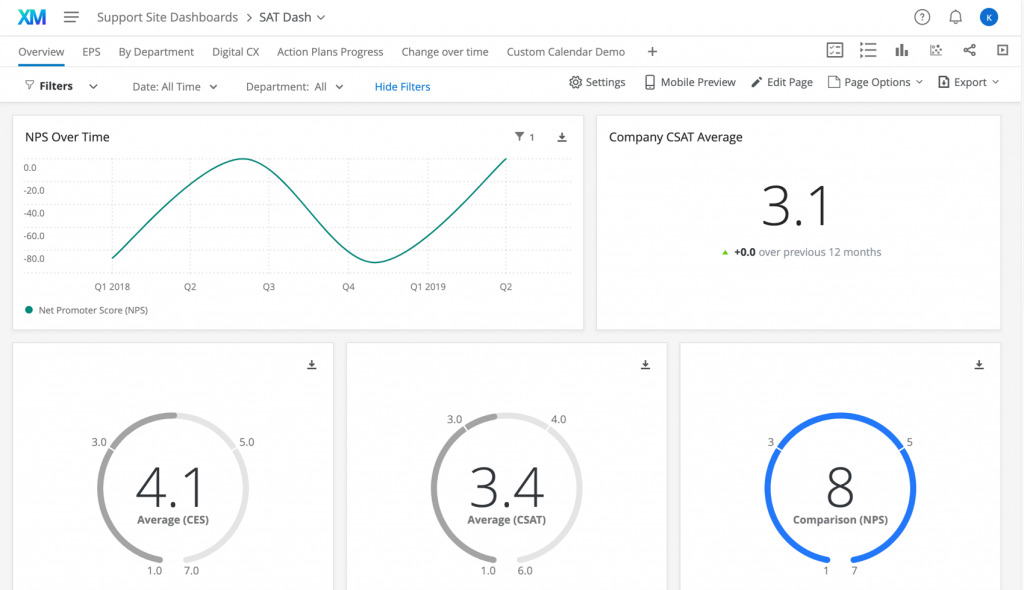
More than 100 question types and templates cover almost any survey, and feedback arrives from the web, mobile apps, SMS, email, and QR codes. Survey pop-ups, inline feedback buttons, and sidebar forms collect quick insights and key driver analysis points that shape the experience, such as quality, usability, and price.
Custom charts and crosstabs keep the analysis flexible, and Salesforce and Adobe connections tie it into the stack. The catches are that responses do not automatically attach to a thread, the interface could be more intuitive, and the price is a quote, so it keeps much of Medallia’s weight, and you should budget for onboarding, too.
Pros
- Text, predictive, and sentiment analysis from the iQ engine
- More than 100 question types and templates
- Custom charts and crosstab support
- Key-driver analysis for experience quality
Cons
- Responses do not automatically attach to a thread
- The interface could be more intuitive
How Qualtrics Compares to Medallia: Qualtrics places greater emphasis on analytics and survey depth, with a similar enterprise pricing and rollout.
Pricing: Quote-only, contact vendor for pricing.
User Rating: 4.6/5 (Capterra)
3. InMoment: Best for Voice of Customer and Experience Orchestration
InMoment is the closest peer to Medallia and brings the same enterprise ambition. It works across three clouds, Customer Experience, Employee Experience, and Market Experience, to give a complete picture of an audience, with a leadership board, employee communication, and modeling on top.
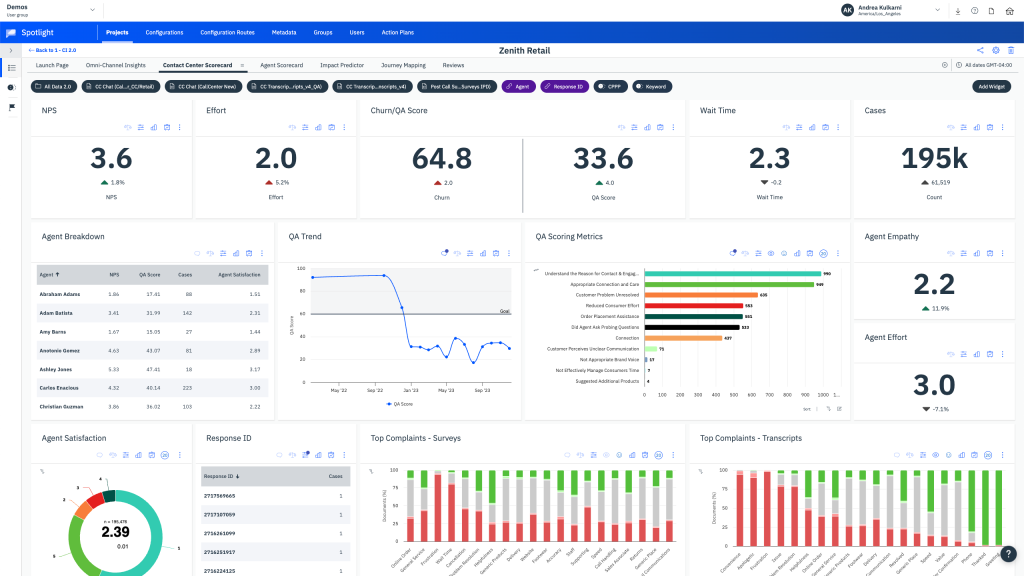
Customer journey mapping supports retention, case management, and action planning; captures individual and collective feedback; and, alongside self-serve NPS, CSAT, CES, and micro surveys, checks the pulse. Feedback comes from websites, mobile apps, SMS, and email, and industry-specific text and sentiment analysis gives it meaning.
Field-level reporting and predictive analytics support problem-solving, but tags require easier tracing, and script configuration is complex. Capterra classifies its pricing as per feature, with no public figure, and the 4.4 comes from just 28 reviews, which makes it a comparable gamble on thin evidence.
Pros
- Customer, employee, and market experience clouds
- Journey mapping with case management and action planning
- Field-level reporting and predictive analytics
- Industry-specific text and sentiment analysis
Cons
- Tags need easier tracing
- Script configuration is complex
How InMoment Compares to Medallia: InMoment offers a comparable enterprise scope, similar quote-based pricing, and a thinner public review base.
Pricing: Quote-only, contact vendor for pricing.
User Rating: 4.4/5 (Capterra)
4. SurveyMonkey: Best for Comprehensive Online Surveys and Feedback Collection
SurveyMonkey is the fast, familiar route for teams whose Medallia use is mostly surveys. It gathers customer feedback in real time, runs 360-degree employee feedback and market research, and lets you design and customize forms without writing code.
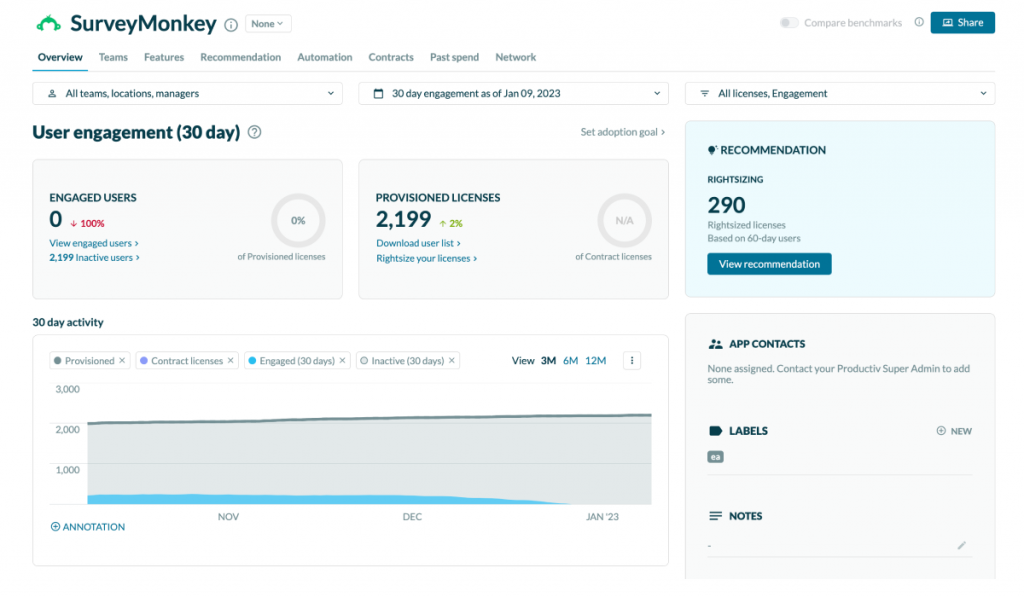
The Survey Audience feature lets you pick respondents from its own panel or from partner panels. More than 1,600 professionally built questions speed up writing, and drag-and-drop editing, branching, and skip logic keep surveys short. Embedding surveys in emails raises response rates.
Word clouds and sentiment analysis show the mood of an audience, results export easily, and multi-channel surveys reach people where they are. Integration options are limited, and customization has little room for it, so it is simpler than Medallia but less deep. Entry pricing is $30 per user per month.
Pros
- A global respondent panel through Survey Audience
- More than 1,600 professionally built questions
- Word cloud and sentiment analysis
- Easy exporting
Cons
- Limited integration options
- Not much room for customization
How SurveyMonkey Compares to Medallia: Compared to Medallia, SurveyMonkey launches faster, costs far less to get started, and has a much larger review base, while giving up program-level depth.
Pricing: Paid plans start at $30/user/month.
User Rating: 4.6/5 (Capterra)
5. AskNicely: Best for NPS Feedback and Closed-Loop Follow-Up
AskNicely measures customer satisfaction with real-time NPS and surveys that automatically trigger after customers receive a service. Feedback arrives by email, SMS, and web, with response rates that service teams value.
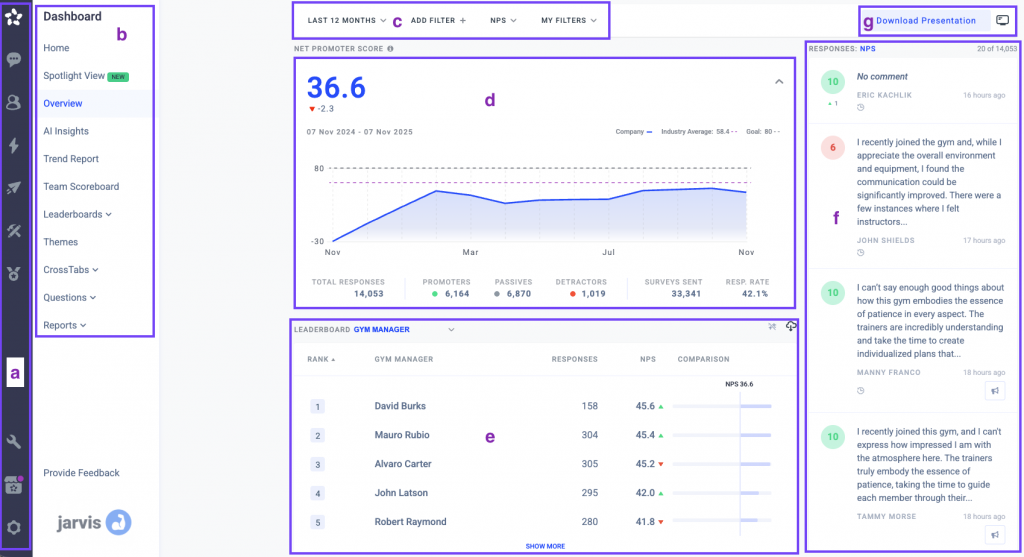
Email notifications flag feedback that needs immediate action, built-in case management lets staff reply to or escalate a customer, and daily sentiment diagnostics show how an audience is feeling. Key growth metrics appear on dashboards that visualize the overall experience.
Entry is the $449-a-month Learn plan on an annual billing cycle, with the price rising alongside response volume. Expect a dated interface, in-app and mobile delivery on higher tiers, and a strong lean toward NPS, which makes it a good match for a focused follow-up program and a poor one for broad research.
Pros
- Real-time NPS with automatic survey triggers
- Built-in case management
- Daily sentiment diagnostics
- Email notifications for immediate action
Cons
- A dated interface
- Leans heavily on NPS
How AskNicely Compares to Medallia: AskNicely gives up Medallia’s enterprise breadth in exchange for a narrower, easier start and a published entry price.
Pricing: Quote-only, contact vendor for pricing.
User Rating: 4.6/5 (Capterra)
6. Birdeye: Best for Reviews, Surveys, and Customer Feedback in One Place
Birdeye covers the review aspect of the customer experience, which Medallia treats as one module among many. It is an all-in-one platform for managing listings across hundreds of platforms, collecting reviews, sending interactive surveys, and running referral and loyalty programs.
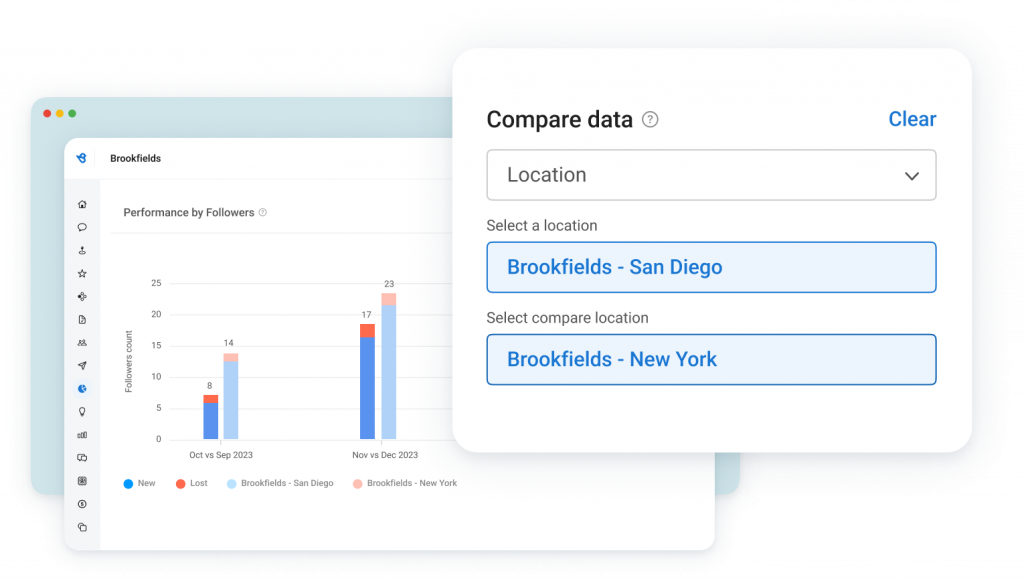
Reviews and data land in a unified dashboard; a centralized inbox handles replies; and review invites prompt customers to post on your behalf. A live chat widget and alerts for new reviews keep the team responsive.
Capterra rates it 4.7 on 701 reviews, one of the larger bases here, and pricing is quote-based. Social listening could be stronger; more API integrations would help. It is a marketing platform first, so it fits location and reputation programs better than deep survey research or enterprise analytics.
Pros
- Listing and review management across platforms
- A unified dashboard and centralized inbox
- Review invites and new-review alerts
- Referral and loyalty programs
Cons
- Social listening could be stronger
- Needs more integration APIs
How Birdeye Compares to Medallia: Birdeye covers reviews and reputation on a smaller scale, with a larger review base but far less survey and analytics depth.
Pricing: Quote-only, contact vendor for pricing.
User Rating: 4.7/5 (Capterra)
7. Zonka Feedback: Best for Reach With Less Sprawl
Zonka Feedback suits teams that want Medallia’s channel coverage in a smaller package. Customers can be reached by email, SMS, tablets, kiosks, web pages, or offline devices, and an alert goes out as soon as someone responds unhappily.
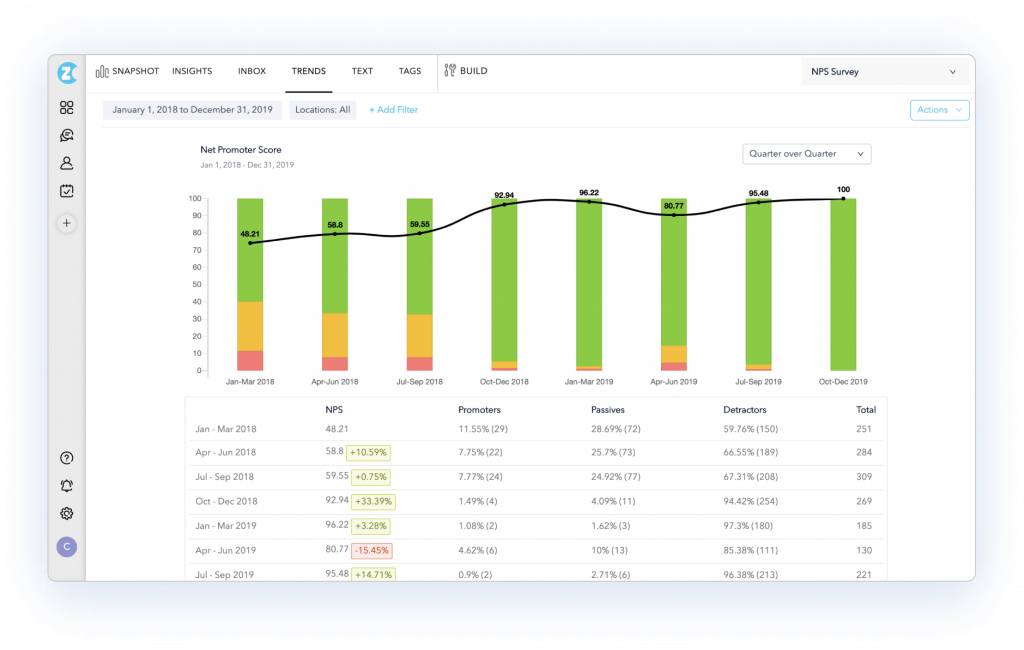
Its AI Feedback Intelligence looks through comments for recurring themes, mood, and trends, closed-loop workflows hand negative feedback to a named owner, and regional hosting answers data-residency rules.
There is no public price, only a quote, and Capterra’s 4.8 comes from 68 reviews, a small sample for a rating that high. It is lighter than Medallia but still more than a team running a few surveys needs, so I would keep it for a genuine experience program.
Pros
- Email, SMS, kiosk, tablet, and offline delivery
- Instant alerts for unhappy customers
- AI analysis of themes, mood, and trends
- Negative feedback routed to a named owner
Cons
- Pricing arrives only through a quote
- Heavier than a few surveys require
How Zonka Feedback Compares to Medallia: Zonka offers similar omnichannel reach and closed-loop action in a lighter package, with its own quote-based pricing.
Pricing: Quote-only, contact vendor for pricing.
User Rating: 4.8/5 (Capterra)
8. Survicate: Best for Surveys Across the Product and Site Without a Project Plan
Survicate helps teams collect product and website answers without writing a project plan. Place a survey on a page, inside the app, in an email, or behind a link, and every reply lands in one Research Hub.
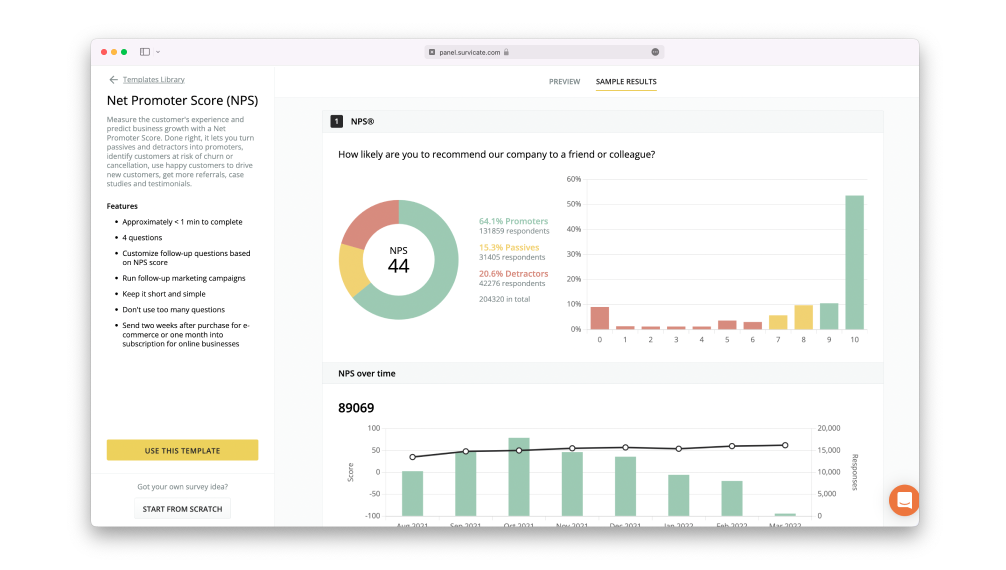
Rules built on user attributes and product events decide who is asked, unfinished surveys still save their answers, and AI-assisted analysis clusters comments by theme, with NPS, CSAT, and CES formats ready.
A free plan covers 25 responses a month, and paid plans begin at $114, so a pilot is cheap. The step up between tiers is visible, and with no journey mapping or case management, it fits programs about asking questions more than running an experience operation.
Pros
- All channels feed one Research Hub
- Event-based targeting inside the product
- AI-assisted theme grouping
- A permanent free plan
Cons
- A visible step between free and paid
- No journey mapping or case management
How Survicate Compares to Medallia: Survicate is much lighter, with posted prices and a free plan, and none of Medallia’s enterprise program tools.
Pricing: Free plan available, up to 25 responses a month. Paid plans start at $114/month.
User Rating: 4.6/5 (Capterra)
9. Sogolytics: Best for Detailed Reports, Cross-Tabs, and Panel Services
Sogolytics, once known as SoGoSurvey, goes straight at the analytics complaint. Custom, segmentation, pivot table, and comparison reports mean that slicing results by group stays within the tool.
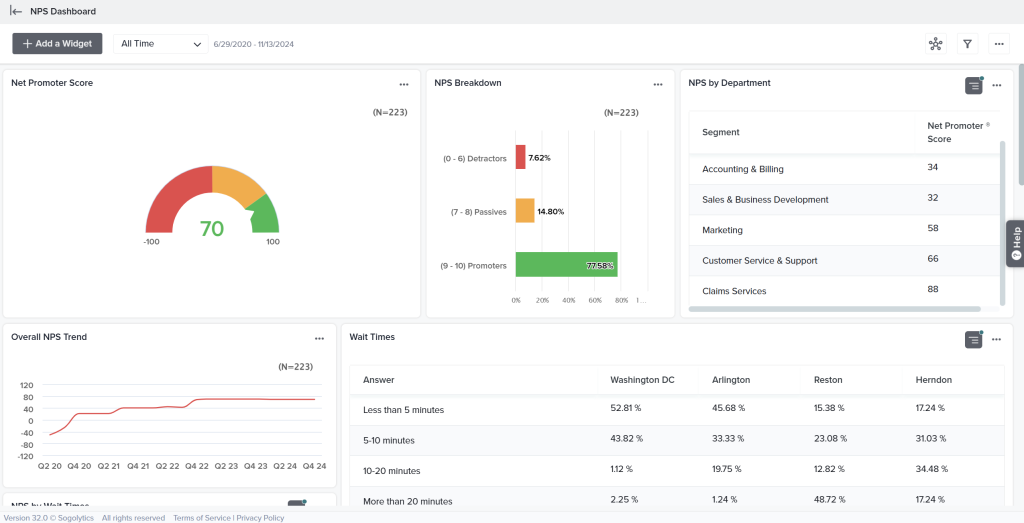
Its panel service helps hit the sample size you need, which speaks to the sampling gap, and scheduled campaigns nudge people who have not finished. Distribution covers the web, email, SMS, links, social media, and offline channels, and SPSS is among the export formats.
The Association for Utah Community Health, whose developers had been building its surveys on the side, rated Sogolytics well ahead of the competition for reporting, advanced question types, and easy customization. Styling options are limited, internal comments on responses would help, and pricing is quote-only, so the budget conversation comes first.
Pros
- Segmentation and pivot-table reports for slicing results
- Panel services to reach a target sample
- Automatic reminders for unfinished surveys
- SPSS is among the export formats
Cons
- Styling options are limited
- Responses cannot carry internal comments
How Sogolytics Compares to Medallia: Sogolytics offers deeper survey reporting and panels at a smaller scale, with quote-based pricing and fewer experience-program features.
Pricing: Quote-only, contact vendor for pricing.
User Rating: 4.7/5 (Capterra)
10. Alchemer: Best for Flexible Survey Logic and Workflow Automation
Alchemer fits teams whose Medallia frustration is how little they can bend a survey. Many question types and advanced logic are standard, and Alchemer Workflow turns a low score into a ticket, an email, or a record update.
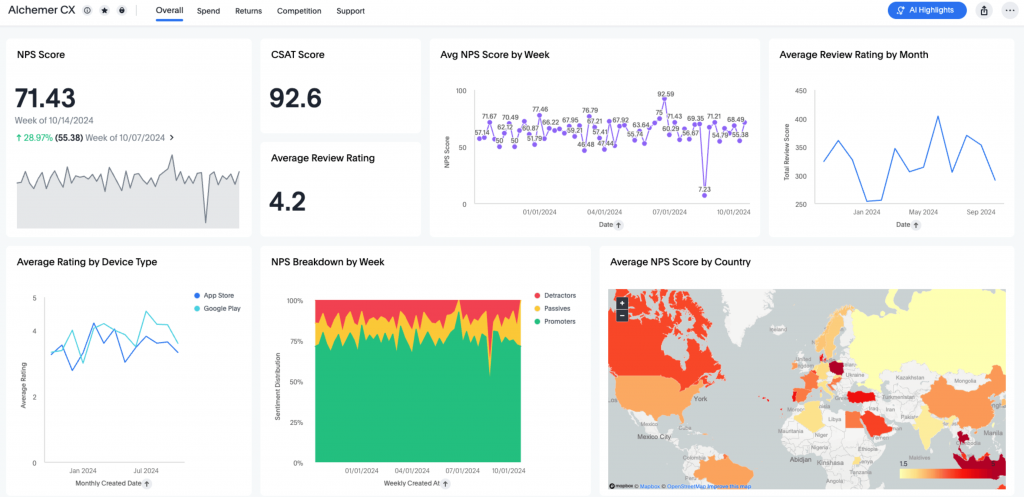
No developer is needed to set it up, responses carry no separate charge, and surveys can be multilingual and multimedia, with branching, skip logic, and in-app mobile surveys. Reports download in several formats, and BI, Webhook, and Salesforce connections handle integration.
New users can wander through the sub-menus for a while, customization is limited, and pricing is quote-only, so the number arrives in a conversation. Capterra gives it a 4.5 across 319 reviews, a sturdier base than the thin samples behind some larger platforms here, which makes it easier to judge.
Pros
- A deep set of question types and advanced logic
- Workflow automation that acts on survey answers
- No separate charge per response
- BI, Webhook, and Salesforce connections
Cons
- The sub-menus can bewilder new users
- Customization is limited
How Alchemer Compares to Medallia: Alchemer is far more flexible on survey logic and automation, with a much smaller scope than Medallia’s experience cloud.
Pricing: Quote-only, contact vendor for pricing.
User Rating: 4.5/5 (Capterra)
Which Medallia Alternative Should Be Your Top Pick?
Short on time? I would start with one of these three, depending on why you are leaving Medallia.
1. Qualaroo: Best for Contextual Insights Without a Long Rollout
Qualaroo is my first pick when speed and focus matter more than program breadth. Templates and the AI Survey Creator get a first Nudge live in minutes, with no consultant in sight, and surveys reach websites, mobile apps, email, SaaS products, and prototypes.
One account runs NPS, CSAT, CES, and exit-intent surveys, while branching and skip logic strip out irrelevant questions, and advanced targeting finds the right people, even a single named person through the Identify API. Open-text replies are scored for sentiment, tagged by theme, and condensed into summaries, and custom reports with integrations carry the findings onward.
Exit-intent surveys also explain why visitors leave. Every premium feature is on the free plan, so I tested the full product long before any contract came up. Lalamove’s growth across 110 cities shows how far steady, in-context listening can take a team.
2. Qualtrics: Best if Analytics Was Your Reason for Leaving
Qualtrics is the choice when you still want enterprise-grade analysis, and your complaint is what Medallia could do with the data. Its iQ engine brings text, predictive, and sentiment analysis to every data point, behavior analytics reveal customer experience trends early, and key-driver analysis shows what shapes quality, usability, and price.
More than 100 question types and templates cover nearly any survey, and answers arrive from the web, mobile apps, SMS, email, and QR codes. Count the costs: responses do not automatically attach to a thread, the interface could be more intuitive, and the price is a quote.
If your organization needs this depth, the trade-offs are acceptable because the analytics are hard to match elsewhere here. Plan for onboarding time, because the breadth that makes it powerful also makes it slower to master. Its cross-channel collection also keeps every touchpoint in one view.
3. SurveyMonkey: Best for Fast, Familiar Surveys
SurveyMonkey is the easy yes for teams whose Medallia use is mostly surveys. It collects customer feedback in real time, handles 360-degree employee feedback and market research, and builds forms without a line of code.
Survey Audience lets you pick respondents from its panel or partner panels, more than 1,600 professionally built questions speed up writing, and branching with skip logic keeps surveys short. Word clouds and sentiment analysis show an audience’s mood, and exports are simple. Know the limits: integration options are limited, customization has little room, and it lacks Medallia’s program-level depth.
When answers are needed this week, that simplicity is the whole point, and the large review base means most rough edges are already documented. It also helps non-specialists contribute, which a heavy enterprise platform rarely does. A pilot takes an afternoon, so the risk of trying it is close to zero.
How Did I Evaluate These Medallia Alternatives?
I evaluated the Medallia alternatives in this list based on what a CX team needs once an enterprise platform is more than the job requires: a setup that does not take months, analysis that does not leave the tool, and a price I can see. I put all ten through one shared set of six checks and flagged anything resting on a small sample or a quote. Having worked with enterprise experience platforms, I gave the most weight to time to launch and visibility of price.
Six factors carried the weight:
User Reviews and Ratings
Medallia’s Capterra page rests on only 33 reviews, and I read every small sample the same careful way, whether it is Medallia’s, InMoment’s 28, or Zonka’s 68. On Capterra, I look at the count before the score. Thousands of reviews say more about life in year two than a perfect rating from a handful.
Essential Features and Functionality
My starting point is the three complaints that send teams away from Medallia: analytics that stop short, sampling done outside the system, and survey tooling that is not specialized. Can the tool segment results, draw a sample internally, and build a targeted survey with no service engagement? Failing any of those meant it had to earn its place another way.
Ease of Use
I measure ease of use in time to the first live survey. Medallia’s rollout runs long, so I expected every alternative to deliver something useful in days, and I asked whether a new colleague could build and edit surveys without a specialist, since that is what keeps a program running.
Customer Support
A drawn-out rollout makes support part of the product, so I asked who gets real help during setup, whether entry plans include onboarding, and whether quote-based vendors fold implementation into the price or bill it as services. Help that shows up only after a six-figure contract earned little credit.
Value for Money
Because Medallia’s price is tied to a sales call, I priced each alternative based on what a real program would use, accounting for seats, response volume, and implementation. A posted price or a free plan beats a number that appears after a demo, and I noted every tool that offers comparable survey and CX features for far less than the cost of an enterprise contract.
Personal Experience and Experts’ Opinions
Entries for tools I have used say so; for the rest, I rely on published customer stories and on findings that recur across independent write-ups, after checking each vendor for shutdowns and acquisitions, since an enterprise platform that changes hands can change its terms overnight.
FREE. All Features. FOREVER!
Try our Forever FREE account with all premium features!
How Do You Choose the Right Medallia Alternative for Your Team?
Choose the row closest to your biggest Medallia headache. If a row lists several tools, each solves it differently, so skim my notes first.
| If My Main Medallia Frustration Is… | Consider This Alternative |
| Enterprise pricing sits behind a sales call | Qualaroo, SurveyMonkey, Survicate, or AskNicely |
| Implementation takes too long | Qualaroo, SurveyMonkey, Survicate, or AskNicely |
| Advanced analytics and sampling fall short | Qualtrics, Sogolytics, or InMoment |
| I need specialized survey tools | Qualaroo, SurveyMonkey, or Alchemer |
| Journey touchpoints are missing | Qualaroo, Zonka Feedback, or Birdeye |
| Integrations feel thin | Qualaroo, Qualtrics, or Alchemer |
Choosing Between a Platform and a Program
An enterprise experience platform is a big commitment, and the right time to question it is when the contract size no longer matches the program’s size. The warning signs are familiar: a rollout that outlasts the quarter, analysis that needs exports to finish, and a price nobody outside the sales team has seen.
Start by listing what your team actually does with the platform each month, then ask every vendor to price only that, in writing, including implementation and training. Take your two leading candidates through one live survey and time everything from first idea to launch. Whichever makes that exercise uneventful is usually the right answer.
In my own work, what paid off most was one well-timed question put to someone while they were using the product, with the analysis done for me. Qualaroo is built on that idea, and its free plan lets you test it on a real survey at no cost.
Frequently Asked Questions
What is Medallia?
Medallia Experience Cloud is an enterprise SaaS platform that pairs customer and employee experience data with machine learning to improve engagement in real time. It gathers direct and indirect feedback, detects patterns and predicts behavior through detailed dashboards, and connects with CRM, ERP, and HCM tools. Capterra tells buyers to contact the company for pricing details.
How much does Medallia cost?
Medallia does not publish a price list, and Capterra's pricing details say to contact the company. One tracker of transaction data estimates the average contract near $64,000 a year, though your quote will depend on modules, seats, and implementation. Ask for a written quote that itemizes every module and any services, and treat estimates as rough guides.
Why look for Medallia alternatives?
Teams usually cite a long, complicated implementation, limits in advanced analytics, sampling that has to happen outside the system, thin integrations, and survey tooling that is not specialized. Price matters too, since several tools offer comparable survey and CX features for far less. If those points match your experience, a lighter alternative may fit better.
What is the cheapest Medallia alternative?
The lowest-cost way in is Qualaroo, with a free plan and paid tiers from $19.99 a month. SurveyMonkey follows at $30 per user, then Survicate at $114 and AskNicely at $449, while Birdeye, Zonka Feedback, Qualtrics, InMoment, Sogolytics, and Alchemer quote. Free tiers make the quickest test, and posted prices are easier to budget.
Which alternative is closest to Medallia?
InMoment and Qualtrics are the closest on enterprise scope, with experience management, journey tools, and advanced analytics, though both are quote-based and carry real setup effort. Zonka Feedback is a lighter option with similar reach and closed-loop action. Choose by implementation time and pricing visibility, since those were the main complaints.
Can Qualaroo replace Medallia?
Yes, for in-context feedback and everyday survey programs: Qualaroo covers websites, apps, and prototypes with AI analysis built in from the free plan, and a first survey can be live in minutes. Medallia's enterprise program breadth and review tools are not included, so teams that rely on them should look at Qualtrics, InMoment, or Birdeye.
Which alternatives analyze open-text feedback?
From the free plan upward, Qualaroo scores sentiment, tags themes, builds Word Clouds, and summarizes replies. Qualtrics applies text, predictive, and sentiment analysis, InMoment industry-specific text analysis, Zonka Feedback its AI Feedback Intelligence, and SurveyMonkey word clouds and sentiment. Capability varies by plan, so run all of them on one identical batch of real replies.
What should I check before switching from Medallia?
Begin by exporting your survey data and listing the modules your team really uses, including any sampling you do outside the system. Have each vendor price those modules in writing, implementation and training included, and time how long a first survey takes before you pilot your top two on a real campaign.
FREE. All Features. FOREVER!
Try our Forever FREE account with all premium features!

 We'd love your feedback!
What did you like & how can we make it even better?
 Thanks for your feedback!
 Ask Your Question
Have a question? Get expert help to make your decision easier.