

Take a page out of biology’s book. Positive and negative feedback loops are the silent mechanisms that grow ecosystems and organisms, and they can grow businesses too.
Whether it’s learning how to skyrocket your site traffic or make sure that your customer acquisition doesn’t outpace your hiring process, you can take these biological principles and apply them to your business.
You’re probably already applying them without even knowing it. These feedback loops sometimes occur naturally in business, but once you know how to identify them, you can capitalize on them. You can use surveys as a growth engine by using them to power your feedback loops.
One caveat up front. A survey doesn’t create a feedback loop by itself. It surfaces a signal. Turning that signal into growth, or into stability, takes experimentation, someone who owns the follow-through, and a way to check the result against real behavior, not just what people say they’ll do.
Positive Feedback Loops Give You Exponential Growth
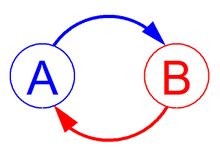
A positive feedback loop happens when growth begets more growth.
[source]
A lot of positive feedback loops are found in nature, but one of the best examples is blood clotting. When a platelet clings to the site of an injury, it releases chemicals that attract more platelets. The platelets come together to make a scab and stop your body from bleeding. It’s the snowball effect.

[source]
This doesn’t happen naturally in nature—it also happens in businesses. For example, when your blog traffic grows, that growth causes more growth. Especially with evergreen content—content that doesn’t lose its relevance over time—the more your new visitors view your blog and backlink to it, the higher it will rank on search results. The higher it ranks on search results, the more people will view it over time.
Improving your SEO is a perfect example of a positive feedback loop in business—the more progress you make, the more progress will happen naturally. But even though positive feedback loops happen naturally, you can use surveys to initiate and accelerate them.
Use Surveys to Power Your Progress
Surveys can power the engine of your positive feedback loop. While growing your blog via positive feedback loop happens naturally, surveys can act as an accelerator. Ask your customers if they find your blog helpful. If they don’t, it’s time for you to change your strategy, but if they do, ask them what they’re interested in seeing next.
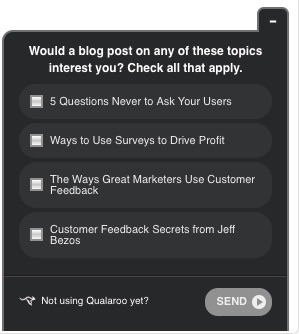
By tailoring your blog content to what your visitors say they want, you reduce guesswork, but self-reported preference isn’t the same as proven demand.
Check what people say against what they actually click, read to the end, and convert on. If the two line up, you’ve found a real growth lever. If they don’t, trust the behavior over the survey.
You’re not chancing a hit or miss. You can cater to what your visitors will read next to drive the engine behind your blog’s growth.
This process works the same way for other parts of your business, too. For example, if you want to know what’s driving your conversions, you can use surveys to discover why and accelerate a feedback loop.
If your customers were attracted to your product because you’re the cheapest high-quality analytics tool on the market, you can accelerate your feedback loop by placing reminders of your pricing all over your site.
How to Turn a Survey Into a Positive Loop
A survey response is a hypothesis, not a result. Here’s the sequence that actually compounds:
- Ask a specific question at the moment it matters. On a blog post, that’s “Was this useful?” followed by “What should we cover next?” On a pricing page, that’s “What almost stopped you from buying?”
- Prioritize themes, not single comments. Ten people asking for the same thing is a signal. One request is an anecdote.
- Test the change on a small segment before rolling it out everywhere.
- Measure the metric the loop is supposed to move: traffic growth, conversion rate, repeat visits, not just survey sentiment.
- Only scale what the data confirms. GraphicSprings took this approach with Qualaroo, using survey and behavioral data together to find UX friction points, and saw a 41% increase in revenue after fixing them.
Skip any of these steps and you’re not running a feedback loop. You’re collecting opinions.
Negative Feedback Loops Prevent Crash and Burn
A negative feedback loop is a regulatory system. It keeps ecosystems and organisms (and businesses) stable. But instead of change producing more change, like in a positive feedback loop, one kind of change produces the opposite kind of change.
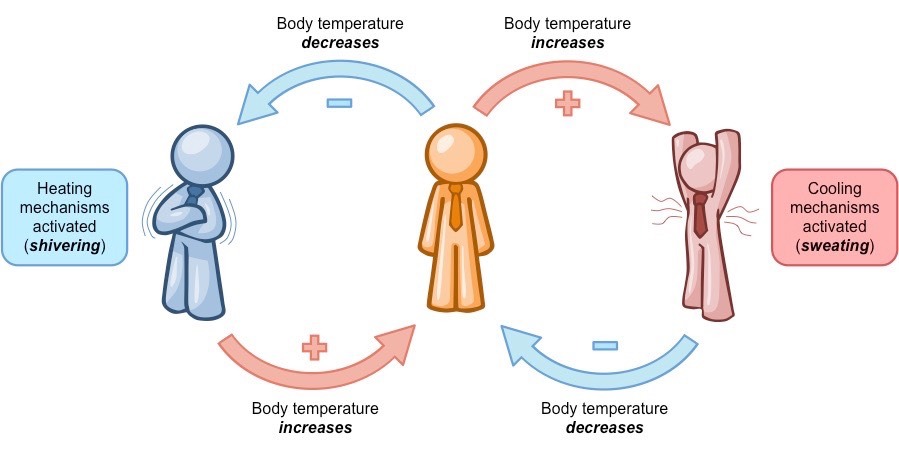
[source]
Think of a negative feedback loop like the human body’s temperature regulation system. When your body heats up, you sweat to cool down. When your body gets cold, you shiver to produce heat.
While some elements of your business benefit from positive feedback loops, the wrong kind of growth can tank your business. If you grow your customer base before hiring enough employees to accommodate them, your customers will churn because they’re not getting the proper attention.
Webvan, the first online grocery platform, had the opposite problem—they grew their infrastructure without first growing their customer base. They bought trucks and groceries for the delivery process, but grocery profits are contingent on the customers buying right away, otherwise the product perishes. Webvan went bankrupt because they grew their platform without growing their customers—the groceries they bought kept going bad.

[source]
To make sure you’re growing your business the right way, you need checks and balances—you need a negative feedback loop. Surveys are one way of creating that regulatory system.
Use surveys for checks and balances
Negative feedback loops don’t happen naturally in business the way that positive feedback loops do. While nature has regulatory systems to keep things from getting out of control, you have to put those checks and balances in place for your business.
For example, if your customer base grows but they aren’t customers who will stick around, you’ll lose money. Your customers will churn after a little while if your product doesn’t cater exactly to their needs, and because of the subscription model, you’ll be in the red.
But you can use surveys to make sure that your growth is the good kind of growth—that you’re acquiring customers who need your product for the long haul.
Stabilizing Growth Takes More Than a Survey
A survey can tell you where the pressure is building. It can’t fix capacity on its own. Pair it with:
- Capacity planning: Match hiring, onboarding, and infrastructure timelines to the growth your survey data predicts, not the growth you hope for.
- Churn analysis: Layer survey feedback with actual cancellation data. If sentiment is high but churn is climbing, the survey is missing something.
- Customer segmentation: Split responses by plan tier, tenure, or usage before acting. A risk for your smallest accounts isn’t necessarily one for your largest.
- Service quality monitoring: Track support response times and satisfaction scores alongside survey results, so you catch quality slipping before customers say so.
- Operational governance: Assign someone to own each risk signal. A survey that flags a problem and goes nowhere isn’t a negative feedback loop, it’s a report nobody read.
Belron takes this layered approach, pairing sentiment analysis with ongoing service tracking to hold a high NPS score even while scaling.

Watch Your Data Quality Before You Trust the Loop
Neither loop works if the data feeding it is skewed. Before you act on results, check:
- Sample Size and Representativeness: A dozen responses from your most engaged users isn’t a signal, it’s an anecdote. Compare who responded against your total audience by segment, tier, or channel.
- Response Bias: The people who answer surveys are rarely a random slice of your users. Frustrated users vent, delighted users evangelize, and the quiet majority often stays silent.
- Survey Fatigue and Frequency: Asking too often or asking the same users repeatedly lowers response rates and skews who actually responds.
- Small or Skewed Groups: Don’t greenlight a change for your whole base off a pilot of 20 responses from one segment. Validate at a larger, more representative scale first.
Make the Loop Actually Close
Most feedback loops break after collection, not during it. A response sits in a spreadsheet, nobody owns it, nothing changes. Closing the loop means:
- Connect survey data to product analytics, so you’re validating stated preference against behavior, not guessing.
- Use AI-assisted theme analysis for open-text responses. At volume, reading every comment manually doesn’t scale.
- Run the change as an experiment, not a rollout. Ship it to a subset, measure against a control, then expand.
- Close the loop with respondents. Tell people what changed because of their input. It costs little and lifts response rates next time.
- Measure the outcome, not the activity. “We made a change” isn’t success. “The change moved retention by X.”
Surveys as a Growth Engine: From Signal to System
Positive and negative feedback loops are the silent mechanisms that drive nature, and the same logic applies to business, with one difference. In biology, the loop runs on its own. In business, someone has to run it.
Surveys give you the signal: what to try next, and where the pressure is building. They don’t create the loop by themselves. That takes prioritizing what you heard, testing it on a real segment, checking the result against behavioral data, and assigning someone to own the follow-through.
Get that operating rhythm right, and surveys stop being a one-off check-in. They become the input that keeps your growth compounding and your operations stable at the same time.
FREE. All Features. FOREVER!
Try our Forever FREE account with all premium features!

 We'd love your feedback!
What did you like & how can we make it even better?
 Thanks for your feedback!
 Ask Your Question
Have a question? Get expert help to make your decision easier.