
Choosing a lead generation tool sounds like a 20-minute decision. It rarely is.
I’ve spent time inside more tools than I’d like to admit, building on-site capture workflows, exit-intent programs, and CRM-connected lead qualification flows.
I’ve also reviewed practitioner discussions on Reddit, Quora, and Capterra to understand where real users feel frustrated, not just where vendors claim differentiation.
Here is what I kept running into: most teams invest heavily in traffic acquisition but have almost no visibility into why visitors don’t convert once they arrive. They have ad dashboards, CRM pipelines, and email tools.
What they don’t have is a system connecting behavioral intent signals to lead capture to a qualified pipeline.
And the tools they do have are often passive: a form sitting on a page waiting to be filled, rather than something that triggers at the moment a visitor is most likely to convert or most likely to leave.
In this guide, I cover the 11 best lead generation tools, what each does best at each funnel stage, which use cases and roles they serve, and how to build a connected system that turns traffic into qualified leads.
What Are Lead Generation Tools?
A lead generation software is a platform that helps businesses attract, identify, capture, qualify, and nurture potential customers across digital channels. They range from on-site behavioral capture tools and form builders to CRM platforms, email automation systems, advertising platforms, and AI-driven prospecting tools.
No single tool covers the entire funnel. The strongest lead generation systems connect tools across five stages: traffic acquisition, on-site capture, qualification, nurturing, and CRM conversion. The tools below are evaluated with that system in mind.
The 11 Best Lead Generation Tools
Before the deep dives, here is a quick-reference comparison table so you can spot your fit at a glance.
| Tool | Best For | Capterra Rating | Free Plan | Starting Price |
|---|---|---|---|---|
| Qualaroo | In-App Surveys, NPS, User Feedback & Exit-intent surveys | 4.7/5 | Yes, forever | $19.99/month |
| ProProfs Survey Maker | Scored lead qualification surveys | 4.8/5 | Yes, forever | $19.99/month |
| Knock AI | Formless inbound conversion and meeting booking | Not yet rated | No | $2,000/month |
| Typeform | High-completion lead gen forms | 4.7/5 | Yes | $28/month |
| Jotform | Lead forms with payments and e-signatures | 4.7/5 | Yes | $34/month |
| HubSpot | All-in-one lead management and CRM | 4.5/5 | Yes | $45/month |
| Salesforce | Enterprise pipeline and lead routing | 4.4/5 | No | $25/user/month |
| LinkedIn Sales Navigator | B2B prospecting and social selling | 4.6/5 | Yes | $119.99/month |
| Apollo.io | Outbound prospecting and sequencing | 4.5/5 | Yes | $49/seat/month |
| Google Ads | High-intent search-based lead capture | 4.4/5 | Yes | Pay-per-click |
| Mailchimp | Email-based lead nurturing | 4.5/5 | Yes | $13/month |
1. Qualaroo: Best for Capturing Real-Time User Insights In-App & on Your Website Using Contextual, AI-Powered Micro-Surveys
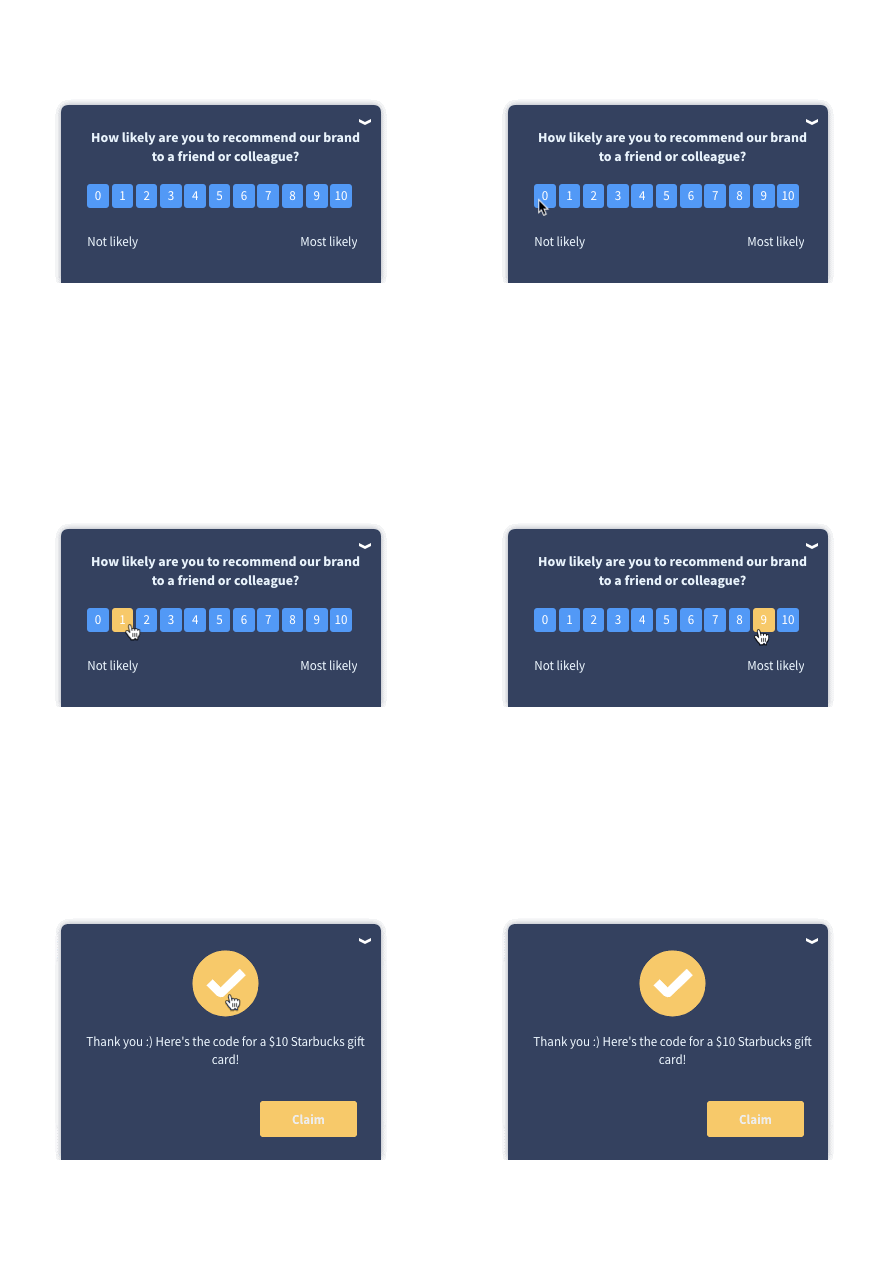
I’ve used Qualaroo extensively for on-site lead capture and behavioral targeting, and it is the tool I reach for when the question is not “how do we get more form fills?” but “why are visitors leaving without converting, and how do we catch them at that exact moment?”
Most lead capture tools are passive: a form sits on a page and waits. Qualaroo’s Nudge™ triggers during the session itself, based on real-time behavioral signals: exit intent, scroll depth, time on page, URL, or custom variables.
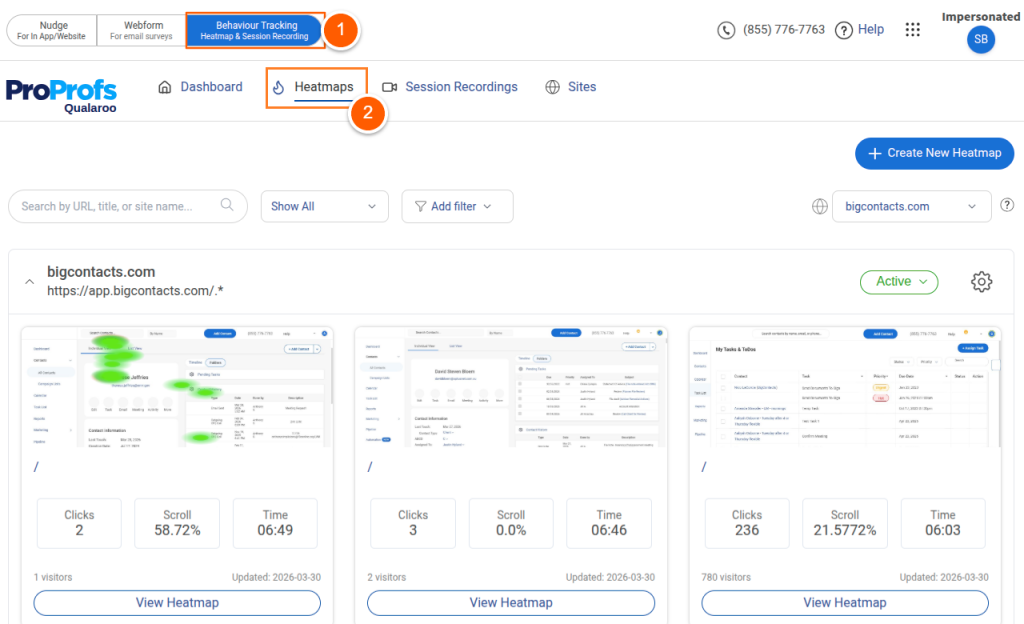
For growth and CRO teams, the combination of Heatmaps, Session Recordings, and native AI Sentiment Analysis means you are not just capturing leads, you are understanding the behavioral context around every conversion or drop-off.
The Identify API ties every response to a real user by email or customer ID, so you can suppress requests for existing customers, target by plan type, or whitelist specific segments for research.
Best For: Exit-intent and behavioral lead capture, on-site CRO, in-app feedback, and conversion research.
Pros:
- Nudge™ surveys trigger at the moment of highest intent, not on page load
- AI Survey Creator builds a survey from a prompt, so there’s no starting from scratch
- Behavioral targeting by URL, scroll depth, time on page, cookies, and custom variables
- Native AI Feedback Analysis (Sentiment Analysis, Automated Tagging, AI Response Summarizer) for free-text responses at scale
- Heatmaps and Session Recordings for behavior-based placement decisions
- 100+ professional templates for lead capturing and in-context feedback
- Identity API links responses to real users by email or customer ID
- iOS and Android SDK for native in-app lead capture
- Prototype testing on Figma, InVision, Adobe XD, and Axure
- Native Salesforce, HubSpot, Slack, Intercom, and Zapier integrations
- 70+ languages supported
- Forever-free plan with all features included
Cons:
- Low-traffic sites take longer to reach statistical significance.
- Advanced targeting rule setup has a learning curve for first-time users.
Capterra Rating: 4.7/5
Pricing: Free forever. Paid plans start at $19.99/month. Enterprise from $149.99/month.
Hootsuite used Qualaroo to achieve a 16% conversion lift at 98% statistical significance.

2. ProProfs Survey Maker: Best for Scored Lead Qualification
I’ve used ProProfs Survey Maker specifically for lead qualification scored assessments, and it is the tool I reach for when the goal is filtering high-intent prospects from low-intent contacts before anyone reaches a sales rep.
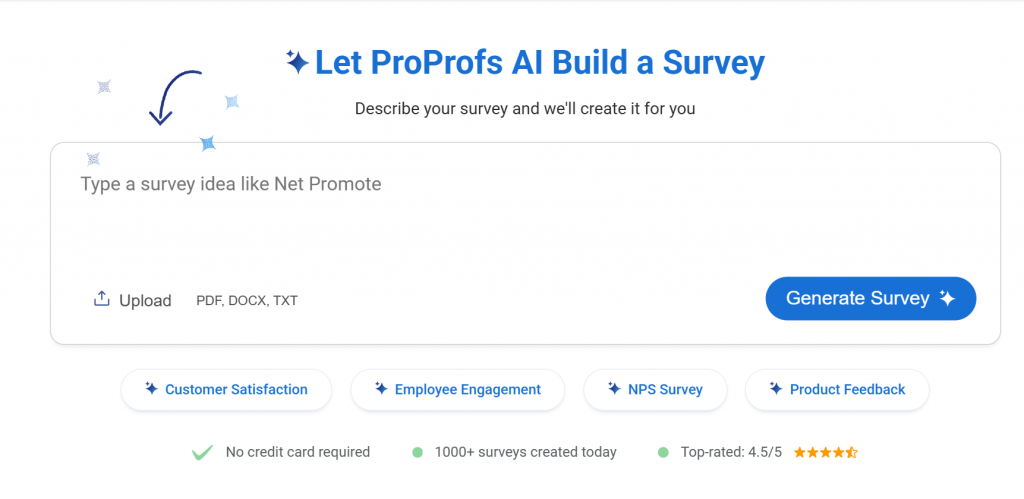
The AI builder is super handy. You give it a small prompt and ask it to create a survey for signups, and it hands you a polished, ready-to-go survey with branching logic in seconds.
The scored survey builder assigns point values to answers, buckets respondents by total score, and serves custom result pages with tailored CTAs based on where they land.
Best For: Scored lead qualification, gated content assessments, and NPS-based funnel research.
Pros:
- Scored surveys with custom result pages that qualify leads by response score
- AI Survey Maker builds a full survey from a plain-language prompt
- 20+ question types, 100+ templates, 1,000,000+ ready-to-use questions
- Skip logic and branching for personalized qualification paths
- Native Salesforce, HubSpot, Mailchimp, and Zendesk integrations
- White label option for agencies
- Forever-free plan with all premium features included
Cons:
- Response volume caps apply on the free plan.
- White-label branding requires a $300/year add-on.
Capterra Rating: 4.8/5
Pricing: Free forever (up to 50 responses). Essentials at $19.99/month per 100 responses.
3. Knock AI: Best for Converting Inbound Traffic Without Forms
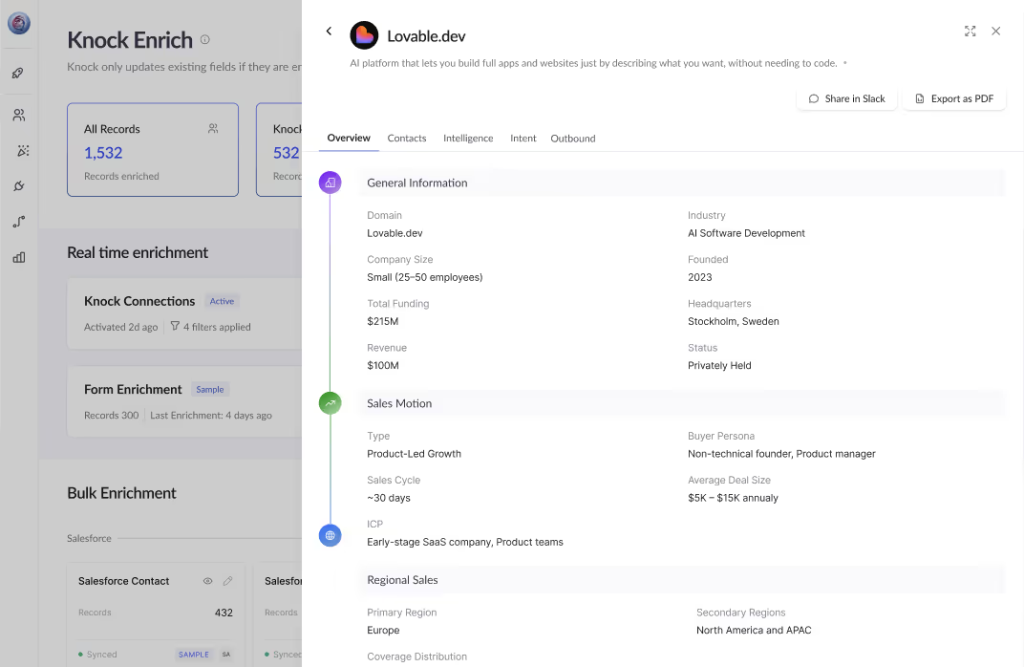
A demand gen lead I spoke to moved off her form-and-follow-up setup after realising most of her inbound never filled anything in. Knock AI identifies the visitor, qualifies them in conversation, instantly routes them, and books the meeting in under 5 seconds.
What separates Knock AI from website chat is what happens after the visitor leaves. The conversation continues in Slack, WhatsApp and LinkedIn, so buyers who did not convert on the first visit keep replying.
Best For: B2B teams with existing inbound volume losing pipeline to slow response or broken routing.
Pros:
- Identifies and enriches anonymous visitors before a form exists
- Routing and enrichment complete in under five seconds
- Conversations continue in Slack, WhatsApp and LinkedIn after the session ends
- Native Salesforce, HubSpot and Marketo integrations
Cons:
- No free plan or trial, and pricing starts at $2,000/month.
- Built for sites with existing inbound volume, not low-traffic sites.
Capterra Rating: Not yet rated
Pricing: From $2,000/month.
4. Typeform: Best for High-Completion Lead Gen Forms
A product marketer I know swore by Typeform for lead qualification flows because the one-question-at-a-time format consistently produced higher form completion rates than traditional multi-field lead capture pages.
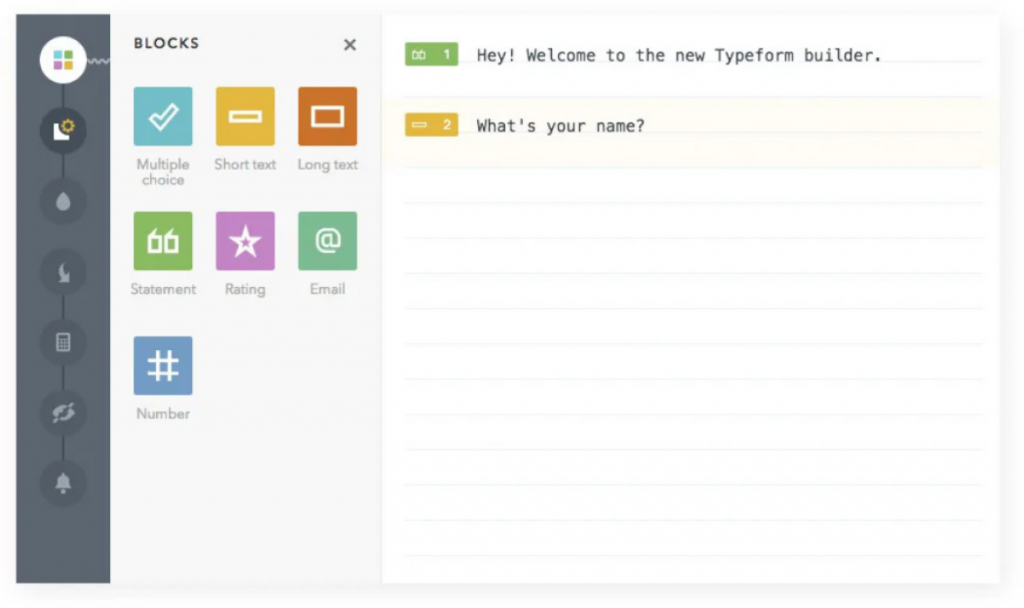
The design quality is genuinely distinctive. If your lead form is also a brand touchpoint, Typeform’s aesthetic is hard to match out of the box.
The free plan is very limited at 10 responses per month, but the paid tiers are where the HubSpot and Salesforce routing integrations that make it useful as a lead gen tool become accessible.
Best For: High-completion lead gen landing page forms and qualification flows.
Pros:
- One-question-at-a-time format reduces drop-off on lead forms
- Strong brand customization and design quality
- Native HubSpot, Salesforce, and Zapier integrations for CRM routing
- Conditional logic for personalized qualification paths
Cons:
- Free plan capped at 10 responses per month.
- No behavioral targeting or exit-intent triggers.
Capterra Rating: 4.7/5
Pricing: Free plan (10 responses/month). Paid plans start at $28/month.
5. Jotform: Best for Lead Forms With Payments and E-Signatures
A consultant in my network mentioned Jotform when she needed to collect signed client agreements, payment details, and lead intake data in a single flow.
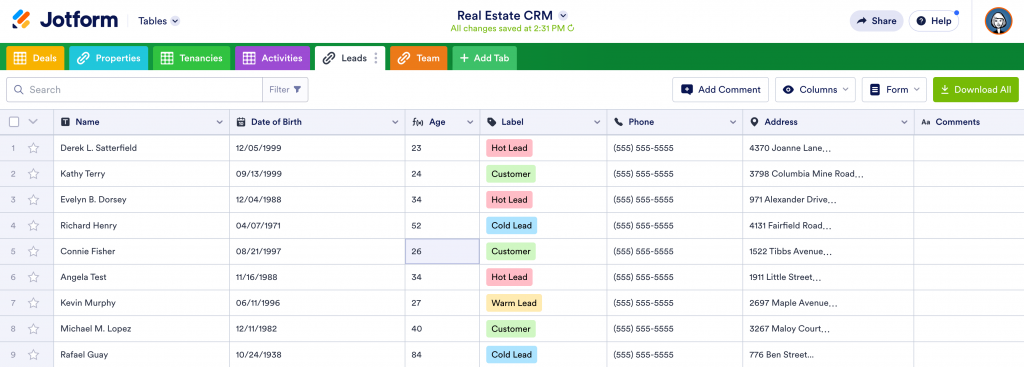
With survey templates, native payment gateways, PDF generation, and e-signature support, Jotform sits between a lead capture tool and a workflow automation platform.
It routes captured leads into downstream CRM tools but is stronger as a form builder than a dedicated behavioral capture or qualification system.
Best For: Multi-step lead intake, gated content forms, and payment collection alongside lead capture.
Pros:
- Professional templates with native payment integration and no transaction fees
- PDF generation and e-signature support
- Workflow automation routes leads to downstream CRM tools
- Strong mobile form experience
Cons:
- Free plan response and storage limits are restrictive.
- No behavioral targeting or exit-intent lead capture.
Capterra Rating: 4.7/5
Pricing: Free plan available. Paid plans start at $34/month.
6. HubSpot: Best for All-in-One Lead Management and CRM
HubSpot is the most commonly mentioned tool in every community discussion I’ve reviewed on this topic, and for good reason.
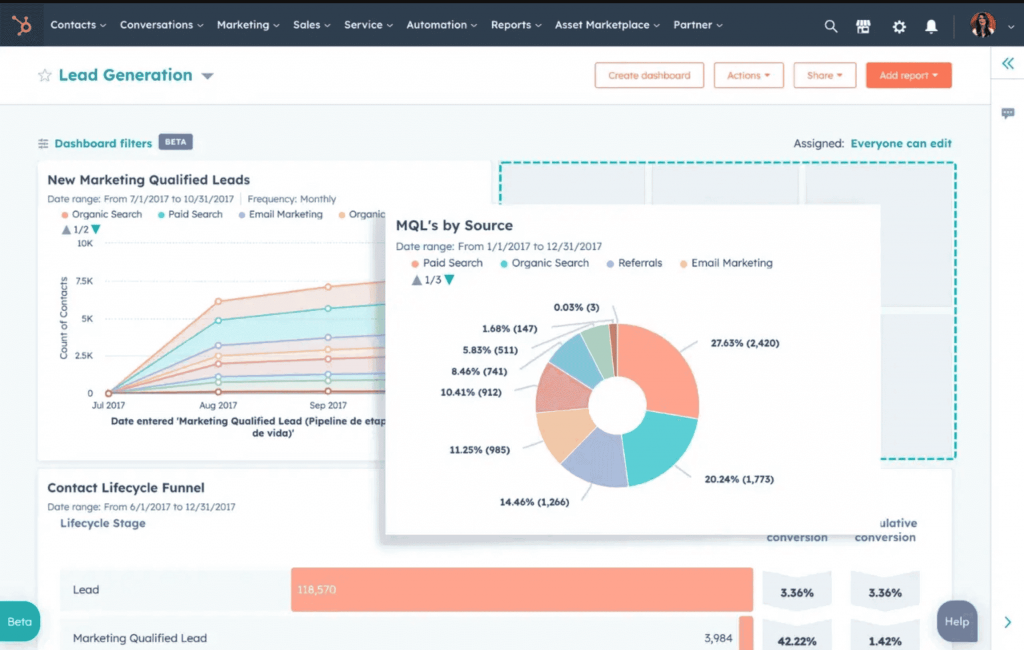
It is the closest thing to a complete lead generation system in a single platform: landing pages, forms, email sequences, lead scoring, pipeline management, and CRM, all connected without middleware.
The free CRM tier is genuinely usable, not a crippled demo. For teams that want one platform to handle capture, nurture, and pipeline without stitching together five separate tools, it is the most complete option at accessible pricing.
Best For: End-to-end lead management, email nurturing, landing pages, and CRM for SMB to mid-market teams.
Pros:
- All-in-one: landing pages, forms, email, CRM, and pipeline in one platform
- Free CRM tier with meaningful functionality
- Lead scoring and lifecycle stage automation
- Native integrations with most major marketing and sales tools
- Visual landing page and form builder
Cons:
- Paid seats become expensive quickly as team size grows.
- Enterprise features require a significant pricing jump from Starter tiers.
Capterra Rating: 4.5/5
Pricing: Free CRM available. Paid plans start at $45/month.
7. Salesforce: Best for Enterprise Pipeline and Lead Routing
Salesforce is the category standard for enterprise lead and pipeline management. Every B2B marketer I’ve spoken to who works at mid-market or above has a Salesforce integration somewhere in their stack.
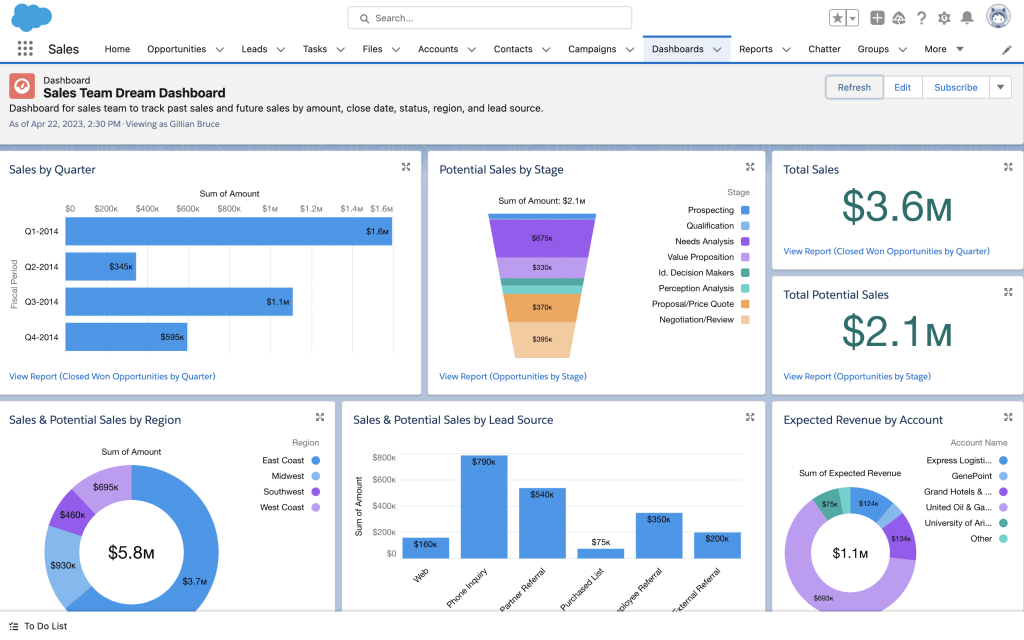
Its AI Einstein engine brings predictive lead scoring and automated workflow routing at a level few platforms match.
I heard about its lead routing capabilities specifically from a revenue operations manager who described rebuilding her entire MQL-to-SQL handoff process inside Salesforce and cutting average time-to-contact from 48 hours to under 2.
Best For: Enterprise lead routing, pipeline management, and AI-driven lead scoring.
Pros:
- Industry-leading CRM with deep customization for complex lead workflows
- AI Einstein for predictive lead scoring and pipeline forecasting
- Real-time dashboard and pipeline reporting
- Broad integration ecosystem across marketing and sales tools
Cons:
- Significant setup and ongoing admin investment required.
- The total cost of ownership, including add-ons, is substantial.
Capterra Rating: 4.4/5
Pricing: Starts at $25/user/month, billed annually. Free trial available.
8. LinkedIn Sales Navigator: Best for B2B Prospecting and Social Selling
LinkedIn Sales Navigator is the most frequently mentioned B2B lead generation software in discussions, and the data supports the reputation.
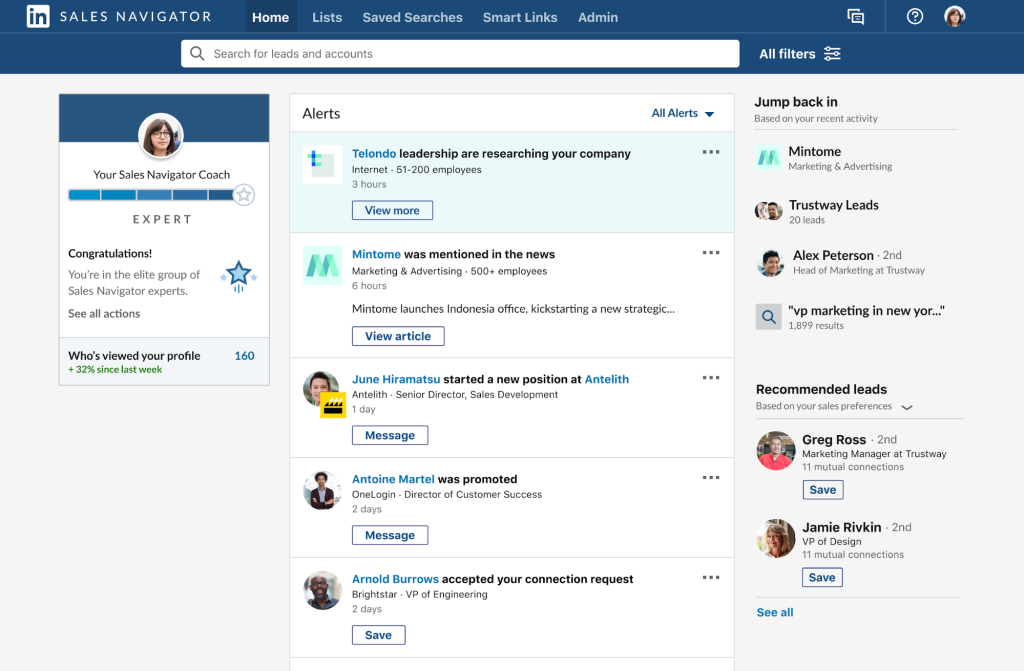
If your ICP is a named role at a named company type, Sales Navigator compresses prospecting from a manual multi-day effort into a targeted, scalable workflow.
I came across it first through a demand generation manager who rebuilt her entire outbound prospecting motion around Sales Navigator’s advanced filters and InMail, cutting prospecting time by more than half while increasing ICP match rate.
Best For: B2B pipeline prospecting, account-based outreach, and LinkedIn-based lead sourcing.
Pros:
- Advanced search filters by industry, seniority, company size, and geography
- Lead recommendations based on saved accounts and ICP criteria
- InMail access to any of LinkedIn’s 500M+ members, regardless of connection
- Direct CRM integration for lead saving and tagging
Cons:
- Only useful if your ICP is active on LinkedIn. Less relevant for B2C.
- Monthly cost adds up quickly for larger sales teams.
Capterra Rating: 4.6/5
Pricing: Starts at $119.99/month. Free trial available.
9. Apollo.io: Best for Outbound Prospecting and Sequencing
Apollo.io came to my attention through a sales development rep on a Reddit thread who described it as the tool that finally combined prospecting database, email sequencing, and CRM sync.
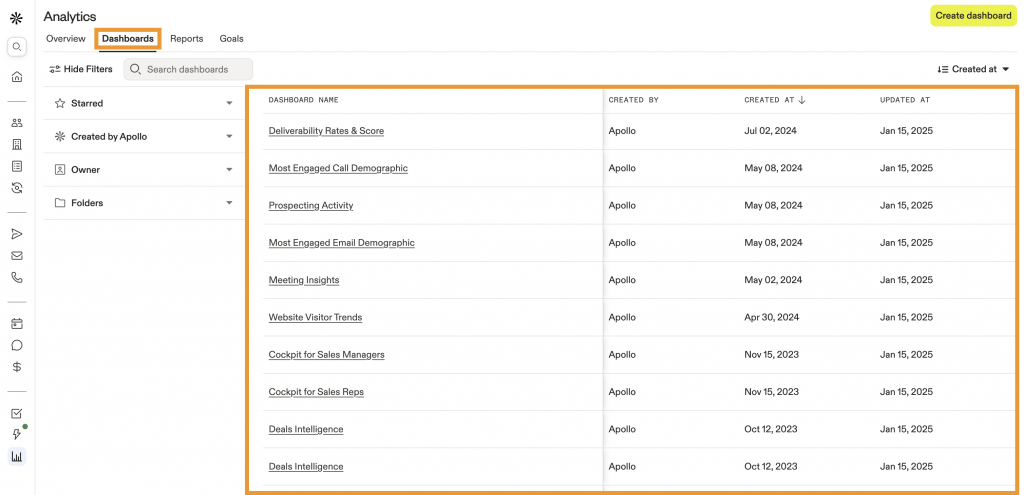
With a database of over 275 million contacts, built-in email sequencing, and lead scoring, Apollo handles the full outbound motion from list building to first reply.
The free plan is more generous than most outbound tools, which makes it accessible for early-stage teams.
Best For: Outbound lead prospecting, cold email sequencing, and sales development workflows.
Pros:
- 275M+ contact database with verified emails and direct dials
- Built-in email sequencing with A/B testing
- Lead scoring and intent data signals
- Native CRM syncs with Salesforce and HubSpot
- Generous free plan with meaningful prospecting access
Cons:
- Data accuracy varies by industry and region. Always verify before large sends.
- Sequencing depth is lighter than dedicated outbound tools like Outreach.
Capterra Rating: 4.5/5
Pricing: Free plan available. Paid plans start at $49/seat/month.
10. Google Ads: Best for High-Intent Search-Based Lead Capture
When a demand generation manager I know rebuilt her lead funnel from scratch, the first tool she turned on was Google Ads.
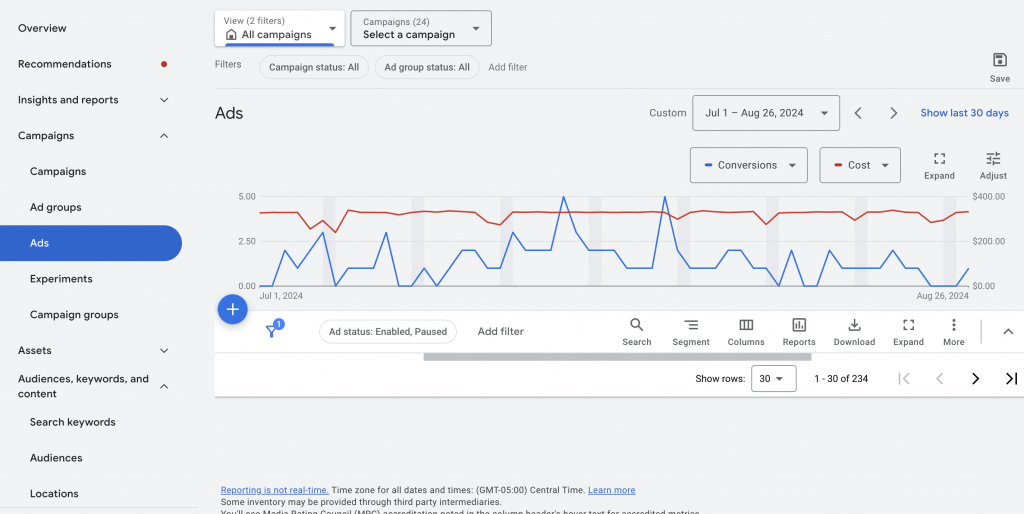
The intent signal from search is uniquely powerful: you are reaching people who are actively searching for a solution at that exact moment, not scrolling past an ad between posts.
For B2B and SaaS teams, search-based lead capture via Google Ads consistently produces a lower cost-per-lead than social at the bottom of the funnel, where purchase intent is highest.
Best For: Bottom-of-funnel lead capture from high-intent search queries.
Pros:
- Reaches prospects at peak purchase intent via search
- Granular targeting by keyword, location, device, and audience
- Measurable ROI at campaign and keyword level
- Lead form extensions capture leads directly within the ad
Cons:
- Competitive keywords can be expensive, especially in B2B SaaS categories.
- Requires ongoing management to avoid wasted spend on low-intent queries.
Capterra Rating: 4.4/5
Pricing: Pay-per-click. Budget set by advertiser.
11. Mailchimp: Best for Email-Based Lead Nurturing
Mailchimp is the tool I’d recommend to any team running its first structured lead nurturing program.
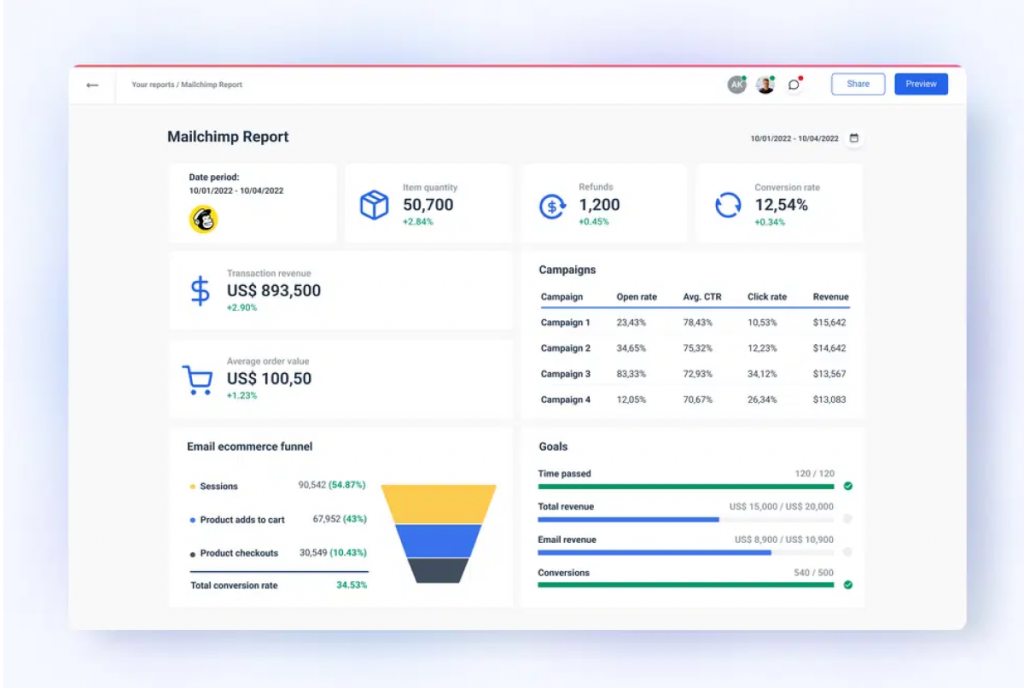
It’s free to start, the interface is genuinely intuitive, and the behavioral automation, which triggers email sequences based on user actions, closes the loop that most small teams leave open after initial capture.
Only 5% of leads are sales-ready at first capture (Forrester). Mailchimp handles the other 95% by keeping captured leads warm through automated drip sequences until they reach the right intent threshold.
Best For: Email-based lead nurturing, drip sequences, and audience segmentation for small to mid-size teams.
Pros:
- Free tier for getting started with up to 500 contacts
- Visual builder with pre-built email templates and drip sequence automation
- Behavioral triggers auto-send emails based on user actions
- Audience segmentation by behavior, demographics, and engagement
- Built-in CRM for contact management
Cons:
- Free tier response limits become restrictive quickly as the list size grows.
- Advanced segmentation and A/B testing require higher-tier plans.
Capterra Rating: 4.5/5
Pricing: Free up to 500 contacts. Paid plans start at $13/month.
My Top 3 Picks Among the Top Lead Generation Tools
Here is where I land after testing and reviewing. These three tools for lead generation cover the widest range of lead generation use cases at the best value-to-capability ratio.
Qualaroo
The tool I’d place first on any lead generation shortlist, where on-site conversion is the goal. Most lead capture tools wait for a visitor to fill out a form.
Qualaroo captures intent signals while the visitor is still engaged, which is why its customer outcomes consistently outperform passive form-based capture on conversion metrics.
If you have traffic and want to understand what is preventing visitors from converting, start here.
Apollo.io
For teams that need to build a pipeline from scratch through outbound, Apollo.io covers more of the prospecting motion in one place than any other tool on this list.
The 275M+ contact database, built-in sequencing, and direct HubSpot and Salesforce sync mean you go from ICP filter to first email to CRM contact without switching platforms.
Pair it with Qualaroo for inbound and HubSpot for pipeline and you have a full-funnel system.
HubSpot
For teams that want one platform covering capture, nurture, and pipeline without stitching together separate tools.
The free CRM tier is genuinely usable, the landing page and form builder work, and the email automation connects to the pipeline in a way that most standalone tools require middleware to replicate.
It is the most complete end-to-end lead generation system at an accessible pricing.
What Criteria Did I Use to Evaluate These Tools?
Every tool in this list was assessed against six criteria, weighted toward what practitioners report as decision factors in verified Capterra reviews and community discussions:
1. Lead-Capture Capabilities: Can the tool actively capture leads through behavioral triggers, forms, exit-intent, or conversational flows? Passive tools that only collect data when a visitor chooses to engage scored lower than tools with active, timed capture mechanisms.
2. Distribution and Channel Reach: Does it capture leads across web, email, in-app, SMS, and QR code? Tools that restrict distribution channels behind paid tiers without clear disclosure were flagged.
3. Integration Reliability: This is the top-rated decision factor in Capterra lead gen tool reviews. Native Salesforce, HubSpot, and Zapier integrations must route leads bidirectionally. A Zapier dependency for basic CRM sync is not the same as a native integration.
4. Qualification and Reporting Depth: Can the tool score, segment, or qualify leads at the point of capture? Can non-technical stakeholders read and act on the reports? Both matter for pipeline quality.
5. Pricing Transparency and Free Plan Value: Is the pricing honest? Are lead capture features accessible at the entry level, or gated behind enterprise tiers? Tools that gate core functionality without publishing pricing were rated lower.
6. Community-Verified Satisfaction: I cross-referenced Capterra verified reviews, Reddit practitioner discussions, and Quora threads to surface real frustrations. Recurring complaints about broken CRM syncs, low lead quality, and pricing surprises all factored in.
FREE. All Features. FOREVER!
Try our Forever FREE account with all premium features!
How Should You Choose a Lead Generation Tool?
The fastest way to pick the wrong tool is to start with the feature matrix. Start with your funnel stage and conversion gap instead.
1. Identify Where Leads Are Dropping Off: Is the problem traffic that doesn’t convert on-site? Leads captured but not qualified? Qualified leads that go cold before follow-up? Different stages need different tools.
2. Identify Where and How Your Leads Arrive: Website visitors need behavioral capture tools. Inbound form fills need qualification workflows. Outbound lists need CRM routing. The channel determines the tool.
3. Identify Where the Data Needs to Go: If captured leads need to route to Salesforce or trigger a HubSpot sequence, that integration must work natively and bidirectionally. A Zapier dependency for basic CRM sync introduces failure points.
4. Match to the Lead Generation Tools That Fit All Three: Use the comparison table above, then test your specific integration before committing.
Use-Case Segmentation Guide
Here is a quick map across the primary lead generation buyer types:
| Role / Use Case | Recommended Tool | Why |
|---|---|---|
| Marketer: On-site exit intent and conversion capture | Qualaroo | Behavioral triggers, Nudge™ technology, in-context timing |
| Product Team: In-app lead capture and intent signals | Qualaroo | iOS and Android SDK, behavioral targeting, session context |
| CX Team: Conversion optimization and UX research | Qualaroo | Heatmaps, Session Recordings, AI Sentiment Analysis, Identity API |
| Marketer: Lead qualification scored assessment | ProProfs Survey Maker | Scored surveys with custom result pages by respondent score |
| Agency: White-labeled lead gen assessments | ProProfs Survey Maker | White label add-on, scored surveys, multi-client management |
| Growth: End-to-end lead capture and nurture | HubSpot | Landing pages, forms, email automation, and CRM in one platform |
| Sales: B2B outbound prospecting | LinkedIn Sales Navigator | Advanced ICP filters, InMail access, direct CRM sync |
| SDR: Cold outbound and email sequencing | Apollo.io | 275M+ contact database, built-in sequencing, HubSpot sync |
| Marketer: High-completion lead gen landing page form | Typeform | Conversational format, brand-quality design, HubSpot integration |
| Growth: Bottom-of-funnel paid lead capture | Google Ads | High-intent search targeting, lead form extensions |
| Marketer: Lead nurturing and drip automation | Mailchimp | Behavioral email triggers, audience segmentation, free tier |
| Demand Gen: Inbound conversion without forms | Knock AI | Visitor identification, conversation, and bookings |
Which Lead Generation Tools Should You Start With?
The lead generation tools on this list cover every stage of the funnel, from the moment a visitor lands on your page to the moment a deal closes in your CRM.
But covering every stage is not the same as fixing every stage. The teams that see the fastest results are not the ones with the most tools.
They are the ones who identified exactly where leads were dropping off and fixed that one problem first.
If your traffic is not converting, the drop-off is happening on your site before anyone fills out a form. That is where Qualaroo starts.
Its Nudge™ triggers at the moment of highest intent, captures the lead or the signal, and routes it into your CRM before the visitor disappears.
Frequently Asked Questions
What features should a lead generation tool have?
At minimum: a capture mechanism triggered by intent or behavior, CRM integration that routes leads without manual handling, and reporting that tracks lead quality, not just volume. For advanced use cases, look for behavioral targeting, scored qualification, exit-intent triggers, and outbound sequencing. Qualaroo covers behavioral capture; ProProfs Survey Maker covers scored qualification; HubSpot covers end-to-end pipeline management.
What is the best free lead generation tool?
Qualaroo offers a forever-free plan with all features included for on-site behavioral lead capture and exit-intent programs. ProProfs Survey Maker offers a forever-free plan for scored lead qualification surveys. HubSpot's free CRM includes forms, landing pages, and pipeline management. Apollo.io's free plan includes prospecting access. Your choice depends on where in the funnel you need the most help.
How do I increase lead conversion rates on my website?
Behavioral timing is the highest-leverage variable. Qualaroo's Nudge™ triggers at the moment of highest intent, based on scroll depth, time on page, or exit signal, which consistently outperforms page-load forms on conversion rate. Beyond timing, routing captured leads to CRM within the first hour (where the 7x qualification advantage applies) and qualifying leads at the point of capture with a scored assessment are the next highest-impact changes.
What is the difference between inbound and outbound lead generation tools?
Inbound tools attract leads who find you: Qualaroo for on-site behavioral capture, ProProfs Survey Maker for qualification assessments, Typeform for landing page forms, Google Ads for search-intent capture, and Mailchimp for nurture. Outbound tools reach leads proactively: Apollo.io for prospecting and sequencing, LinkedIn Sales Navigator for B2B social selling, and Salesforce or HubSpot for pipeline routing. The strongest systems use both in coordination.
How do lead generation tools connect to CRM platforms?
The best tools connect natively: a lead captured in Qualaroo or ProProfs Survey Maker routes directly into a Salesforce contact or HubSpot deal without a manual export or Zapier step. Apollo.io syncs prospected contacts directly to HubSpot or Salesforce. Native integrations sync in near-real time, which matters because leads contacted within one hour of capture are 7x more likely to qualify (InsideSales Research). Always verify bidirectional sync before committing.
Which lead generation tool is best for SaaS teams?
Qualaroo is the strongest fit for SaaS teams because it captures behavioral signals from users already inside the product via iOS and Android SDK, and ties responses to real user accounts through the Identity API. For outbound pipeline building, Apollo.io's contact database and sequencing covers prospecting. For end-to-end funnel management from lead capture to closed deal, HubSpot connects all three stages without middleware.
FREE. All Features. FOREVER!
Try our Forever FREE account with all premium features!

 We'd love your feedback!
What did you like & how can we make it even better?
 Thanks for your feedback!
 Ask Your Question
Have a question? Get expert help to make your decision easier.