

“We all need people who will give us feedback. That’s how we improve,” Bill Gates once said wisely. In the realm of business, building a successful business isn’t just about sales figures and profit margins; it’s also about creating meaningful customer relationships. Each customer interaction is an incredible opportunity to learn and grow.
But how do you truly understand what your customers are thinking and feeling? NPS surveys are one useful tool for this, with an important caveat: NPS is primarily a CX and loyalty metric.
It measures how likely customers are to recommend you, and it does so well. What it does not do is replace broader market research methods such as segmentation studies, competitive analysis, concept testing, pricing research, or customer needs exploration.
Used alongside those methods, NPS adds a fast, repeatable loyalty signal. Used instead of them, it leaves significant gaps in your understanding of the market.
In this post, I will explain how to use NPS surveys in your market research, unlock the power of customer feedback, and create truly legendary experiences.
Perks of Using an NPS Survey for Market Research
There are many reasons why NPS surveys are crucial for market research. Some of them are as follows:
1. Simplicity and Efficiency
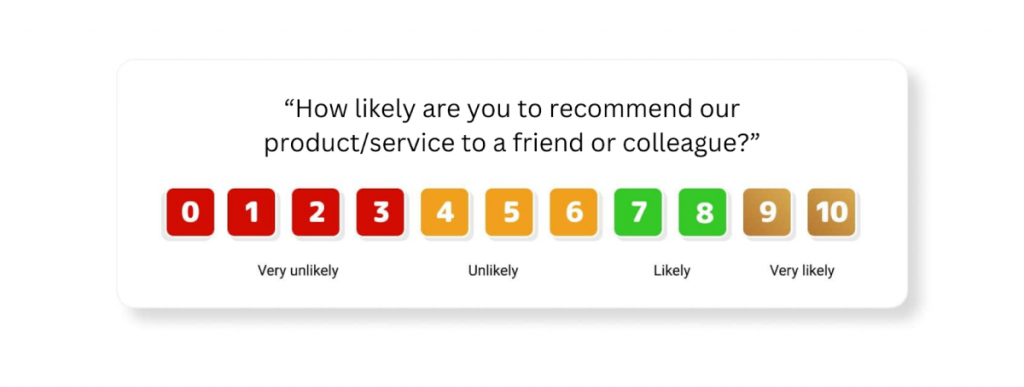
Easy to Understand and Implement: I believe that one of the greatest strengths of NPS surveys is their simplicity. They typically revolve around a straightforward question: “How likely are you to tell about us to a friend or colleague?” This concise format makes it easy for customers to provide feedback without feeling overwhelmed.
Quick to Deploy and Analyze: NPS surveys can be deployed quickly across various channels, such as email, websites, or mobile apps. This flexibility lets businesses reach customers where they are most active. Once collected, the data is straightforward to analyze, which offers a rapid snapshot of customer sentiment that can be understood at a glance.
2. Valuable and Actionable Insights
Identify Areas for Improvement: NPS surveys provide more than numerical scores; they offer qualitative feedback through optional open-ended questions. I find this feedback crucial because it reveals the reasons behind the scores. Understanding the “why” allows businesses to pinpoint areas that require enhancement, whether customer service, product quality, or overall experience.
Segment Your Customer Base: The NPS methodology categorizes customers into three distinct groups: Promoters (those who score 9-10), Passives (7-8), and Detractors (0-6). This segmentation is invaluable for understanding different customer perspectives. Promoters will likely spread positive word-of-mouth, while Detractors may risk the brand’s reputation. By identifying these segments, you can tailor their interventions and communications to meet the unique needs of each group, which leads to more effective customer engagement strategies.
3. Predictive Capabilities
Predict Business Growth: A 2023 Research has found correlations between higher NPS scores and stronger customer retention and revenue growth in certain industries, particularly subscription businesses and financial services. The relationship is meaningful in those contexts, but is not universal.
NPS is one signal among several that together give a picture of customer health. Regularly monitoring NPS is worthwhile, but treat it as an input to forecasting alongside churn data, product usage metrics, and customer support trends, not as a standalone predictor of future growth.
Forecast Future Behavior: NPS reflects current customer sentiment and can provide early warning signals about loyalty risk. A sustained decline in NPS, particularly from a specific customer segment, warrants investigation into the underlying causes. However, NPS is a lagging indicator: it reflects how customers felt after an experience, not what drove their decision in real time.
A low NPS score tells you something is wrong; it does not tell you what, or whether the specific customers who scored low will churn. Cross-reference NPS data with behavioral metrics (login frequency, feature usage, support ticket volume) to build a more complete picture before taking action.
4. Wide Applicability and Benchmarking
Versatile Metric: NPS is a versatile tool you can use across industries, from retail to technology to healthcare. Its primary purposes are measuring customer loyalty, tracking how that loyalty changes over time, and identifying which customer segments are at risk of churning or most likely to refer.
It is less suited to measuring overall customer satisfaction in detail (CSAT does that better at the touchpoint level), and it is not a direct measure of marketing campaign effectiveness, which requires attribution data and behavioral metrics rather than a recommendation likelihood score. Within its intended scope, NPS is a reliable and widely understood signal.
Industry Benchmarking: One significant advantage of using NPS is the ability to benchmark performance against competitors and industry standards. By comparing NPS scores with those of peers, businesses can gain valuable context for their results. This benchmarking helps identify areas where they excel and highlights potential gaps that need to be addressed to improve overall competitiveness.
5. Foster a Customer-Centric Culture
Focus on Customer Experience: I believe that regularly measuring and tracking NPS conveys that an organization prioritizes customer experience. Businesses can cultivate a customer-centric culture by demonstrating a commitment to understanding and improving customer sentiment. This shift encourages employees at all levels to consider customer feedback in their decision-making processes and promotes a mindset focused on continuous improvement.
Promote Dialogue with Customers: NPS surveys facilitate ongoing dialogue between businesses and customers. Organizations can strengthen relationships and build trust by actively seeking and responding to customer feedback. This engagement helps address immediate concerns and creates a sense of customer community, which eventually leads to greater brand loyalty.
How to Maximize Your NPS Surveys for Effective Market Research
Here are the practical tips for gathering the most relevant feedback from your net promoter score (NPS) surveys.
1. Group Customers for Enhanced Insights
Segmenting your customers is a valuable market research strategy involving categorizing them based on shared characteristics. By using segmentation with your NPS data, you can more easily identify trends, strengths, and areas for improvement.
This approach allows you to develop tailored strategies that boost customer satisfaction and loyalty, eventually leading to better business outcomes. Here are some practical ways to group your customers for deeper NPS analysis:
- Demographics: Consider attributes such as age, gender, income, education, or location.
- Customer Lifecycle Stage: Classify customers as prospects, new customers, regulars, or those who have lapsed.
- Purchasing Behavior: Analyze how often customers make purchases, when they last bought something, and their spending habits.
- Product or Service Usage: Assess which products they have purchased, the features they use most, and their level of engagement.
- Customer Support Interactions: Track metrics such as the number of support requests, resolution times, and overall satisfaction with the support experience.
- Acquisition Channel: Identify how customers discovered your business, whether through email marketing, social media, organic search, or referrals.
- Subscription or Contract Status: Segment customers based on subscription type, contract length, or renewal status.
Additionally, I would suggest considering the type of NPS survey you are sending. While relationship NPS surveys can be sent to all customers, narrowing the selection for transactional surveys based on specific interactions, such as renewals or customer support experiences, may be beneficial. Ultimately, your segmentation choices should align with your market research objectives.
2. Time Your Surveys Thoughtfully
While it may be tempting to conduct research during periods of success, surveying customers during downturns can yield invaluable insights. This helps you understand the reasons behind challenges and gather genuine feedback instead of relying on assumptions.
I recommend paying attention to critical moments in the customer journey, such as after a purchase, a customer service interaction, or product updates. These instances often provide the most relevant and timely feedback.
It’s wise to avoid sending surveys during holidays, weekends, or other times when your audience may be less likely to respond. Aim to distribute surveys during regular business hours or when customers actively engage with your product or service.
Feel free to experiment with different timings and frequencies to discover what works best for your business. Monitor response rates and feedback quality to refine your strategy.
3. Understand Sample Quality and Response Rates Before Drawing Conclusions
The analytical value of NPS data depends heavily on who responds, not just how many.
Sample Size: For NPS results to be statistically reliable, you generally need at least 200 to 300 responses per segment you plan to analyze separately. Below that threshold, a small shift in the number of promoters or detractors can move your score by several points without reflecting any real change in customer sentiment. Treat low-sample scores as directional rather than precise.
Confidence Levels and Margin of Error: NPS is a point estimate calculated from a sample. Every estimate has a margin of error that widens as sample size decreases. If your NPS is 42 with a margin of error of plus or minus 8 points, the true score could be anywhere from 34 to 50. Before reporting a score change to leadership as meaningful, check whether it exceeds the margin of error for your sample size.
Non-Response Bias: Customers who complete your NPS survey are systematically different from those who do not. Highly satisfied and highly dissatisfied customers both respond at higher rates than the neutral middle. This means your NPS data typically over-represents the emotional extremes. When interpreting scores, note the response rate alongside the score, and be cautious about generalizing from a low-response dataset to the full customer base.
Representativeness: Check whether your respondent profile matches the customer segment you are measuring. If your survey reaches primarily power users, recently onboarded customers, or users in a specific geographic region, the scores reflect that group, not your broader customer base. Segment your NPS data by customer type, tenure, and channel before drawing conclusions about overall loyalty.
4. Consider Offering Incentives
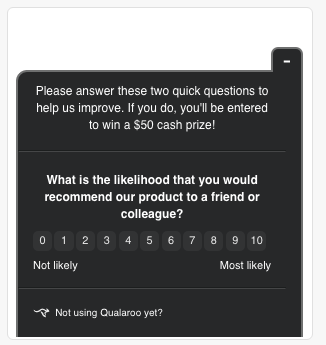
If you want more people to take your survey and ensure the results are more accurate, I would suggest offering a little something in return that can help. Studies have shown that even a small reward or incentive can significantly affect how many people finish your survey.
But here’s the thing: you want to stay moderate with the incentives. Offering too much can make people suspicious and attract respondents who are more interested in the reward than in giving you their honest feedback. That can mess up your results and make your survey findings less meaningful.
So, the key is to offer an appealing incentive to encourage people to participate without making it the main reason they’re taking the survey. A small gift card, an incentive on a future purchase, or a chance to win a raffle can often be enough to incentivize respondents without compromising the integrity of your research.
Here are some effective incentive options to consider:
- Extended subscriptions
- Access to new features
- Gift cards
- Discounts
- Invitations to exclusive events
- Loyalty program benefits
Two data quality risks to manage when using incentives: selection bias (only incentive-seekers respond, skewing your sample toward a non-representative group) and social desirability bias (respondents give more favorable answers because they associate the reward with the brand).
Neither disqualifies incentivized NPS surveys, but both mean you should cross-reference incentivized results with a non-incentivized baseline before treating the scores as interchangeable.
If response rates are adequate without incentives, running incentivized and non-incentivized surveys separately and comparing the score distributions is worth doing at least once to understand whether the incentive is changing the data.
5. Include a Follow-Up Question
When customers are given the opportunity, they are often more than willing to explain the reasons behind their scores in an NPS survey. This precious feedback provides context that a simple number alone cannot convey.
I recommend using an NPS survey template with a follow-up question to tap into these insights effectively. By customizing this follow-up question, you can significantly enhance the value of your NPS survey. For instance, a good NPS survey for market research sample can ask, “What’s the main reason for your score?” or “What could we do to improve your experience?”
These tailored prompts encourage customers to share their thoughts and feelings in detail, which helps you understand their motivations and concerns. This deeper insight lets you identify what your Promoters genuinely value about your product or service.
Conversely, this approach also sheds light on what might turn Detractors away. Understanding their pain points—be it issues with product quality, service delays, or unmet expectations—enables you to take actionable steps toward improvement.
6. Engage With Respondents
Taking a moment to thank each person who completes your NPS survey is essential. This simple gesture acknowledges their participation and helps create a positive atmosphere for future interactions.
I believe that when you express gratitude, you also have a chance to ask for more details about their feedback. By reaching out, you can better understand their experience, identify areas for improvement, and quickly address any concerns they may have.
For Promoters: A good NPS survey for market research example is thanking them for their loyalty reinforces their good feelings about your organization and helps strengthen your connection with them.
For Passives: You can encourage these customers to become enthusiastic supporters by listening to their feedback and addressing any underlying concerns.
For Detractors: Actively engaging with Detractors and working to replace their negative experiences with positive ones, you can reduce churn and foster lasting loyalty.
7. Track NPS Over Time
To get the most out of your market research, it’s essential to conduct NPS surveys across different customer groups regularly. This helps you confirm whether changes to your product or service are hitting the mark and allows you to spot any new trends or issues that may arise.
Unlike one-time surveys, which recent events or outside influences can skew, regular surveys give a clearer and more accurate picture of customer feedback over time. They provide longitudinal data, consistency, reduced bias, identification of emerging trends, improved customer relationships, and data-driven decision-making.
Additionally, I prefer regularly looking at NPS results to create a workplace culture focused on continuous improvement. Following up with customers after each survey shows that you care about their opinions and are eager to address their concerns.
Finally, adding open-ended survey questions can give you even deeper insights. These questions allow customers to explain their scores while revealing their true feelings and any specific issues.
8. Leverage the Right Tools
Leveraging the right tool can make a big difference in how effectively you can utilize NPS for market research. While the core concept of NPS is simple, using the right tools can substantially increase your ability to collect, assess, and act on customer feedback.
Look for tools that offer features like:
- Easy survey creation and distribution: Seamlessly design and send NPS surveys across multiple channels.
- Advanced reporting and analytics: Go beyond basic NPS scores for deeper insights and trends.
- Automated feedback collection and analysis: Streamline your workflow and save valuable time.
- Integration with other business tools: Connect your NPS data with CRM, marketing automation, and other platforms for a holistic view of your customers.
Tools like Qualaroo can be invaluable for streamlining your NPS surveys and maximizing their impact. With features like targeted surveys, real-time feedback, and advanced analytics, Qualaroo empowers you to gather rich insights and take action to improve customer experience.
NPS Survey for Market Research Questions
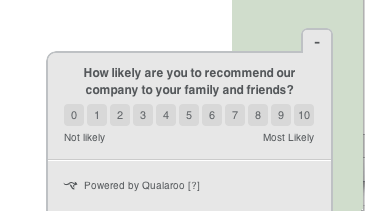
Now that we’ve covered the basics of NPS, let’s explore how to implement it. Using a combination of these questions, you can gather valuable customer sentiment data, identify improvement areas, and drive business growth.
Here’s a breakdown of practical NPS survey questions for market research:
General Feedback:
- What is the primary reason for your score?
- What could we do to improve your experience?
- What do you value most about [your company/product/service]?
For Promoters (9-10):
- What specifically do you love about [your company/product/service]?
- What would you tell a friend considering [your company/product/service]?
For Passives (7-8):
- What could we do to make your experience even better?
- What is missing or could be improved?
For Detractors (0-6):
- What was disappointing about your experience?
- What could we have done differently?
Additional Questions (optional, for deeper insights):
Demographics:
- What is your age range?
- What is your gender?
- What is your location?
Customer Segmentation:
- How long have you been a customer?
- What products/services have you used?
- How often do you use [your company/product/service]?
Why stop at just the questions? I have also gathered some tips to question your customers effectively and non-obtrusively:
- Keep it concise: Avoid lengthy surveys that discourage completion.
- Use clear language: Ensure questions are easy to understand.
- Personalize when possible: Tailor questions to specific customer segments or interactions.
How to Collect NPS Data & Analyze It
While true mind-reading might still be a distant fantasy, NPS surveys offer a powerful way to get remarkably close. These simple yet insightful surveys provide a direct line to the customer’s voice, which allows you to gather invaluable feedback and make data-driven decisions that can transform your business.
However, manually collecting and analyzing NPS responses can be time-consuming and inefficient. Fortunately, tools like Qualaroo automate much of the process. It has always helped me focus on what matters most: understanding my customers and improving their experience.
But how will you create these surveys?
Here are the steps to guide you better. I’ve used Qualaroo as an example tool here:
Step 1: From the dashboard’s interface, select “Create New.”

Step 2: Select “Choose Template” from any nudge type.
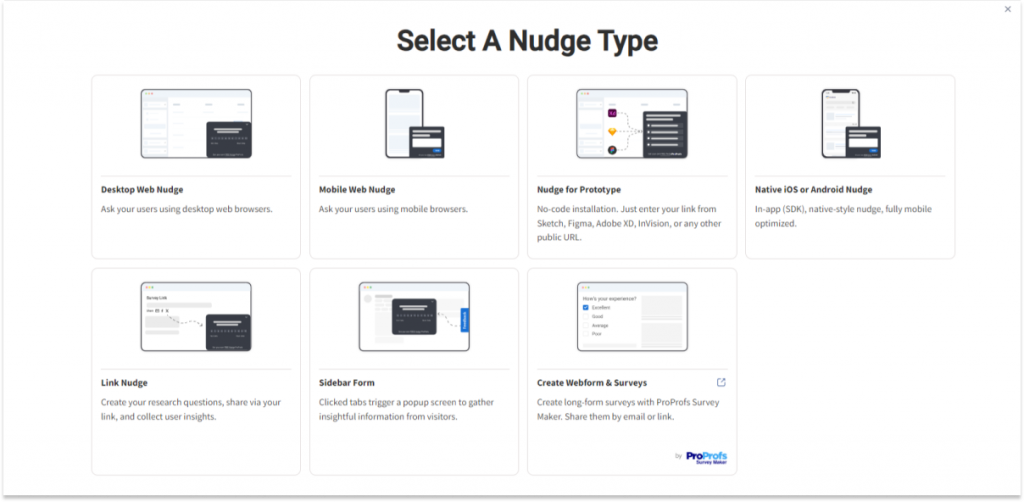
NPS survey works with mobile sites, Native iOS/Android, and Link Nudge, except for Nudge for Prototype.
Step 3: To utilize the NPS template:
- Locate the template within the available options.
- Move the cursor over the template.
- Click on the “Use This Template” button.
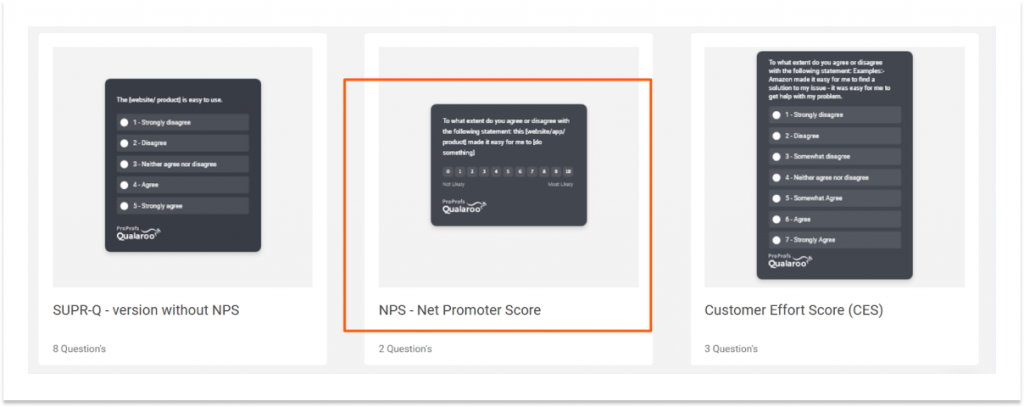
Step 4: Input your survey question.

Step 5: In the “Continue to” section, you have two options:
- Enable “Allow branching” to create different follow-up questions based on initial responses.
- Enter a label and select the corresponding message screen option.
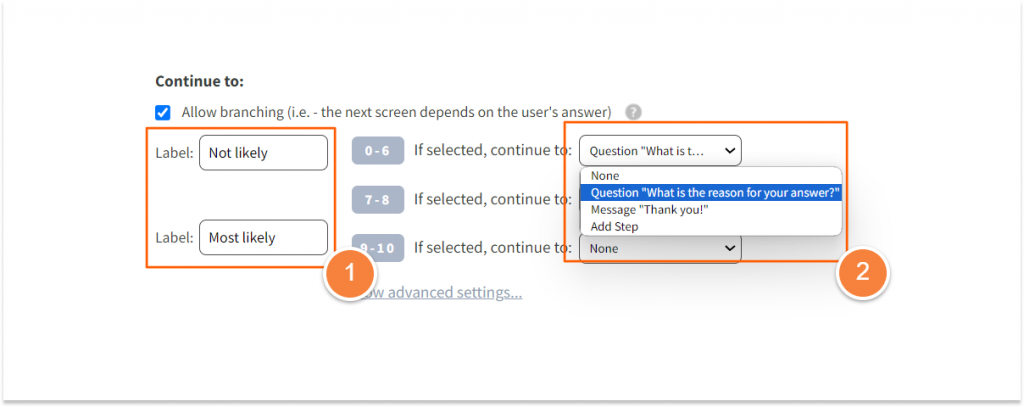
Step 6: Review the “Targeting” and “Design” sections in Qualaroo’s help center. Make modifications based on your preferences and goals.
Step 7: Upon completion, select either “Save” or “Save & Activate” to make the survey live on your website.

Your NPS survey is now ready to gather meaningful customer feedback, so that you can assess customer satisfaction and loyalty.
FREE. All Features. FOREVER!
Try our Forever FREE account with all premium features!
Drive Business Growth Through Insights from NPS Surveys
Regularly collecting and analyzing NPS data gives you a reliable, repeatable read on customer loyalty and a structured way to surface friction before it becomes churn.
To get the most from it, keep surveys short, time them to meaningful interactions, segment responses by customer type, and act on the verbatim feedback rather than just the score.
NPS works best as one component of a broader research and measurement program. For questions that go beyond loyalty, such as understanding unmet needs, evaluating new product concepts, assessing competitive positioning, or exploring new market segments, complement NPS with dedicated research methods designed for those objectives.
The score tells you how customers feel about their current experience. The rest of your research tells you where to take them next.
Consider using a dedicated survey tool to get the most from your NPS program. With platforms like Qualaroo, you can create a free NPS survey for market research, manage everything more efficiently, offer advanced insights, and turn customer feedback into practical strategies.
FAQs

Are NPS surveys worth it?
Absolutely! NPS surveys are a quick and simple way to get a pulse on customer sentiment. They help you identify your strengths and weaknesses, predict future customer behavior, and improve your business performance.
What is an NPS survey model?
The NPS survey categorizes customers into groups:
- Promoters (9-10): Highly satisfied and likely to recommend.
- Passives (7-8): Generally happy but less enthusiastic.
- Detractors (0-6): Dissatisfied and might discourage others.
This model helps businesses identify areas for improvement and enhance customer satisfaction.
What is a good NPS score?
Any score above ‘0’ is considered good because it shows you have more fans than haters. A score of 50 or higher is solid, and a score of 70 or more is outstanding, but both are tough to achieve.
FREE. All Features. FOREVER!
Try our Forever FREE account with all premium features!

 We'd love your feedback!
What did you like & how can we make it even better?
 Thanks for your feedback!
 Ask Your Question
Have a question? Get expert help to make your decision easier.