Customer insight is supposed to be the superpower of modern businesses. I’ve spent years inside growth teams, product teams, and early-stage companies, and one thing has always been clear: collecting feedback is the easy part.
Every organization sends surveys, gathers NPS scores, reviews chat transcripts, and tracks behavior in analytics dashboards. But somewhere between capturing feedback and acting on it, momentum quietly disappears. Insights pile up, reports circulate, and very little actually changes.
In my experience, the challenge has never been a lack of information. It’s the gap between what the customer is telling you and what the business does next. Many teams can explain the trends they’re seeing. Far fewer can point to the specific decisions, updates, or improvements that were made because of those trends.
Startups approach this differently. In small, fast-moving environments, customer feedback isn’t an artifact or a report — it’s a pulse. The result is visible: tighter feedback loops, faster improvements, and a stronger connection between what customers say and what the product becomes.
So what do startups consistently get right about acting on customer insights, and how can larger, more complex organizations adopt the same habits? Let’s find out.
Why Startups Turn Insights Into Action Faster
Their advantage starts with how they treat feedback, not as information, but as momentum. And that momentum begins with a simple shift in mindset.
1. Feedback as a Catalyst for Action
Most established companies use feedback to confirm decisions that have already been made. They use surveys to validate assumptions or justify product roadmaps. But startups don’t have that luxury. They collect feedback to inform what comes next.
This difference in intent is subtle but crucial. Startups treat feedback as fuel; energy that propels immediate action. Every data point, comment, or complaint becomes input for iteration.
When a startup notices five similar comments about onboarding friction, they fix it that week. If users describe confusion with pricing, they rewrite the copy by Friday. Startups don’t need to prove their hypothesis first, they experiment in the wild and let the response guide them.
It’s an instinct born from necessity: they can’t afford inaction. But it’s also a mindset that larger organizations can learn from. Instead of waiting for perfect consensus or statistically significant data, they can build “momentum loops”, quick cycles of insight, action, and measurement.
The goal isn’t to be reckless; it’s to make the distance between listening and doing shorter than the next customer interaction.
2. The Power of Clear Ownership
In startups, everyone knows who’s responsible for what.
If a customer reports a bug, there’s one person who owns the fix.
If a user leaves a comment about the product experience, one person takes it forward.
If a new idea comes up, someone tests it by Monday.
This is how feedback becomes operational, through single-threaded ownership.
Research by OKRs Tool, which analyzed 200 early-stage startups, found that teams that assigned a single owner to activities achieved 26% better outcomes than teams that split responsibility. When ownership is clear, execution accelerates.
Ownership doesn’t mean isolation. It means clarity. One name next to each task, one person who ensures progress, one feedback item that never disappears into a spreadsheet.
Even in enterprises, this can be replicated. Instead of “shared responsibility,” create a model where each insight has a lead. They don’t need to do everything, they just ensure it gets done.
3. Speed Through Short Feedback Cycles
Startups run on rhythm. Their product meetings, customer support reviews, and feedback discussions happen weekly, not quarterly.
This frequency matters more than any framework. Acting on feedback is easier when the review cycle is short. The team still remembers what the customer said, the context is fresh, and decisions can be made in hours, not weeks.
Many large organizations still rely on quarterly “voice of the customer” summaries; decks that look impressive but arrive long after the moment has passed. By then, customers have either adapted or left.
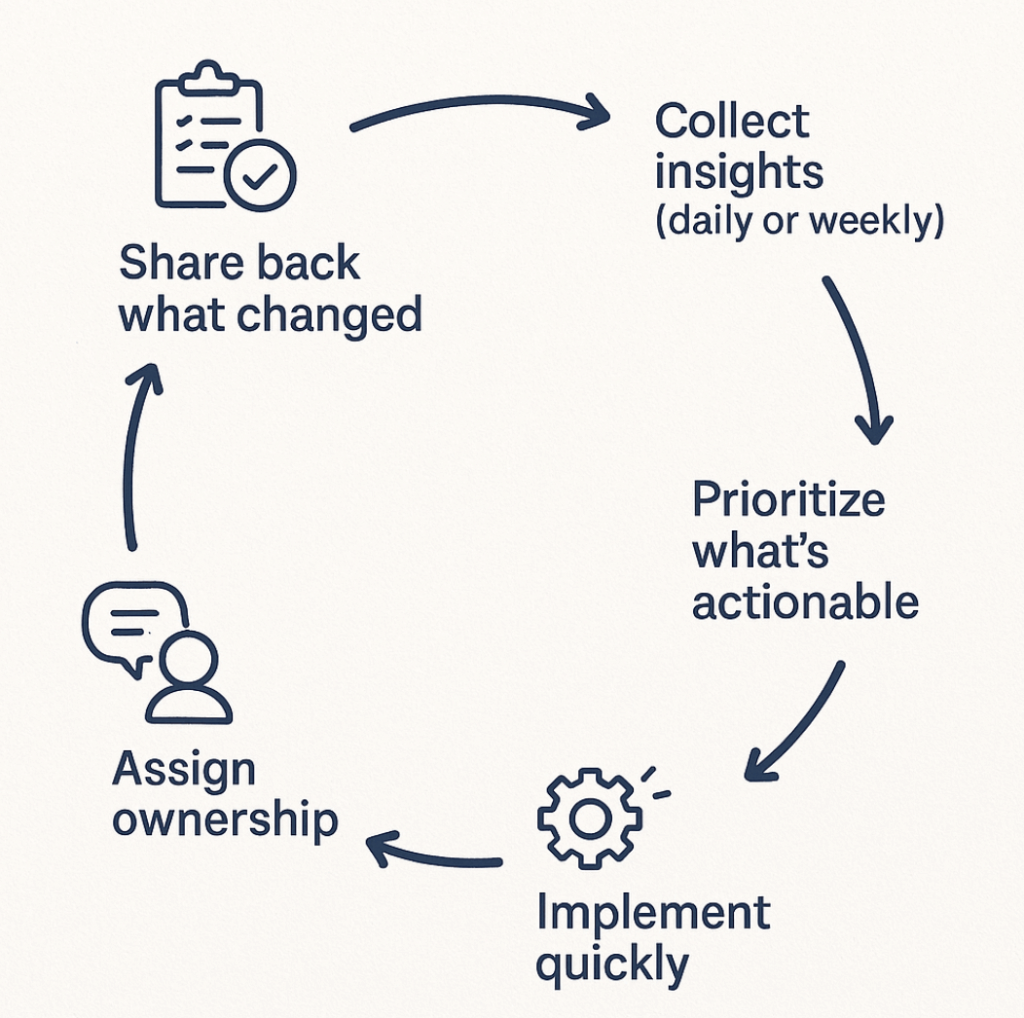
A startup’s rhythm, by contrast, keeps feedback alive. They work in micro-feedback loops:
- Collect insights (daily or weekly).
- Prioritize what’s actionable.
- Assign ownership.
- Implement quickly.
- Share back what changed.
This cadence doesn’t just produce faster fixes—it builds trust. Customers notice when their input leads to visible improvement, and that trust compounds over time.
The best enterprise teams mimic this rhythm by running lightweight review rituals: 20-minute feedback standups, rotating customer insight digests, or Slack updates summarizing top learnings each week.
The more frequent the cycle, the more useful the feedback becomes.
From Insights to Action: What Fast-Moving Teams Do Differently
Turning customer insights into action isn’t just about speed. It’s about structure.
When we compared how startups versus larger organizations handle customer feedback, a few consistent differences stood out.
| Process Stage | Typical Enterprise Approach | Startup Approach | Why It Matters |
|---|---|---|---|
| Feedback Collection | Periodic surveys and formal reports | Continuous, lightweight feedback loops | Frequent input keeps insights relevant and actionable. |
| Ownership | Shared across departments | Single clear owner per action item | One accountable lead ensures nothing slips through the cracks. |
| Review Cadence | Quarterly or monthly review cycles | Weekly or biweekly check-ins | Shorter cycles prevent backlog and create real-time adaptation. |
| Implementation | Sequential approval and documentation | Parallel action with rapid testing | Speed enables experimentation— learning through doing, not debating. |
| Visibility | Stored in dashboards or internal tools, reviewed occasionally | Shared publicly across team channels | Visibility builds accountability and reinforces customer focus. |
| Measurement | Success tracked in KPIs only | OKRs linked directly to feedback-driven goals | Connection between insight and outcome keeps teams aligned. |
This contrast shows why smaller teams are often more responsive. It’s not because they have better tools, but because their habits make feedback operational.
For larger organizations, the takeaway is clear: responsiveness can be designed. You don’t need to be small to move fast. You need to be consistent.
4. Integrating Insights Into Everyday Strategy
In most corporations, “customer feedback” lives in one function—usually marketing, support, or UX. But in startups, customer insights are the strategy.
When a founder reads customer comments, it directly shapes the roadmap. When a support rep hears a recurring complaint, it feeds product decisions. When a growth lead notices drop-offs in a flow, it triggers immediate design adjustments.
This integration keeps everyone aligned around a single truth: customer feedback is not supplementary. It’s directional.
It also creates cultural coherence. Instead of viewing feedback as criticism, startups see it as navigation. Every insight brings the company closer to product–market fit.
Larger organizations can adopt this by embedding feedback review into existing strategic discussions. The agenda for leadership meetings shouldn’t just include “performance metrics”. It should include “customer sentiment.” Every decision should be grounded in what customers are actually experiencing, not just what dashboards show.
Feedback should never live downstream of strategy. It should define it.
5. Lightweight Systems, Lasting Learning
Startups don’t need big infrastructure to act fast. A Notion page, a shared Slack thread, or a Kanban board often does the job.
The secret is lightweight systems with clear outcomes:
- Collect insights.
- Discuss quickly.
- Decide ownership.
- Act.
- Document what changed.
That final step—documentation—is often overlooked but essential. It creates an internal memory of what was learned and done. When teams revisit similar issues later, they can see patterns instead of starting from scratch.
Enterprises can adapt this same logic with scalable tools. Feedback management platforms, survey automation, and tagging systems help maintain visibility, but they only work if paired with disciplined follow-up.
The point isn’t to centralize for centralization’s sake. It’s to make sure learning doesn’t disappear in translation.
The best systems are those that reduce friction, not add it. A good process helps teams spend less time organizing insights and more time acting on them.
6. Making Small Wins Visible
Startups build momentum by celebrating every small win, including those triggered by customer feedback.
A Slack message announcing, “We updated onboarding based on last week’s user feedback—early results look great!” has an outsized cultural effect. It reminds teams that insights aren’t just collected; they matter.
Celebrating feedback-driven action serves three purposes:
- It reinforces learning: teams remember what worked.
- It increases participation: people share more feedback when they see it creates change.
- It strengthens customer empathy: employees stay connected to real user impact.
Large organizations can scale this by publishing short internal updates.“Feedback Fridays,” for example, where teams highlight what’s changed and what’s next. Over time, this builds a culture of responsiveness that customers feel externally.
Momentum is emotional as much as operational. The more visible the wins, the faster the loop spins.
7. Turning Feedback Into Measurable Outcomes
Startups are ruthless about measuring what matters. They don’t have the bandwidth to chase vanity metrics.
When they act on feedback, they track its effect directly:
- Did the change reduce churn?
- Did satisfaction scores rise?
- Did onboarding time drop?
This accountability transforms feedback from qualitative noise into quantitative value.
Enterprises often struggle here because their metrics are siloed—product measures adoption, support tracks CSAT, marketing tracks NPS—but no one connects them.
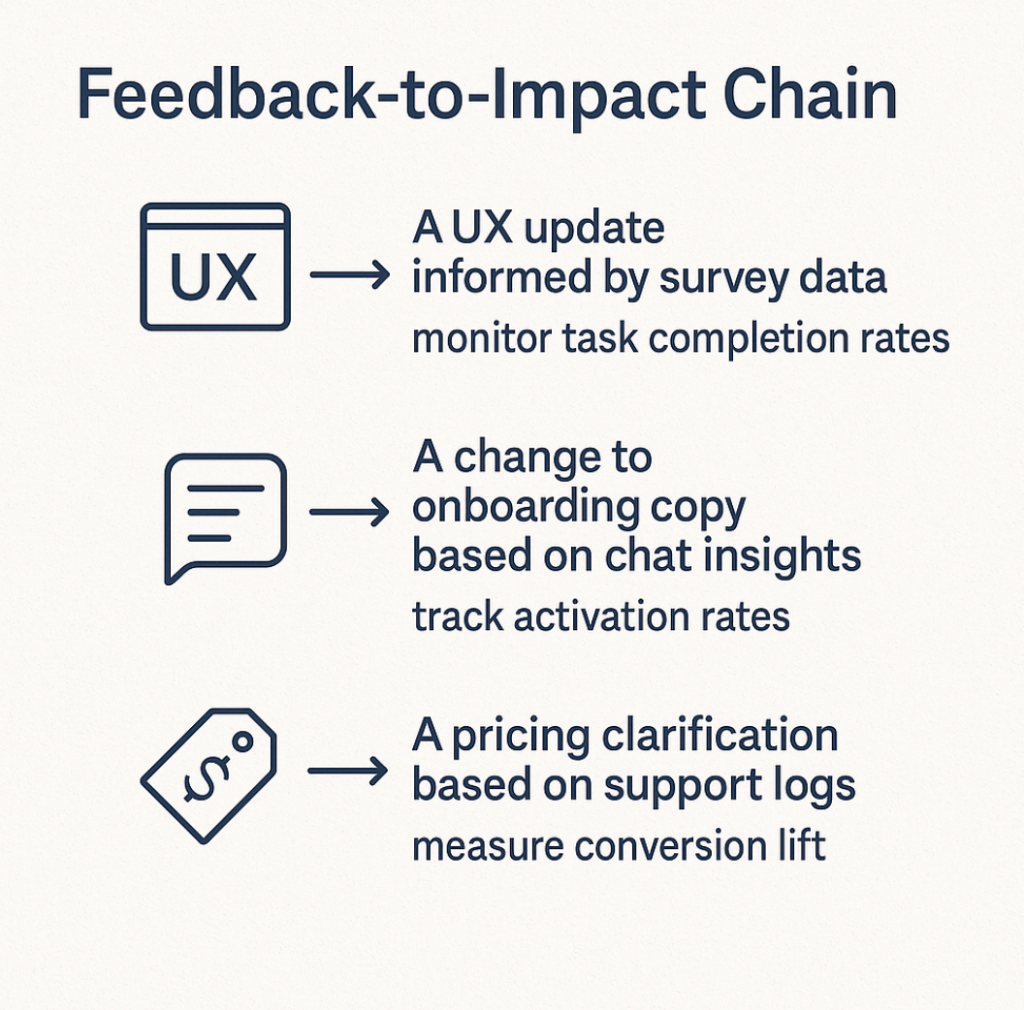
To fix this, teams should link every significant feedback-driven action to a clear performance indicator. For instance:
- A UX update informed by survey data → monitor task completion rates.
- A change to onboarding copy based on chat insights → track activation rates.
- A pricing clarification based on support logs → measure conversion lift.
Over time, this creates a feedback-to-impact chain, turning customer input into proof of ROI. It’s not enough to collect insights; teams must close the loop with evidence of improvement.
8. Building Culture Around the Customer Voice
Perhaps the most overlooked aspect of acting on insights is its cultural value.
When startups consistently act on customer input, it creates internal alignment. Every employee understands the same priority: serving users better. That shared sense of purpose fuels motivation, cross-team cooperation, and transparency.
Customer insight becomes the connective tissue between departments. Engineering understands marketing’s messaging choices. Support feels heard by product. Everyone sees their role in delivering a consistent experience.
Enterprises that elevate customer insight to this cultural level can achieve the same cohesion. It requires leaders to model curiosity and action, and to treat feedback as an opportunity, not a threat.
When people see that customer voices directly influence decisions, they stop viewing feedback as “extra work.” It becomes the heartbeat of the organization.
Turning Startup Habits Into Enterprise Practice
So how can larger companies adapt these lessons without losing structure?
Here’s a framework to start:
- Shorten the loop. Move from quarterly to monthly or even biweekly feedback reviews.
- Assign ownership. Every recurring theme has one lead responsible for driving action.
- Share visibly. Use dashboards, newsletters, or Slack channels to keep progress transparent.
- Link to metrics. Tie feedback-driven changes to measurable results.
- Reward responsiveness. Recognize teams that act fast on insights.
You don’t need to move at startup speed— just startup clarity. The difference between agility and bureaucracy often comes down to how quickly you act on what customers are already telling you.
Startup Habits that Scale
Even large organizations can adopt the same lightweight rhythms that help startups act fast on customer feedback. The key is structure, not size.
| Habit | Why It Works |
|---|---|
| Assign ownership | Creates accountability and ensures every insight has a clear next step. |
| Review weekly | Keeps insights fresh and prevents backlog from piling up. |
| Make progress visible | Builds trust internally and shows customers their feedback drives change. |
| Link actions to outcomes | Connects customer insights directly to measurable business results. |
| Celebrate quick wins | Reinforces learning and sustains a culture of responsiveness. |
When these habits become routine, feedback stops being a report and becomes part of the company’s operating rhythm.
FREE. All Features. FOREVER!
Try our Forever FREE account with all premium features!
Final thoughts
Startups get a lot wrong: processes are messy, documentation is light, and structure can lag behind ambition. But one thing they excel at is making customer feedback live.
They understand that the fastest way to grow isn’t by guessing what customers need. It’s by building mechanisms to listen, act, and adjust continuously.
That’s not just startup scrappiness; it’s operational discipline in disguise.
Acting on insights isn’t a tactic—it’s a muscle. And like any muscle, it strengthens with repetition. The more often teams close the loop between feedback and action, the more instinctive it becomes.
Larger organizations that internalize that rhythm will find they don’t just react faster; they anticipate better. Because once feedback stops being a task and becomes a habit, customer-centricity stops being a slogan and starts being a system.
Frequently Asked Questions

How can enterprises replicate startup agility without chaos?
The goal isn’t to copy startup speed but to replicate startup clarity. Introduce shorter review cycles, assign ownership to each feedback theme, and keep actions visible. These simple structures bring accountability without disrupting scale.
What’s the most effective way to measure feedback impact?
Connect every customer-driven change to a measurable outcome. Whether that’s reduced churn, improved satisfaction, or higher adoption. The impact doesn’t have to be immediate, but it must be visible. Over time, this creates a direct link between feedback and business growth.
FREE. All Features. FOREVER!
Try our Forever FREE account with all premium features!

 We'd love your feedback!
What did you like & how can we make it even better?
 Thanks for your feedback!
 Ask Your Question
Have a question? Get expert help to make your decision easier.