I’ve watched more than a few growth teams start with MoEngage and stick with it longer than they should. Not because it’s bad, but because switching feels like a project. So they patch the gaps, add another tool for feedback, another for in-app, and quietly accept the friction.
Then one day, the lookback window runs out, or the in-app messages look nothing like the product, or the data team starts asking questions MoEngage can’t answer. That’s the moment.
If you’re at that moment right now, this list is for you. I’ve gone through Qualaroo and 9 other MoEngage alternatives that actually fix the problems teams hit most, whether that’s data depth, predictive personalization, real-time targeting, or just understanding why users do what they do.
Why Are Businesses Looking for MoEngage Alternatives?
You probably didn’t search for “MoEngage alternatives” because you hate the product. Most teams don’t. They start with MoEngage because it’s accessible, ships fast, and genuinely works for early-stage automation.
Then you start scaling. You want more historical data, deeper segmentation, or real in-app personalization. That’s when the seams start to show.
Here’s the thing: MoEngage was built for a specific kind of team, and if you’re no longer that team, forcing the fit gets expensive. This list of MoEngage alternatives is for anyone who’s hit that wall and wants to see what’s actually out there before making a move.
If this hits close to home, keep reading.
The Best MoEngage Alternatives: A Quick Comparison
Here’s the shortlist before we go deep. Use this table to narrow down your options based on what you actually need.
| Tool | Best For | Key Strength | G2 / Capterra Rating | Starting Price |
|---|---|---|---|---|
| Qualaroo | In-context user feedback | Behavior-based nudges and AI sentiment analysis | 4.7/5 (Capterra) | Free plan available. Paid from $19.99/month |
| CleverTap | Mobile-first engagement | Real-time streaming and 10-year data retention | 4.6/5 (G2) | From $75/month |
| Braze | Enterprise orchestration | Real-time, high-volume journey management | 4.5/5 (G2) | Custom quote |
| Insider One | AI-driven personalization | Predictive intent across 12+ channels | 4.8/5 (G2) | Custom quote |
| Netcore Cloud | APAC-focused delivery | 95%+ email inbox placement, regional compliance | 4.5/5 (G2) | Custom quote |
| Klaviyo | E-commerce and DTC brands | Deep Shopify integration and revenue-attributed automation | 4.6/5 (G2) | Custom quote |
| WebEngage | Mid-market SaaS and consumer apps | Journey designer and full-funnel engagement | 4.5/5 (G2) | Custom quote |
| Amplitude | Product and growth teams | Behavioral analytics combined with campaign activation | 4.5/5 (G2) | Paid from $49/month |
| Hightouch | Data and engineering teams | Warehouse-native activation with zero data duplication | 4.6/5 (G2) | Custom quote |
| Plotline | Consumer app engagement | Native in-app stories, quizzes, and spotlights | 4.7/5 (G2) | From $999/month |
10 MoEngage Competitors That Actually Solve the Real Problems
A table gives you the lay of the land. But the real question is how these tools behave in practice, how they hold up under real conditions. Here’s the full breakdown, tool by tool.
1. Qualaroo: In-Context Feedback That Tells You the Why
I’ve used Qualaroo directly on two different product feedback workflows, and the difference it makes is immediate. Most engagement platforms, including MoEngage, are built to push messages out. Qualaroo is built to pull insight in.
It works through “Nudges™,” lightweight survey prompts that appear while users are actively using your product or browsing your site. You can trigger them based on behavior, time on page, scroll depth, specific URLs, or device type. That precision is what separates it from post-session surveys or generic feedback forms.
The AI sentiment analysis layer is where it gets genuinely useful. Instead of sifting through hundreds of open-ended responses manually, Qualaroo categorizes and scores them for you. You get a clear signal on user motivation fast enough to actually act on it.
Pros
- Behavior-based and URL-specific advanced survey targeting
- AI-powered sentiment analysis for open-ended responses
- Fast deployment without developer involvement
- 100+ templates, including NPS, CSAT, exit-intent, and product feedback in one place
- Integrations with HubSpot, Mailchimp, Salesforce, and major analytics tools
Cons
- Fully cloud-based, so an internet connection is required
- Not designed for broad omnichannel campaign automation
How Qualaroo Compares to MoEngage: MoEngage automates campaigns based on user behavior. Qualaroo captures why they do it. If your team is constantly guessing at motivation or running A/B tests without understanding the underlying user intent, Qualaroo fills the gap MoEngage leaves wide open.
Pricing: Free plan available. Paid plans start from $19.99/month.
User Rating: 4.7 (Capterra)
2. CleverTap: Real-Time Data Depth That MoEngage Can’t Match
A product manager at a food delivery app put it plainly when she told me, “We moved to CleverTap because MoEngage couldn’t tell us what happened 6 months ago.” That sentence captures the core difference.
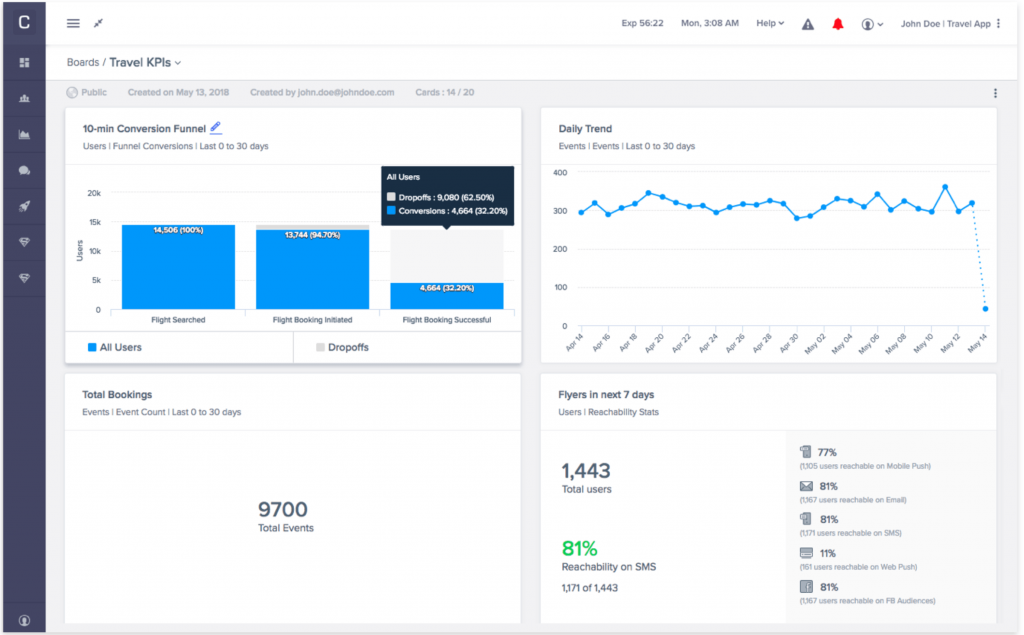
It’s built to store up to 10 years of historical user data and ingest up to 10,000 data points per user per month. That’s not a feature you notice until you need it, and then you feel the absence immediately. The real-time streaming architecture is the other big differentiator. Where MoEngage processes data in batches, CleverTap acts on user behavior as it happens for mobile-heavy products.
Pros
- Real-time segmentation based on current user actions
- Up to 10 years of historical data retention
- Churn prediction and lifecycle analytics
- Deep push, in-app, and email automation
- Strong attribution tool integrations
Cons
- Interface has a learning curve for non-technical marketers
- Pricing scales with monthly active users and can climb quickly
How CleverTap Compares to MoEngage: If data depth and real-time responsiveness are your primary constraints, CleverTap is the strongest step up. Teams frequently cite it as the natural next step once they outgrow MoEngage’s lookback limitations.
Pricing: Starts at $75/month, with pricing scaled by monthly active users.
User Rating: 4.6 (G2)
3. Braze: Enterprise-Grade Orchestration at Full Scale
Every enterprise growth team I’ve spoken with eventually mentions Braze, usually with a mix of respect and mild intimidation. It’s the platform you graduate to when customer journeys become complex enough that rule-based automation no longer cuts it.
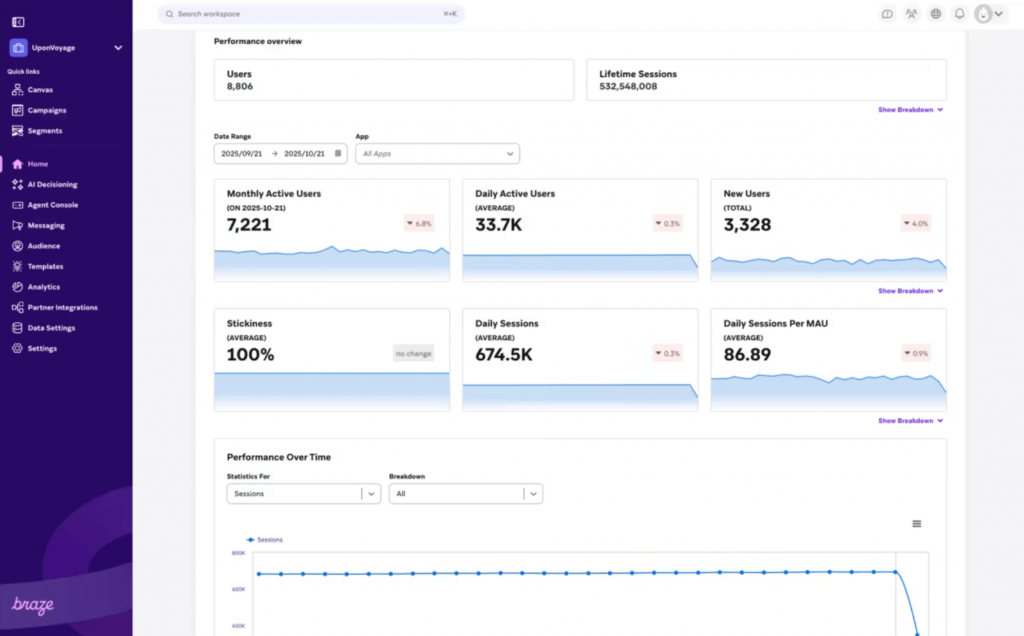
Braze runs high-volume, real-time engagement across email, push, SMS, in-app, and web. The catch is real: Braze basically requires engineering support to manage. Its Liquid templating and data manipulation features are powerful, but they are not marketer-friendly out of the box.
Pros
- Real-time personalization across multiple channels simultaneously
- Canvas journey builder for complex, adaptive customer flows
- Native data warehouse integrations (Snowflake, BigQuery, etc.)
- Highly scalable for global campaigns and large user bases
- Strong documentation and an active developer community
Cons
- Requires dedicated engineering resources to unlock full value
- Pricing is the highest in the category by a significant margin
How Braze Compares to MoEngage: MoEngage gives you automation. Braze provides real-time orchestration. If you’re at a stage where personalization directly drives millions in revenue, and you have the team to support it, Braze is the right move. If you’re not there yet, it’s overkill.
Pricing: Custom quote.
User Rating: 4.5 (G2)
4. Insider One: Predictive Personalization Before the User Acts
A growth lead at a fintech startup described Insider One to me like this: “It feels like it knows what my users want before I do.” That’s not marketing language. That’s how predictive intent modeling actually behaves when it’s working.
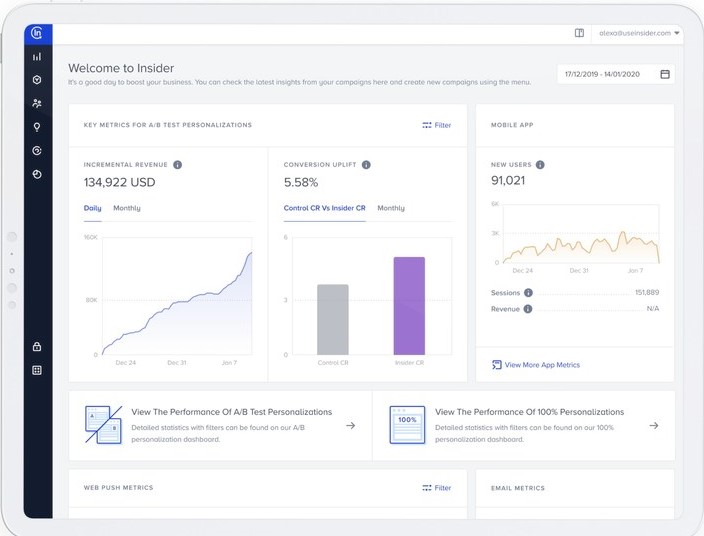
Insider’s core differentiator is its AI layer. It runs across 12+ channels, including web, app, email, SMS, and WhatsApp, all managed from one orchestration layer. Onboarding and support quality consistently rank above MoEngage in independent reviews, which matters most during the weeks of complex initial setup.
Pros
- Predictive AI that models user intent before actions occur
- Omnichannel orchestration across 12+ platforms
- Real-time data processing with no meaningful lag
- Support quality rated 9.6/10 on G2, among the highest in the category (verify before publishing)
- Strong use case library for e-commerce, fintech, and travel verticals
Cons
- Requires a mature data setup to unlock predictive features
- Pricing is enterprise-oriented and not suitable for smaller teams
How Insider Compares to MoEngage: MoEngage reacts to what users have done. Insider acts before they act. If your retention campaigns keep arriving a beat too late, Insider’s predictive layer is what fixes that.
Pricing: Custom quote based on channels and data volume.
User Rating: 4.8 (G2)
5. Netcore Cloud: Deliverability and Regional Depth for APAC Teams
I first heard about Netcore from a founder running an e-commerce brand across five markets in Southeast Asia. His take was straightforward: “It just works, quietly and reliably, every time.” That’s exactly the kind of endorsement that actually means something.
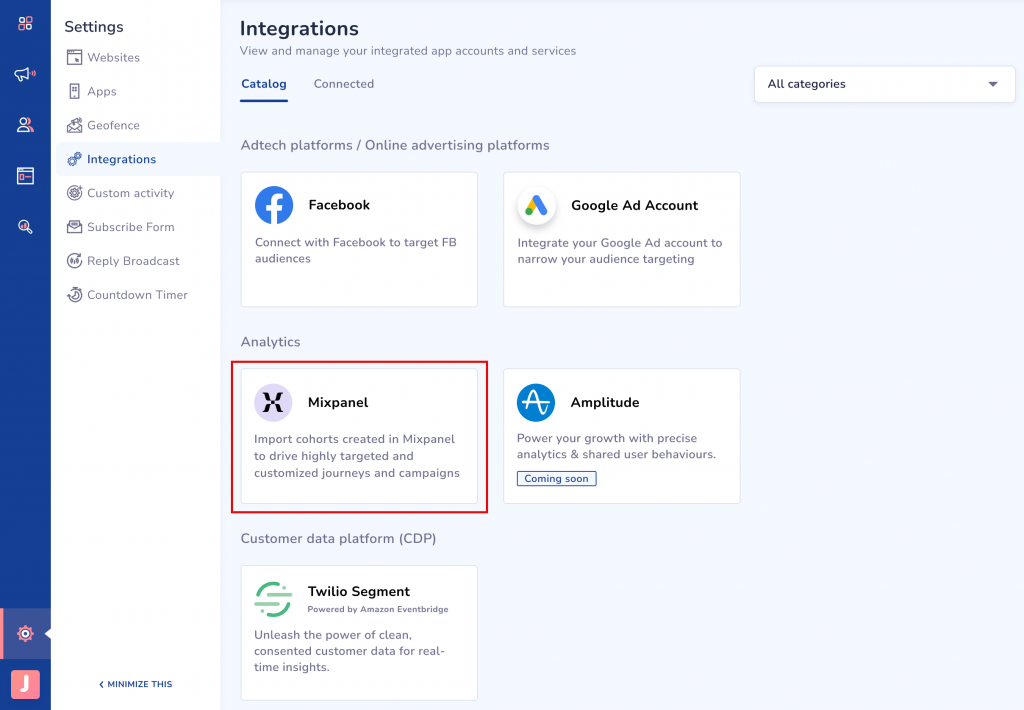
Netcore’s edge is infrastructure. It owns a proprietary email service provider that consistently delivers inbox placement. That’s a layer of ownership that most engagement platforms, including MoEngage, don’t have natively, when you’re running campaigns across markets with variable deliverability standards, that matters more than any feature list.
Pros
- 95%+ email inbox placement through its proprietary ESP
- Full channel coverage, including WhatsApp and web push
- APAC compliance and market localization built in
- AI-powered product recommendations and personalization
- Consistent performance across high-volume, multi-market campaigns
Cons
- Interface feels dated compared to newer platforms
- Advanced automation flows require onboarding support
How Netcore Cloud Compares to MoEngage: MoEngage handles multi-channel reasonably well, but Netcore’s infrastructure depth makes it more reliable at scale across diverse markets. If you operate in Asia or manage campaigns across regulatory environments, Netcore handles regional complexity that MoEngage often struggles to localize for.
Pricing: Custom quote based on market coverage and feature set.
User Rating: 4.5 (G2)
6. Klaviyo: Revenue-First Automation for E-Commerce and DTC Brands
A DTC founder I know switched to Klaviyo after hitting MoEngage’s e-commerce ceiling. Her exact words: “MoEngage treats our store like a campaign target. Klaviyo treats it like a revenue engine.” That framing stuck with me.
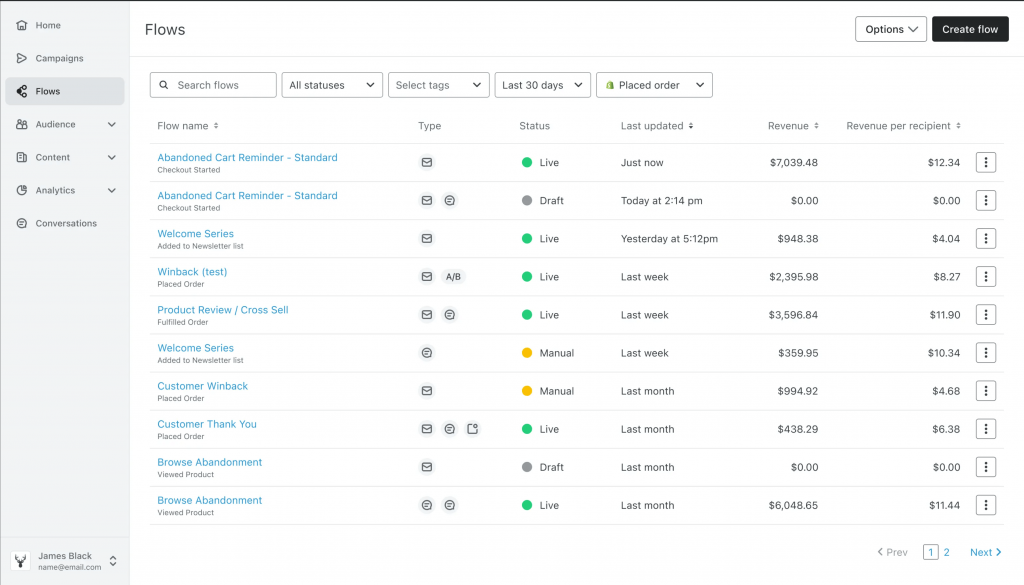
Klaviyo is built around a simple idea: every message should be traceable to revenue. It integrates deeply with Shopify, WooCommerce, and BigCommerce, pulling real purchase data, browsing behavior, and order history directly into your segmentation and automation logic. The tradeoff is cost. As your contact list grows, so does the bill, and it grows faster than most teams expect.
Pros
- Native Shopify, WooCommerce, and BigCommerce integrations with real purchase data
- Revenue-attributed reporting per flow, campaign, and channel
- Predictive analytics for lifetime value, churn risk, and next order date
- Strong email and SMS automation with granular segmentation
- Large library of prebuilt e-commerce templates and flows
Cons
- Pricing scales steeply with contact list size
- Less effective for SaaS, B2B, or non-transactional products
How Klaviyo Compares to MoEngage: MoEngage covers e-commerce as one use case among many. Klaviyo is built for nothing else. If your business lives on repeat purchases and customer lifetime value, Klaviyo’s depth of purchase-data integration and revenue attribution makes it the sharper tool for that specific problem.
Pricing: From $20/month, scaled by contact list size.
User Rating: 4.6 (G2)
7. WebEngage: Full-Funnel Engagement for Mid-Market SaaS and Consumer Apps
WebEngage comes up whenever I talk to growth teams in South Asia and Southeast Asia who have outgrown basic automation but aren’t ready to commit to Braze-level complexity. It occupies an interesting space: more opinionated than MoEngage on journey design, but still accessible enough for teams without a dedicated marketing engineer.
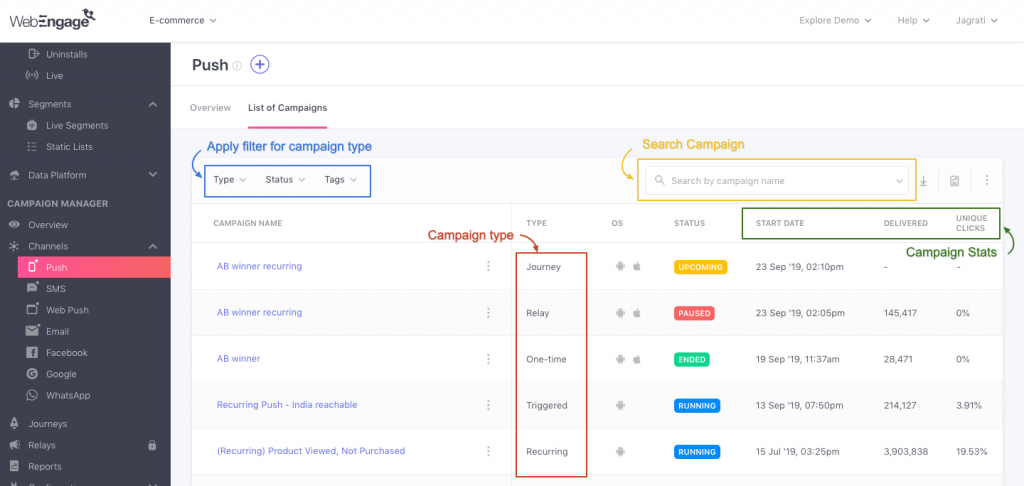
The journey designer is the standout feature. You can map out complex, multi-step user flows visually, connecting email, push, SMS, in-app, and web notifications in a single canvas. The irony is that WebEngage itself shows up as a tool teams are replacing, for the same targeting and customization reasons that make MoEngage frustrating. But for teams stepping up from simpler tools, it’s a legitimate middle ground.
Pros
- Visual journey designer across email, push, SMS, in-app, and web
- Built-in exit-intent surveys, overlays, and on-site feedback tools
- Strong presence and support in APAC and South Asian markets
- Solid mid-market pricing relative to enterprise alternatives
- Decent analytics for funnel visualization and cohort tracking
Cons
- Survey and popup designs can feel dated and hard to customize to brand standards
- Targeting specific pages or user flows requires developer involvement
How WebEngage Compares to MoEngage: Both tools occupy similar mid-market territory, but WebEngage edges ahead on journey complexity and on-site engagement. Where MoEngage is strong on mobile automation, WebEngage gives you more visual control over multi-step flows.
Pricing: Custom quote based on MAUs and feature tier.
User Rating: 4.4 (G2)
8. Amplitude: Analytics-Led Engagement for Product and Growth Teams
Amplitude came up in a conversation with a product lead at a mid-stage SaaS company who had a specific frustration with MoEngage: “It tells me what to send. It doesn’t tell me what’s actually worth sending.” She had Amplitude running alongside it for analytics, and eventually realized the insights she needed to run better campaigns were sitting in one tool while the campaign execution lived in another.
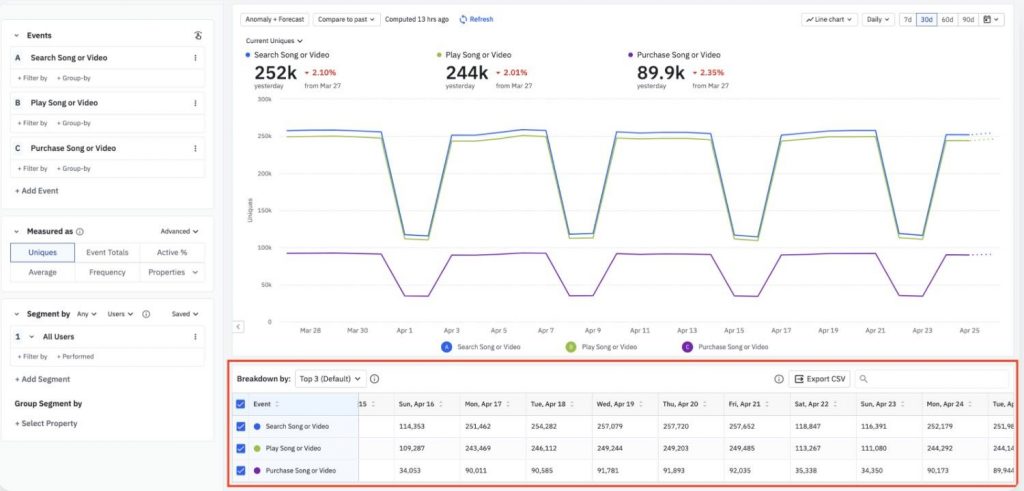
Amplitude started as a product analytics platform and has expanded into activation through Amplitude Audiences and its campaign tooling. The core strength is behavioral cohorts. The analytics depth is genuinely best-in-class. The campaign execution side is newer and not as mature as MoEngage’s, which is worth knowing before you treat it as a full replacement.
Pros
- Best-in-class behavioral analytics and cohort building
- Amplitude Audiences for direct campaign activation from analytics
- Syncs behavioral cohorts to 50+ downstream tools in real time
- Strong experimentation and A/B testing framework
- Free plan available with generous event limits for early-stage teams
Cons
- Campaign execution features are newer and less mature than dedicated engagement platforms
- Full value requires engineering involvement for event tracking setup
How Amplitude Compares to MoEngage: MoEngage is built to execute campaigns. Amplitude is built to understand behavior, and increasingly to activate on it. If your team’s core problem is not knowing which users to target or why a campaign isn’t working, Amplitude answers those questions at a depth MoEngage’s analytics layer never reaches. Many teams run both: Amplitude for the insight, MoEngage or another platform for the send.
Pricing: Free plan available. Paid plans from $49/month based on tracked users.
User Rating: 4.5 (G2)
9. Hightouch: Warehouse-Native Activation for Data-Forward Teams
Hightouch came up in a conversation with a data engineer at a B2B SaaS company who was tired of duplicating their entire customer dataset into yet another engagement platform.
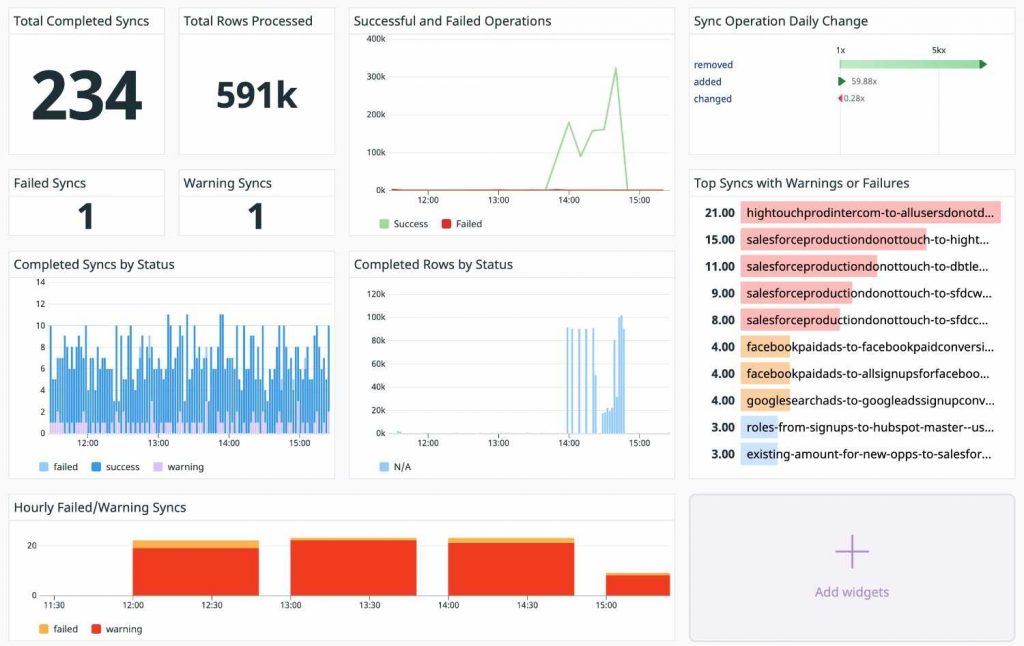
Hightouch is a composable CDP. Instead of ingesting your data into a traditional engagement platform like MoEngage, it activates data directly from your cloud warehouse. It’s not a replacement for MoEngage’s campaign execution layer. It’s what you put underneath it, or underneath whatever platform you choose, to make sure your data is always fresh and your segments are always accurate.
10. Plotline: Native In-App Engagement for Consumer Apps
Plotline came up in a conversation with a mobile product lead who had tried everything in MoEngage’s in-app toolkit and still felt like he was “pushing HTML modals into a native app.” That’s the exact problem Plotline is built to solve.
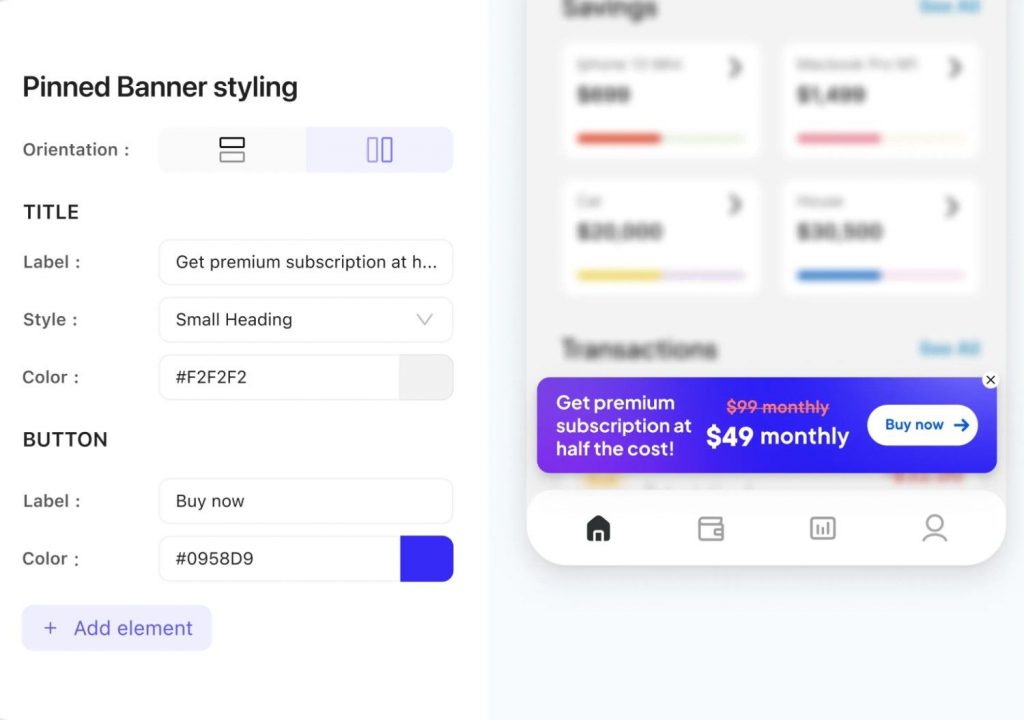
Where MoEngage treats in-app messaging as a campaign channel, Plotline treats it as a product experience. For consumer apps competing on retention and activation, that difference is significant. Users notice when something feels bolted on, and it quietly kills activation and onboarding completion rates.
Pros
- Native-looking in-app stories, spotlights, and interactive flows
- No-code builder for product and growth teams
- Precise targeting by user segment, screen, or behavior
- Fast implementation without heavy engineering dependency
- Purpose-built for mobile activation and onboarding use cases
Cons
- Narrower channel coverage than full-suite platforms
- Less suitable for teams that need email or SMS automation in the same tool
How Plotline Compares to MoEngage: If your primary pain is that in-app messages feel generic and off-brand, Plotline fixes that problem directly. It’s not trying to replace MoEngage’s full scope. It’s going deeper on the one channel MoEngage handles most superficially.
Pricing: Starts at $999/month, pricing scaled based on feature tiers.
User Rating: 4.7 (G2)
My Top 3 Picks Among the Best MoEngage Alternatives
After testing some of these MoEngage alternatives directly and speaking with teams running others in production, here’s where I land.
1. Qualaroo
For any team where the “why” behind user behavior is the missing piece. If your product decisions are driven by clicks and session data but you’re still guessing at motivation, Qualaroo’s in-context nudges give you answers faster and more reliably than any campaign platform.
2. CleverTap
For mobile-first products that have outgrown MoEngage’s data depth. The combination of real-time streaming and long-term historical retention makes it the clearest next step for teams that need more than 3 months of actionable data.
3. Insider
For teams ready to move from reactive campaigns to predictive ones. If you have the data foundation in place and want to stop chasing users after they’ve already left, Insider’s intent modeling changes how campaigns feel to the end user.
FREE. All Features. FOREVER!
Try our Forever FREE account with all premium features!
How Did I Evaluate These MoEngage Alternatives?
I didn’t want to build a list of MoEngage alternatives that looks good in a spreadsheet but falls apart the moment you actually try to use one of these tools.
Every platform here was either tested directly, vetted through conversations with teams using it in production, or assessed against a consistent set of criteria applied across the board.
Here’s exactly what I looked at for each one:
1. User Reviews and Ratings: I pulled ratings and qualitative feedback from G2, Capterra, Reddit, and Quora to get a ground-level picture of real satisfaction, not just what the vendor claims. Patterns in negative reviews told me as much as the star ratings.
2. Essential Features and Functionality: I evaluated each tool on its core capabilities: segmentation depth, automation flexibility, channel coverage, and data handling. A long feature list means nothing if the things that matter most are shallow or paywalled.
3. Ease of Use: How quickly can a non-technical marketer get a campaign live? How clean is the interface under real workflow conditions, not just the demo? Tools that require weeks of onboarding before delivering any value scored lower here, regardless of their feature depth.
4. Customer Support: Support quality is a real differentiator in this category, especially when you’re mid-implementation, and something breaks. I looked at documented response times, onboarding support, and patterns in user complaints about resolution speed.
5. Value for Money: I compared what each platform delivers against its price tier, including hidden costs like per-channel add-ons, data volume limits, and feature paywalls that inflate the effective price. A tool priced at $8/month that does the job cleanly scores better than a $500/month platform that requires three workarounds.
6. Personal Experience and Expert Opinions: Where I’ve used a tool directly, I’ve said so. For tools I haven’t run myself, I relied on direct conversations with growth leads, product managers, and engineers who use them in production. No unnamed sources, no fabricated composite reviews.
What Makes Teams Switch Away From MoEngage?
Before you evaluate anything, it helps to know what’s actually driving people out. I’ve spoken with growth leads, product managers, and engineers who’ve made this switch to MoEngage alternatives, and the frustrations land in the same few places every time.
Data Depth Runs out Faster Than Expected: MoEngage’s default historical data lookback sits at around 3 months for actionable segmentation. That sounds fine until you need to analyze a full customer lifecycle or re-engage users from a year ago.
There’s No Native CDP: If your data stack is maturing, the absence of a customer data platform inside MoEngage means you’re constantly bridging gaps with third-party tools. That adds cost and complexity.
In-App Engagement Feels Basic: For consumer apps where native stories, quizzes, or contextual spotlights matter, MoEngage’s in-app tools feel like a checkbox feature rather than a core capability.
Hidden Channel Costs Add Up: Multiple reviewers flag that WhatsApp, voice, and some automation “enhancements” are priced separately. What looks like a flat plan quietly grows.
The Feedback Loop Is Incomplete: MoEngage tells you what users do. It doesn’t tell you why. That gap forces teams to layer on separate survey or feedback tools, which defeats the point of a unified stack.
How Do You Choose the Right MoEngage Alternative?
Running through a list of MoEngage alternatives is the easy part. The harder part is matching the right platform to where your team actually is right now. Here’s a simple framework to cut through the noise. Start by naming your primary constraint. Focus on what’s actively slowing you down today, not what you wish you had.
| If Your Primary Problem Is... | Consider This First |
|---|---|
| You don't know why users are churning or dropping off | Qualaroo |
| You've outgrown 3-month data lookbacks | CleverTap |
| In-app experiences feel generic and off-brand | Plotline |
| You need predictive campaigns, not reactive ones | Insider |
| You run campaigns across APAC markets | Netcore Cloud |
| You want enterprise orchestration and have the team for it | Braze |
| Your business is e-commerce or DTC, and revenue attribution matters | Klaviyo |
| You want mid-market journey design without enterprise complexity | WebEngage |
| You need behavioral analytics depth before you can improve campaigns | Amplitude |
Pick the MoEngage alternatives that solve your actual bottlenecks first. You can always expand the scope later.
Build an Engagement Stack That Actually Scales
Most teams find MoEngage alternatives because they’ve outgrown what it was designed to handle. The data lookbacks run short. The in-app tools feel generic. The feedback loop stays empty. And the hidden costs start compounding.
The right alternative doesn’t need to replace every feature MoEngage offers. It needs to fix the specific constraint that’s slowing your team down right now.
If that constraint is understanding user intent, start with Qualaroo. It’s the layer most engagement platforms leave out, and it’s the one that tends to unlock everything else.
Frequently Asked Questions
Which MoEngage alternatives support omnichannel marketing?
Insider, Braze, CleverTap, Iterable, and Netcore Cloud all handle full omnichannel orchestration across email, push, SMS, in-app, and WhatsApp. For e-commerce brands, Omnisend covers the same ground more affordably. What most of these platforms miss is the feedback layer. Qualaroo fills that gap by capturing in-product sentiment that makes every other channel smarter, whether you're running one channel or five.
Which customer engagement platforms offer better automation than MoEngage?
For rule-based automation, CleverTap, Braze, and Omnisend all outperform MoEngage on data depth and flexibility. For predictive automation, Insider leads. But the category most platforms skip entirely is feedback-informed automation: capturing what users actually say and looping it back into targeting. That's where Qualaroo stands apart. Microsurveys surface the intent behind behavior, giving you the signal to make every automated campaign more precise.
What is a good alternative to MoEngage for feedback-driven engagement?
Qualaroo is the strongest option here. It captures user sentiment directly inside your product using targeted nudges triggered by behavior, page context, or user segment, while users are still engaged rather than after they've left. MoEngage tells you what users did. Qualaroo tells you why, and surfaces that as actionable segments you can use to sharpen targeting, fix copy, or address UX issues without waiting on a data request.
Which tools compete with MoEngage on pricing?
Qualaroo offers a free plan and paid plans from $19.99/month, making it one of the most accessible entry points in this category. Brevo starts at $8/month and OneSignal at $19/month for broader automation needs. If budget is the primary constraint, Qualaroo's free plan gives you immediate value on the feedback side while you evaluate larger platforms.
What platforms are similar to MoEngage but with better data depth?
CleverTap is the closest match on raw data depth, storing up to 10 years of historical user data versus MoEngage's default of roughly 3 months. Iterable adds a native CDP for teams that need a unified data layer. But data depth alone doesn't explain user behavior. Qualaroo complements both by adding the qualitative layer: direct user responses that tell you what the data can't.
Which customer engagement platforms offer better in-app engagement than MoEngage?
Plotline is the strongest option for native in-app experiences like stories, spotlights, and interactive onboarding flows. For in-product feedback specifically, Qualaroo goes deeper than any engagement platform in this list. Its nudges appear inside your product at the exact moment users hit a friction point, capturing the response before they leave rather than chasing them with a survey afterward.
Is there a free MoEngage alternative?
Yes. Qualaroo offers a free plan that includes core nudge and targeting features, making it a practical starting point for product and UX teams who want immediate feedback without a budget commitment. OneSignal also has a free plan for push and in-app, and Brevo offers a free tier for email automation.
How long does it take to switch from MoEngage to an alternative?
It depends on what you're replacing. Qualaroo can be live the same day: install the snippet, set your targeting rules, and your first nudge is collecting responses within hours. Broader engagement platforms take longer. OneSignal and Brevo are typically up in a day or two. CleverTap requires more data configuration. Insider and Braze can take weeks to implement fully, particularly if your data infrastructure needs to be restructured first.
FREE. All Features. FOREVER!
Try our Forever FREE account with all premium features!

 We'd love your feedback!
What did you like & how can we make it even better?
 Thanks for your feedback!
 Ask Your Question
Have a question? Get expert help to make your decision easier.