

I’ve been on both sides of this. You pour weeks into an event, it wraps up, people seem happy, and then someone asks: “So did it work?”
“People seemed happy” doesn’t hold up for long. Not with stakeholders. Not with budgets. Not with yourself when you’re trying to make the next one better.
That’s what event survey questions are actually for. Not to prove the event was good. To understand what worked, what quietly failed, and what to change before you run it again.
Most surveys fail for three simple reasons: they’re too long, too generic, or sent after the moment has passed. People rush through, the data turns fuzzy, and you’re left trying to sell “4.2 out of 5” as a strategy.
This guide gives you practical questions, filled-in templates, and a clear framework for what to do with the results, so your feedback becomes a decision, not just a data point.
What Is an Event Survey?
An event survey is a structured questionnaire distributed to attendees after an event to collect their honest feedback. It measures overall satisfaction, session quality, speaker performance, organization, venue experience, and areas for improvement. Event surveys provide valuable insights that help organizers evaluate success, understand attendee preferences, and make data-driven decisions to enhance future events.
I think of it as the event’s reality check. It helps you answer questions like:
- Did the event deliver what people came for?
- What felt genuinely valuable, and what felt like filler?
- Where did people struggle with content, logistics, networking, or the platform?
- What should you repeat next time, and what should you fix immediately?
The best event surveys are tied to a specific moment. Send them right after a session ends, right after check-in, or right after the event wraps. When feedback is captured while the experience is still fresh, people respond with clarity. When you wait too long, responses get vague or disappear.
Start Here: What Do You Actually Need to Learn?
Before you write a single question, answer this:
What decision will this feedback help me make?
Not in general terms. Specifically. Here’s what that looks like in practice:
| If you need to decide... | You're measuring... | Which means you ask about... |
|---|---|---|
| Whether to run this event again | Overall value and likelihood to return | Satisfaction, ROI perception, repeat intent |
| What to cut from the agenda | Which sessions earned attention | Per-session ratings, time well spent |
| Why attendance dropped | Barriers and expectations | Pre-event motivations, registration friction |
| Whether the format worked | Engagement and pacing | Content flow, platform ease, participation quality |
| How to improve logistics | Operational friction | Check-in, scheduling, accessibility, communication |
When the decision is clear, the questions write themselves. When it isn’t, you end up with a 20-question survey that tells you nothing you can act on.
Event Survey Questions and Templates
This is where most event surveys either become useful or completely forgettable. I have learned that the difference usually comes down to one thing: context. A workshop, a webinar, and a neighborhood event should never be surveyed the same way, even if the questions look similar on the surface.
Below are common event survey types, grouped by purpose. You do not need to use all of them. Pick the one that matches the event you are running, and keep the survey focused on that moment.
1. Pre-Event Survey Questions
Typical length: 8–10 questions
Best for: Conferences, workshops, training programs
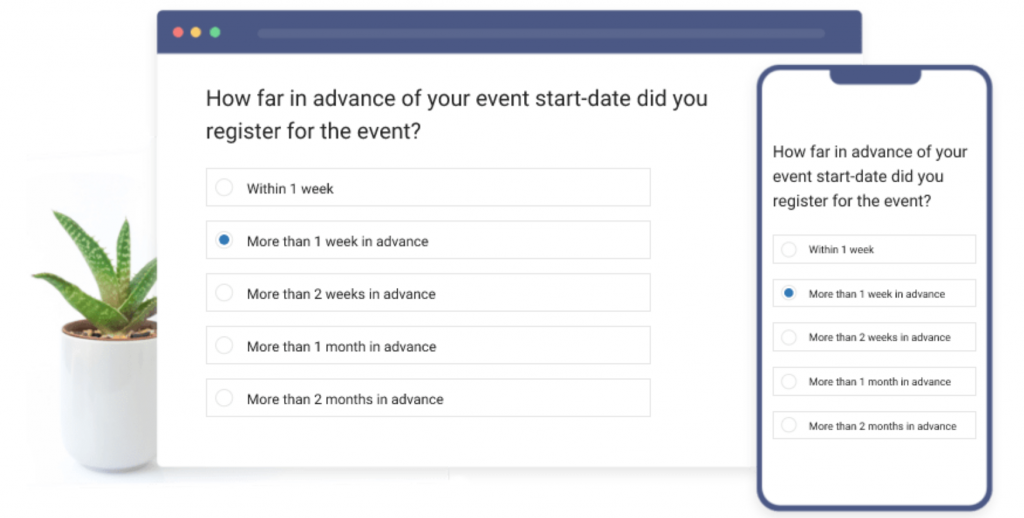
Pre-event surveys help you shape content, logistics, and communication before it is too late to fix anything.
| Question | What It's Measuring |
|---|---|
| What motivated you to register for this event? | Whether your positioning is attracting the right people or the wrong ones |
| What do you hope to gain from attending? | Expectation gaps you can address in opening remarks |
| Have you attended similar events before? | Experience level, which shapes how deep or introductory your content should go |
| Which topics or sessions are you most interested in? | Where to focus energy and which sessions may be underpromoting themselves |
| How did you hear about this event? | Which channels are driving quality registrations |
| What challenges are you hoping this event will help you solve? | The exact language your audience uses; useful for framing and follow-up |
| Do you plan to attend live or watch recordings later? | Helps you plan for on-demand demand, not just live attendance |
| Do you have any accessibility or scheduling needs? | Operational planning and inclusiveness signal |
| What would make this event a success for you? | Sets a benchmark you can measure against in the post-event survey |
| Is there anything else we should know before the event? | Open catch-all that often surfaces the most useful surprises |
Here’s a quick pre-event survey template you can use:
2. Post-Event Survey Sample Questions
Typical length: 10 questions
Best for: Any event where you want immediate feedback
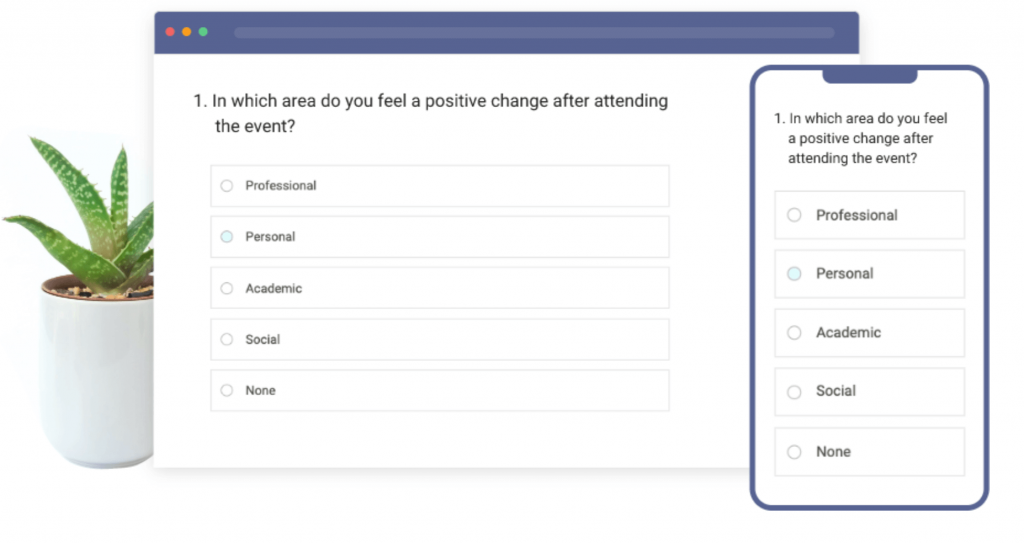
Post-event surveys work best when sent shortly after the event ends. Keep them short and focused on outcomes.
| Question | What It's Measuring |
|---|---|
| How would you rate your overall experience? | Baseline satisfaction: your north star metric for comparing across events |
| Did the event meet your expectations? | The gap between what you promised and what you delivered |
| What was the most valuable part of the event? | What to repeat and amplify next time |
| Which session or activity stood out most? | Identifies your strongest content so you can feature it in follow-up and repurposing |
| Was the event well organized? | Operational quality: logistics, communication, flow |
| Did the event respect your time? | Pacing signal: one of the most honest indicators of whether content was tight or bloated |
| What could have been improved? | The most direct path to fixing the next event |
| How likely are you to attend a similar event again? | Retention signal: more honest than satisfaction because it requires a real commitment |
| How likely are you to recommend this event to others? | NPS signal: useful as a benchmark, not as a standalone metric |
| Any additional feedback you'd like to share? | Catch-all that often surfaces the most specific and useful comments |
Here’s a post-event survey template for you to use:
3. Event Feedback & Event Satisfaction Survey Questions
Typical length: 10 questions
Best for: Smaller events, internal events, recurring events where you want to benchmark over time
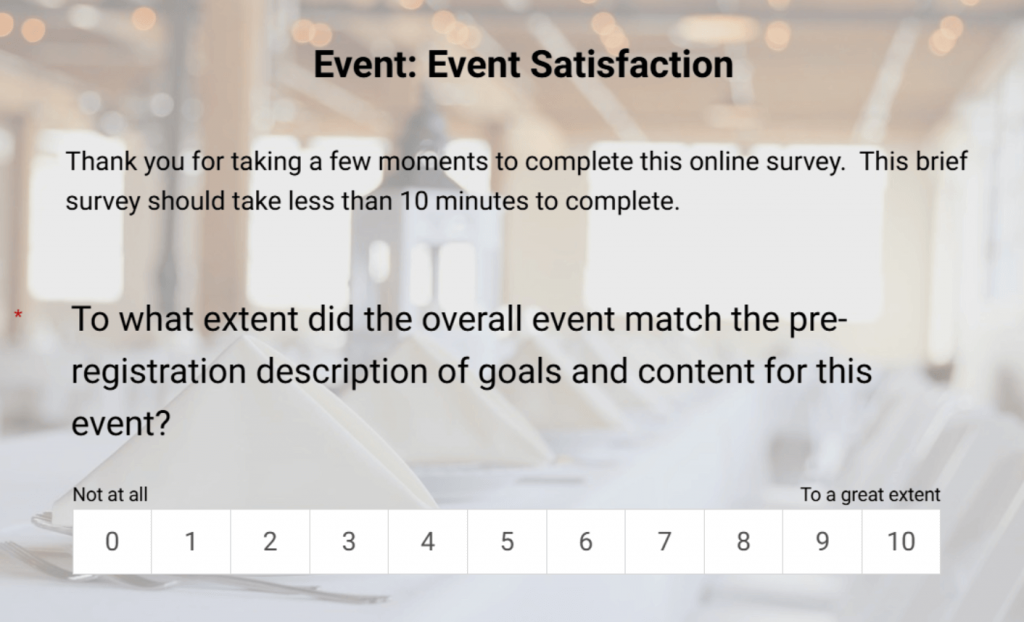
Satisfaction surveys work best when kept consistent. The goal is benchmarking, not diagnosis. Use the same questions across all instances of the event to track movement over time.
| Question | What It's Measuring |
|---|---|
| How satisfied were you with the event overall? | Overall satisfaction benchmark |
| Did the event meet your expectations? | Promise vs. delivery gap |
| How would you rate the overall quality of the event? | Perceived production and content quality |
| Was the event worth the time you invested? | Perceived ROI — often more honest than a satisfaction rating |
| What part of the event did you enjoy the most? | Qualitative signal for what to protect |
| What part of the event could have been better? | Qualitative signal for what to fix |
| How satisfied were you with the organization and flow? | Operational quality |
| How likely are you to attend another event like this? | Retention intent |
| How likely are you to recommend this event to others? | Advocacy intent |
| Any additional comments or suggestions? | Open catch-all |
Here’s a template you can use to gauge event satisfaction:
4. Conference & Trade Show Survey Questions
- Conference surveys: ~10 questions
- Trade show surveys: as few as 2 questions
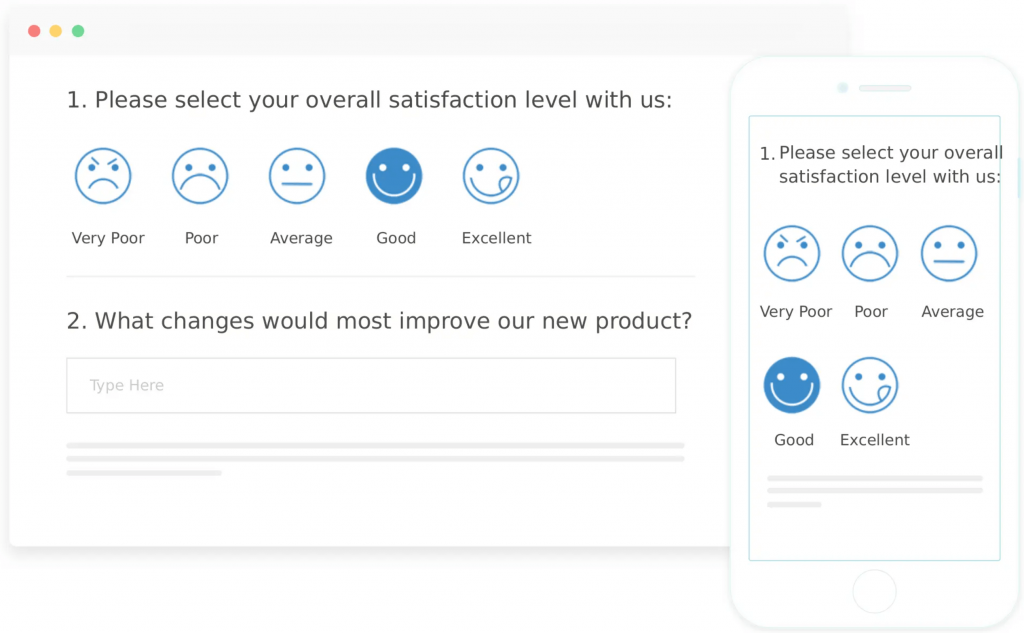
These two event types need completely different approaches. Conferences have a captive audience with enough context to answer substantive questions. Trade shows have attendees who are moving fast, scanning booths, and won’t stop to fill out a 10-question form. Respect that difference.
Conference Surveys:
| Question | What It's Measuring |
|---|---|
| How relevant were the sessions to your work? | Content-audience fit |
| How would you rate the quality of speakers overall? | Speaker curation quality |
| Did you have enough opportunities to network? | Format effectiveness for relationship-building |
| Which session was most valuable to you? | Content prioritization for next year |
| What topic would you want to see covered next time? | Future programming signal |
| How was the venue or platform experience? | Operational quality |
| Did the event respect your time? | Pacing and schedule management |
| How likely are you to attend next year? | Retention intent |
Trade Show Questions:
| Question | What It's Measuring |
|---|---|
| Did you find what you were looking for at this event? | Whether the event delivered on its premise |
| Would you like someone from our team to follow up with you? | Direct pipeline signal |
Here’s a quick template you can use for your trade show feedback:
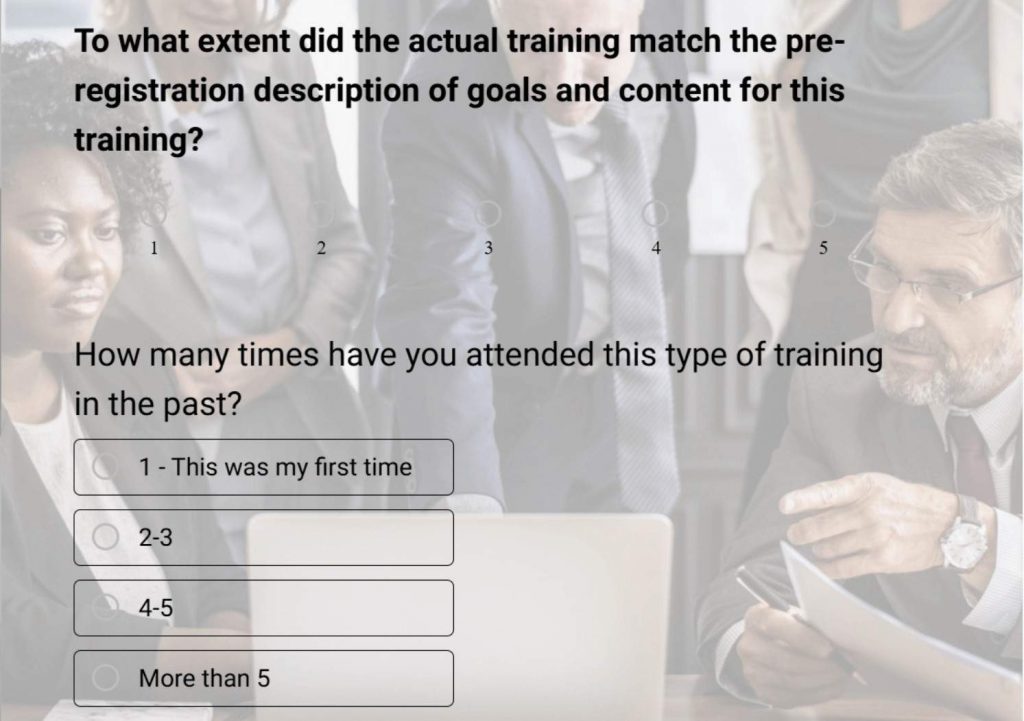
5. Workshop, Seminar & Training Feedback Questions
- Professional Workshop (11 questions)
- Post-Training Surveys (10 questions)
Best for: Skill-building events, onboarding sessions, professional development
| Question | What It's Measuring |
|---|---|
| How clear were the workshop objectives? | Whether the session was set up well before the learning began |
| Did the workshop deliver practical takeaways? | Whether the content was actionable, not just informational |
| How confident do you feel applying what you learned? | The most important metric capability gained, not just satisfaction |
| Was the pace of the workshop appropriate? | Whether the facilitator moved too fast for comprehension or too slow for engagement |
| How effective was the facilitator? | Delivery quality: separate from content quality |
| Were the materials easy to follow? | Support resource quality |
| Did the exercises help reinforce learning? | Whether the format matched the learning goal |
| What part of the workshop was most useful? | Identify what to keep and expand |
| What part felt unnecessary? | What to cut: this question takes courage to ask and almost always surfaces something useful |
| Would you recommend this workshop to others? | Advocacy intent as a proxy for perceived value |
Here’s a template you can tweak and use for your post-training feedback:
6. Webinar & Virtual Event Feedback Questions
Typical length: 10 questions
Best for: Online presentations, virtual panels, live-streamed sessions
Virtual events benefit from shorter surveys and very clear language.
| Question | What It's Measuring |
|---|---|
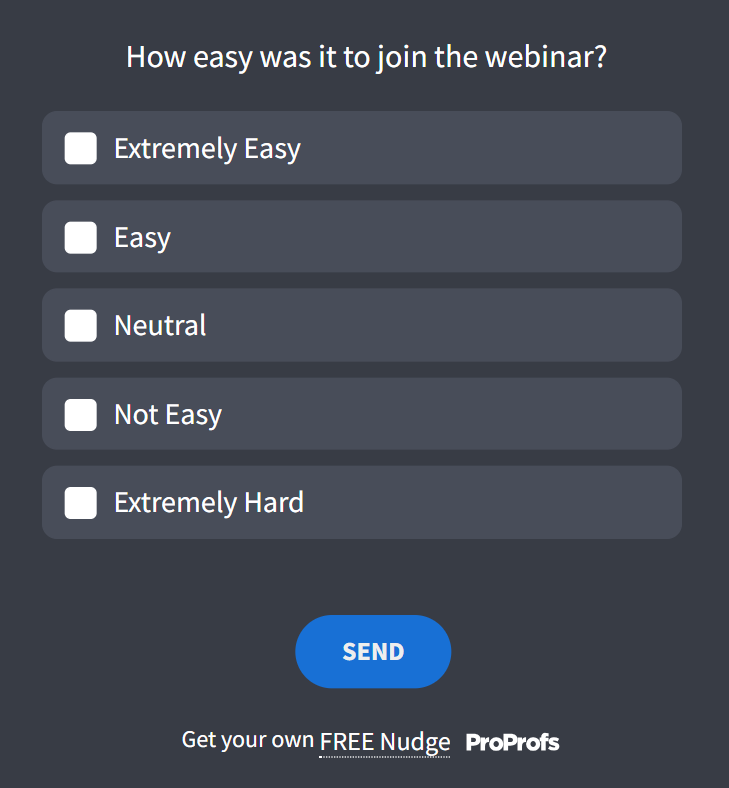
| How easy was it to join the webinar? | Platform and access friction: if this scores low, you have a technical problem to fix |
| Was the topic relevant to you? | Content-audience fit: if this scores low, you have a targeting or positioning problem |
| How engaging was the presentation? | Delivery and format quality |
| Was the pacing appropriate? | Whether the content was too dense or too stretched |
| Did the webinar respect your time? | One of the most honest engagement signals available |
| What part did you find most valuable? | Identifies what to repurpose and promote |
| Were your questions addressed clearly? | Q&A quality: critical for webinars where audience participation drives trust |
| Would you attend another webinar like this? | Retention intent |
| How likely are you to recommend this webinar? | Advocacy intent |
| What could we improve for future webinars? | Open-ended catch-all for context behind the ratings |
Here you can use a nudge, a tiny microsurvey on your event webpage, to gauge how audiences feel about the webinar/virtual event.
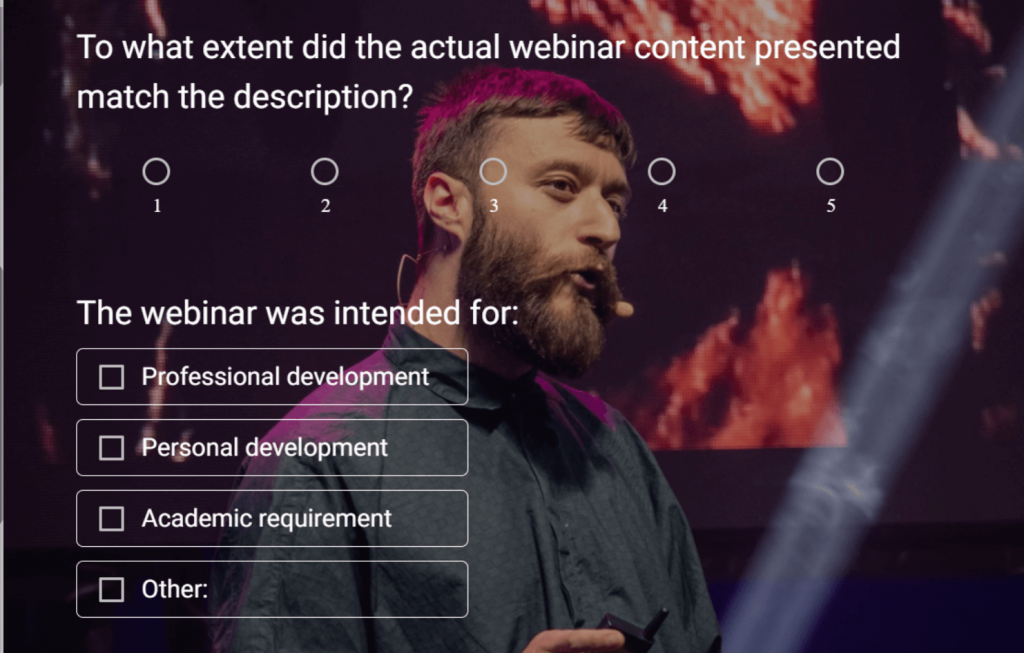
Here’s a long-format webinar event survey template you can use:
7. Team Building & Company Event Feedback Questions
- Team Building Event (10 questions)
- Company Event Planning (8 questions)
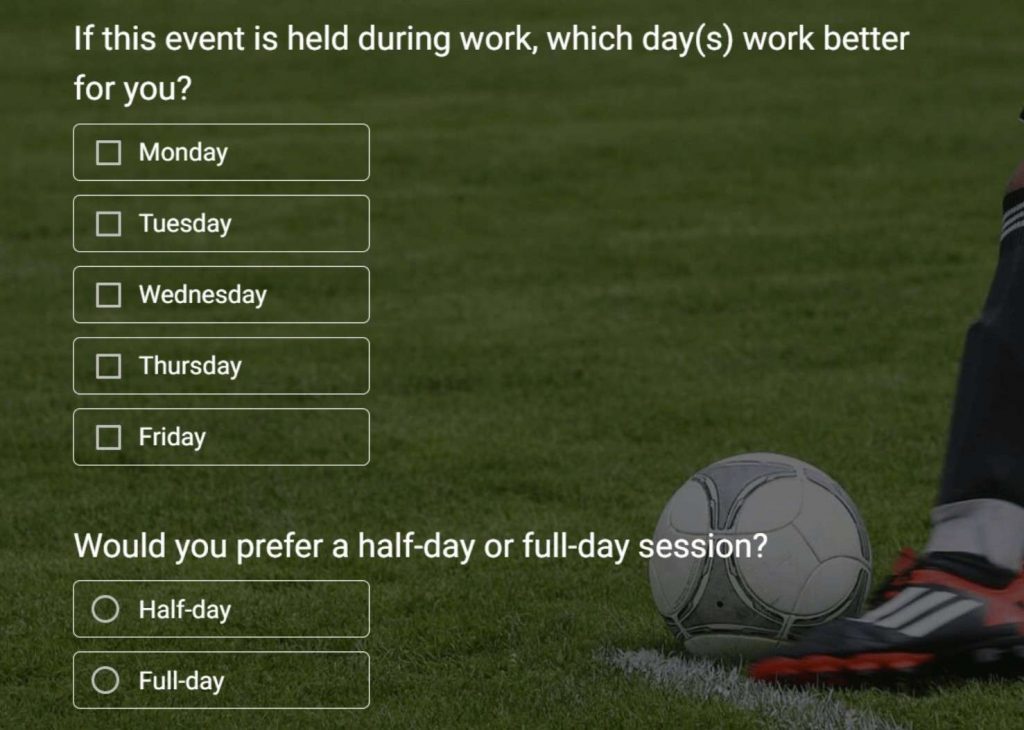
- Sports Team Event Planning (10 questions)
Best for: Offsites, team activities, internal culture events
| Question | What It's Measuring |
|---|---|
| Did the event help you connect with your team? | Whether the format actually created a connection or just proximity |
| How engaging were the activities? | Participation quality |
| Did you feel included during the event? | Inclusiveness is critical for teams with different personalities and comfort levels |
| Was the event well organized? | Operational quality |
| Did the activities encourage collaboration? | Whether the format matched the goal |
| What activity worked best? | What to repeat |
| What could be improved? | What to fix or drop |
| Would you participate in a similar event again? | Honest enthusiasm signal |
| Did the event meet its intended purpose? | Ties the survey back to the goal that justified the event budget |
| Any suggestions for future team events? | Open catch-all |
You can use this team-building event feedback form:
8. Community, Entertainment & Social Event Survey Questions
- Neighborhood Events (10 questions)
- Party Planning (10 questions)
- Entertainment Event Feedback (11 questions)
- Athletic Event (10 questions)
Best for: Neighborhood events, parties, entertainment events, athletic events
These surveys are best kept light and conversational, focusing on enjoyment, logistics, and future interest. Use these when experience and atmosphere matter more than content depth.
| Question | What It's Measuring |
|---|---|
| What type of community event would you most want to attend? | Future programming signal |
| What days and times work best for you? | Scheduling optimization |
| How likely are you to attend a community event in the next few weeks? | Near-term engagement intent |
| What would motivate you to attend a local event like this? | What drives participation in your specific community |
| Which activities would you enjoy most? | Format preference |
| What location would be most convenient for you? | Logistics optimization |
| Are there accessibility or safety considerations we should plan for? | Inclusiveness and safety planning |
| What would make this event feel welcoming and inclusive? | Culture and atmosphere signal |
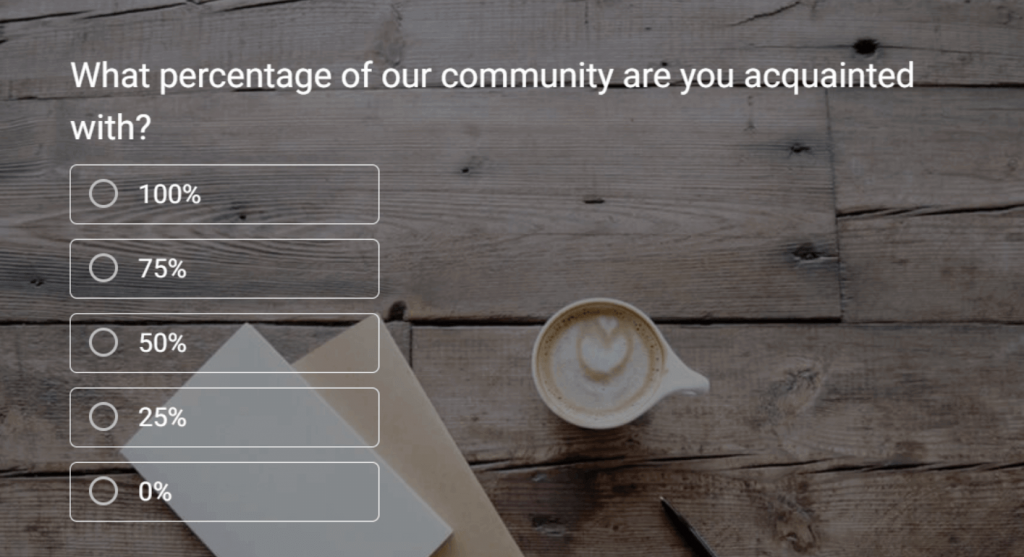
Here’s a pre-made community event planning template you can use:
9. Meeting & Evaluation Feedback Survey Questions
- Meeting Feedback (10 questions)
- Event Evaluation (10 questions)
Best for: Internal meetings, board reviews, formal evaluations
Meeting surveys are the most skipped category and often the most valuable for teams that run frequent internal events. They create accountability for meeting quality in a way that verbal feedback rarely does.
| Question | What It's Measuring |
|---|---|
| Did this meeting have a clear purpose? | Whether goals were communicated before the meeting, not just assumed |
| Was the agenda shared in advance? | Preparation quality: meetings without agendas reliably run long |
| Did the discussion stay focused on the intended goals? | Facilitation quality |
| Was the time allocated effectively? | Respect for attendee time |
| Did you leave with clear next steps? | Decision quality: the most important outcome of most meetings |
| Were the right people in the room? | Meeting design: unnecessary attendees are expensive |
| What part was most productive? | What to protect in future meetings |
| What felt unnecessary or could have been shorter? | What to cut |
| How could future meetings be improved? | Open signal for structural fixes |
| Was this meeting worth the time invested? | The most honest overall signal |
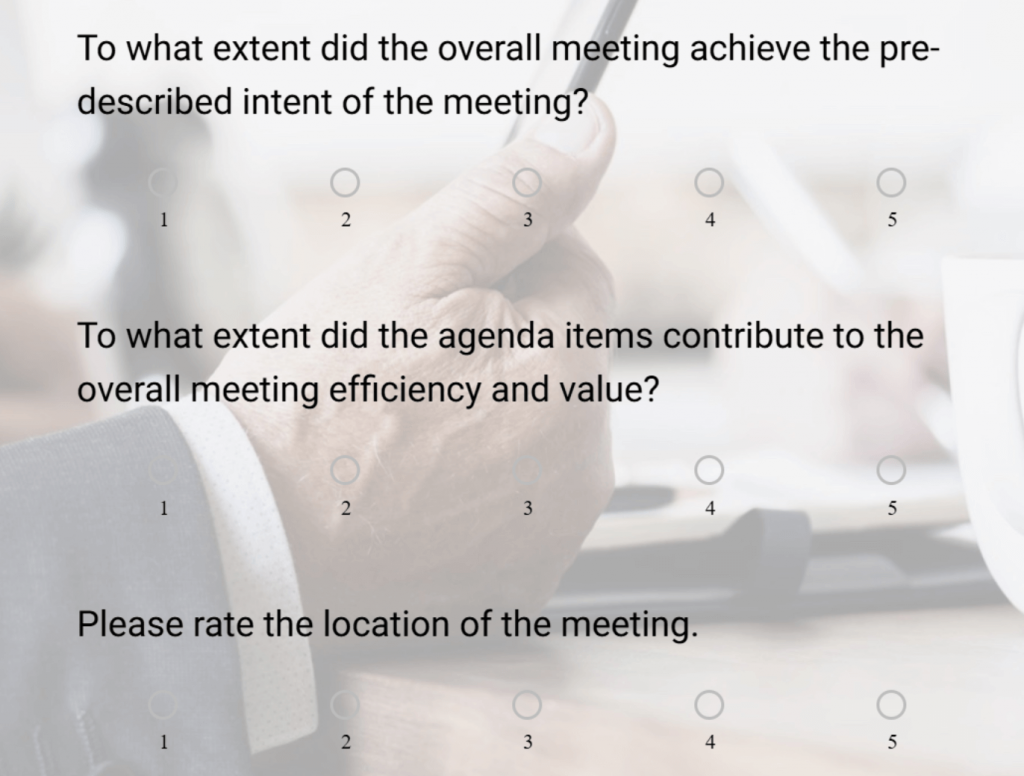
Here’s a quick template you can use to evaluate how the meeting went:
Event Survey Question Types & Answer Scales
Once you have the right event survey questions, the next decision is how you ask them. This part matters more than it looks. The same question can give you clear insight or completely misleading data, depending on the answer format you choose.
I usually think about answer scales as guardrails. They guide people to respond quickly and honestly without overworking them.
| Question Type | When to Use It | Common Scale | Example Question |
|---|---|---|---|
| Rating Scale | When you want a quick sense of quality or experience | 1 to 5 or 1 to 7 | How would you rate your overall experience at the event? |
| Net Promoter Score | When measuring overall loyalty or recommendation intent | 0 to 10 | How likely are you to recommend this event to others? |
| Customer Satisfaction Score | When capturing immediate feedback after a session or event | 1 to 5 | How satisfied were you with this session? |
| Customer Effort Score | When identifying friction or difficulty in the experience | 1 to 5 | How easy was it to participate in the event? |
| Multiple Choice | When you want fast answers that are easy to analyze | Fixed options | Which session did you find most valuable? |
| Open-Ended | When you need context or explanation behind a rating | Text response | What is one thing we could improve for future events? |
| Yes or No | When the decision is binary and clear | Yes or No | Would you attend another event like this? |
One Rule on NPS: Use it as a summary signal, not as your primary metric. A score of 42 tells you people are broadly positive. It doesn’t tell you why attendance dropped, which session to cut, or why your Q&A fell flat. Always pair NPS with at least one open-ended follow-up.
FREE. All Features. FOREVER!
Try our Forever FREE account with all premium features!
How to Create an Effective Event Survey
Good event surveys are not about asking more questions. They are about asking the right ones, at the right time, and then getting out of the way. I have seen short, well-timed surveys outperform long, carefully worded ones every single time.
Here is a simple way to create an event survey that actually gets answered.
Step 1: Start With a Clear Goal
Before you write a single question, decide what you need to learn, not in general terms, but in practical ones.
Ask yourself:
- What decision will this feedback help me make?
- What will I change if the answer is negative?
- Who needs to act on these results?
When the goal is clear, the questions usually write themselves.
Step 2: Keep the Survey Short on Purpose
People are far more willing to answer a few thoughtful questions than a long list that feels like homework.
As a rule of thumb:
- 1 to 3 questions work well for quick feedback nudges
- 5 to 8 questions are ideal for post-event surveys
- 10 or more questions should be reserved for workshops, training, or formal evaluations
If you are unsure, cut one question. It is almost always the right call. Here’s a video you can watch to create an engaging event survey:
Step 3: Choose the Right Moment to Send It
Timing matters more than wording. Feedback is best when the experience is still fresh.
Send surveys:
- Immediately after a session or event ends
- Shortly after check-in or completion of a key action
- Within a day for post-event feedback
Waiting too long turns clear opinions into vague impressions.
Step 4: Match the Delivery Method to the Event
Your survey sharing methods should match how people experienced the event.
- Email works well for post-event feedback
- QR codes are effective for in-person events
- SMS works when speed matters and attention is limited
- In-app or on-site prompts capture in-the-moment reactions
Here’s a quick video you can watch to learn how to create in-context surveys:
The easier it is to access, the higher the response rate.
Step 5: Use Logic to Keep It Relevant
Not everyone needs to answer every question. Use simple logic to route people based on their responses.
For example:
- Ask for details only if someone gives a low rating
- Skip advanced questions for first-time attendees
This keeps the survey feeling personal without adding length.
Step 6: Design for Mobile First
Most people will answer your survey on a phone.
That means:
- Short questions
- Clear language
- Important questions are placed early
If it feels easy on mobile, it will feel easy everywhere.
Step 7: Avoid Survey Fatigue
Sending too many surveys trains people to ignore them.
Space them out, rotate who you survey, and close the loop by showing how feedback leads to change. When people see results, they are more willing to respond again.
The 5-Part Event Survey Reporting Framework
1. The Headline: Write one sentence that sums up the event outcome.
Example: Overall satisfaction was strong, but logistics and session pacing dragged the experience down for first-time attendees.
2. The Scorecard: Pick a small set of metrics that reflect success. Keep it consistent across events. Include:
- Overall satisfaction score
- Likelihood to recommend
- Likelihood to attend again
- Top session rating or content score
- A single operational score, such as check-in or platform ease
3. The Three Wins: Call out what clearly worked, supported by data and one short attendee quote if you have it. Example wins:
- Keynote content quality
- Networking format
- Venue or platform experience
4. The Three Fixes: List the top issues that showed up repeatedly, not the loudest complaint. For each fix, include:
- What went wrong
- Who did it impact the most
- What will you do next time
5. The Next-Event Decisions: This is the part that turns reporting into momentum. Make three lists:
- Keep: what will you repeat exactly
- Improve: what will you change
- Remove: what will you stop doing
That final list is usually where the real maturity shows up.
One Simple Rule I Use
If a data point does not lead to a decision, it does not belong in the report. The goal is not to prove you collected feedback. The goal is to make the next event better with confidence.
Common Event Survey Mistakes to Avoid
This is where a quick table works better than paragraphs. These are mistakes I see repeatedly, even in well-run events, and they usually explain why surveys underperform.
| Mistake | Why It Happens | What to Do Instead |
|---|---|---|
| Sending the survey too late | Teams wait until everything settles | Send it while the experience is still fresh, ideally within hours |
| Asking too many questions | Trying to measure everything at once | Focus on the few decisions you actually need to make |
| Using generic questions | Reusing the same survey for every event | Match questions to the event type and goal |
| Overusing NPS | Treating it as a catch-all metric | Use NPS as a summary, not a replacement for feedback |
| Ignoring mobile experience | Designing surveys on desktop only | Write short questions and test on a phone |
| Asking leading questions | Trying to get positive validation | Keep wording neutral and specific |
| Surveying everyone every time | No control over frequency | Rotate audiences and space surveys out |
| Collecting feedback without action | No clear owner or follow-up | Tie results to visible decisions and changes |
| Sharing raw data with stakeholders | Assuming numbers speak for themselves | Share insights, patterns, and next steps |
| Never closing the loop | Forgetting the attendee afterward | Show people how their feedback was used |
The Simple Rule That Makes All of This Work
You don’t need more questions. You need better ones, asked at the right moment, with a clear plan for what happens after.
When someone fills out your post-event survey, they’re giving you their time and their honest reaction. The way you honor that is by doing something with it, and occasionally, by telling them what you changed because of what they said.
That loop (ask, act, communicate) is what turns a one-time respondent into someone who answers every survey you send.
If you want a straightforward way to trigger the right questions at the right time without adding friction for attendees, Qualaroo lets you run lightweight feedback nudges directly in your event experience, so you capture reactions in the moment rather than chasing them afterward.
Frequently Asked Questions
What is a 1 to 10 survey question?
A 1 to 10 survey question asks someone to rate an experience on a numeric scale where 1 is the lowest and 10 is the highest. It is useful for quick benchmarking across events. A common example is the likelihood to recommend. Use it with a follow-up question to learn why.
What are some 360-degree feedback questions?
360-degree feedback questions collect perspectives from multiple angles, not just overall satisfaction. Ask about clarity of communication, organization, facilitator effectiveness, responsiveness to attendee needs, and whether outcomes were achieved. Include questions that compare expectations to reality and prompt one suggestion that would improve future performance.
What are some fun survey questions?
Fun survey questions boost participation, especially for community or casual events. Keep them light but still useful. Ask for a favorite moment, one word to describe the event, the most surprising part, or what they would change if they ran the event themselves. Pair fun questions with one serious metric.
How soon should you send event survey questions after an event?
Send event survey questions as soon as possible while the experience is fresh. For most events, within a few hours is ideal. For workshops and webinars, send immediately after completion. Waiting beyond 24 hours often reduces response rates and the quality of details because people forget specifics and respond more generally.
FREE. All Features. FOREVER!
Try our Forever FREE account with all premium features!

 We'd love your feedback!
What did you like & how can we make it even better?
 Thanks for your feedback!
 Ask Your Question
Have a question? Get expert help to make your decision easier.