

Most healthcare teams find out they’re using the wrong survey tool at the worst possible moment: during a compliance review, after a data incident, or when a security audit flags a third-party form with no signed BAA on file.
HIPAA compliance in survey software is not a badge or a marketing claim.
It’s a specific set of technical and legal requirements, and the tools that meet them are not the same as the tools that simply say they take security seriously.
I put together this guide for patient experience managers, digital health product teams, and practice leads who need to move fast on this decision without getting it wrong.
It covers seven HIPAA-compliant survey tools, which actually separates a compliant platform from a risky one.
What Is a HIPAA-Compliant Survey Tool?
A HIPAA-compliant survey tool is a platform specifically designed to collect, store, and transmit patient data in accordance with the Health Insurance Portability and Accountability Act. It protects Protected Health Information (PHI) through encryption, access controls, audit logs, and a signed Business Associate Agreement (BAA) with your organization.
Using a standard survey tool for healthcare data without these safeguards is a HIPAA violation, regardless of how secure the platform claims to be.
What Does HIPAA Compliance Actually Require From a Survey Tool?
When I evaluate whether a survey platform genuinely meets HIPAA requirements, I look for four things. Everything else is secondary.
Business Associate Agreement (BAA): A legal contract establishing that the survey vendor shares responsibility for protecting PHI. If a vendor won’t sign a BAA, I stop the evaluation right there. You cannot legally use their platform for surveys involving patient data.
Encryption in Transit and at Rest: Data moving between the patient and your server must be encrypted with TLS 1.2 or higher. Data stored on the platform’s servers must be encrypted at rest using AES-256 or an equivalent algorithm. Both are required. One alone is not enough.
Audit Logging: All access, modifications, and exports of PHI must be automatically logged. If a regulator or internal review asks who accessed patient responses and when, your platform needs to produce that record without manual intervention.
Role-Based Access Controls (RBAC): Not everyone on your team needs access to patient responses. HIPAA requires that access be limited to those with a genuine need. A compliant survey tool lets you assign permissions granularly, not just at an account level.
Features like session timeouts, multi-factor authentication, and incident response procedures are also expected as part of a defensible security posture. They’re worth checking for, but the four above are the floor.
7 HIPAA-Compliant Survey Tools That Made My List
I built this list for teams that are actually collecting patient feedback, not running clinical trials or academic research.
The focus is on platforms suited for patient satisfaction surveys, in-app feedback, NPS tracking, digital health product experience, and post-visit follow-up.
I also included Qualaroo because most HIPAA survey lists describe which tools collect data, but ignore what healthcare teams do with the data afterward.
That qualitative gap is a real problem, and I rarely see it addressed. Here’s a quick comparison table for you to skim through:
| Tool | Best For | Key Features | Pricing | Rating (Capterra) |
| Qualaroo | In-App surveys, NPS & user feedback | Nudge™ surveys, AI survey creation and feedback analysis, behavioral targeting, and the Identify API | From $19.99/month | 4.7/5 |
| Alchemer | Enterprise healthcare teams needing flexible HIPAA surveys | BAA available, advanced logic, Salesforce integration, custom workflows | Custom pricing | 4.5/5 |
| SurveyMonkey Enterprise | Teams needing a familiar HIPAA-ready platform at scale | BAA on Enterprise, audit logging, SSO, HIPAA-enabled account settings | Custom pricing | 4.6/5 |
| Qualtrics CoreXM | Enterprise-grade research with HITRUST certification | HITRUST-certified, end-to-end encryption, role-based access, advanced analytics | Custom pricing | 4.6/5 |
| Zonka Feedback | Patient experience programs across multi-channel touchpoints | BAA available, HIPAA-ready forms, kiosk, and SMS modes, and real-time dashboards | Custom pricing | 4.8/5 |
| Jotform | Accessible HIPAA forms for smaller practices and clinics | BAA on Gold/Enterprise plans, conditional logic, healthcare templates | From $19/month | 4.7/5 |
| BlockSurvey | Privacy-first surveys for sensitive health research | End-to-end encryption, zero-knowledge architecture, no ads/tracking | From $39/month | 4.9/5 (60 ratings) |
Let’s move into the deeper dive:
1. Qualaroo: Best for In-App Surveys, NPS & User Feedback
Qualaroo is built around the Nudge™, a non-intrusive micro-survey that fires on your website, web app, or mobile product while users are actively engaged. Moreover, you can create your surveys instantly using the AI survey creator.
For healthcare teams, that means feedback at the moment of experience: on the patient portal after login, during appointment booking, at session end in a telehealth app.
The Nudge™ catches patients before both problems kick in. The Identify API links responses to an anonymous customer ID without surfacing PHI, giving you the segmentation layer to understand which patient cohorts are experiencing friction.
AI Sentiment Analysis categorizes open-text responses at scale. Plus, you get word clouds and themes for all open-ended responses. And when a patient flags confusion in the booking flow but doesn’t explain why, Heatmaps and Session Recordings show exactly where they hesitated.
Pros:
- AI survey creation for instant surveys
- Nudge™ format captures feedback at the moment of experience, not after the fact
- AI Sentiment Analysis processes open-text responses without manual tagging
- Behavioral targeting lets you survey specific users based on behavior, session, or identity variables
- Exit intent surveys catch patients before they abandon key flows
- Session Recordings and Heatmaps connect stated feedback to observed behavior
- Supports iOS and Android SDK for in-app feedback in telehealth products
- Multilingual surveys in 100+ languages for diverse patient populations
Cons:
- Dedicated onboarding/account manager services are generally reserved for the paid plans.
- There is no downloadable or on-premise version available (Internet connection required to use the tool)
Rating: 4.7/5 (Capterra)
Pricing: Free plan available. Paid plans from $19.99/month.
2. Alchemer: Best for Enterprise Healthcare Teams Needing Flexible HIPAA Surveys
Alchemer, formerly SurveyGizmo, is the platform I’d point to when a healthcare team has outgrown simpler tools and needs complex survey logic, multiple distribution channels, and CRM-connected workflows under a signed BAA.
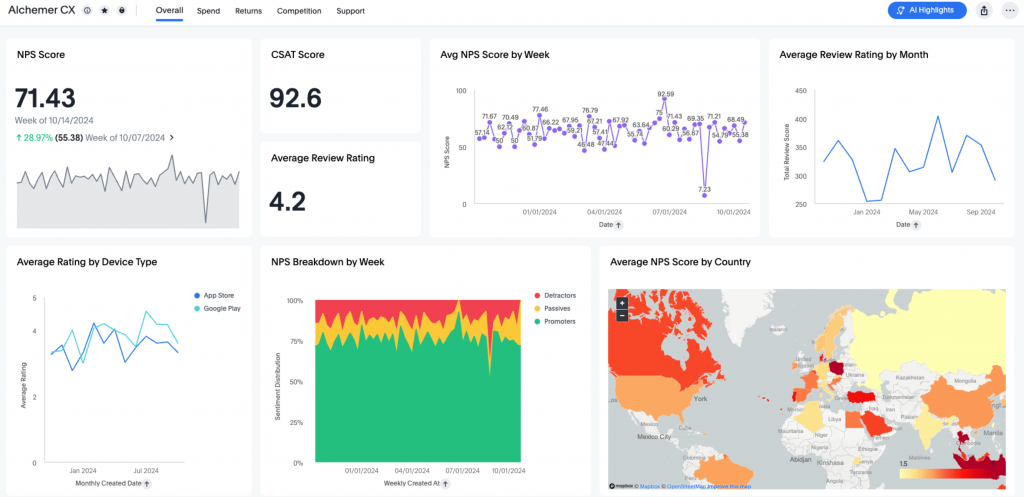
You can build patient satisfaction surveys with branching logic that adapts based on care setting or patient segment, then route results directly into Salesforce or a care management platform without manual exports.
It’s not the right starting point for teams setting up their first patient survey.
The learning curve is real, there’s no self-serve path to the HIPAA features, and you’ll go through a sales process before you can test the compliance configuration. For organizations with a dedicated CX function that needs this depth, it holds up.
Pros:
- BAA available, meeting the baseline HIPAA requirement
- Advanced branching logic and skip logic for multi-pathway patient surveys
- Native integrations with Salesforce, HubSpot, and Zapier for connected feedback workflows
- Custom reporting and dashboard tools for internal and board-level reporting
- Multi-channel distribution: web, email, SMS, and embedded forms
Cons:
- Steeper learning curve than entry-level HIPAA survey platforms
- Custom pricing with no self-serve trial; requires a sales conversation to access HIPAA features
- Not purpose-built for patient experience: more of a horizontal enterprise survey tool
Rating: 4.5/5 (Capterra)
Pricing: Custom pricing. Contact Alchemer for HIPAA-eligible plan details.
3. SurveyMonkey Enterprise: Best for Teams That Need a Familiar HIPAA-Ready Platform
If I’m working with a healthcare team that already runs on SurveyMonkey and doesn’t want to retrain staff, the Enterprise plan is the path to HIPAA compliance without disruption.
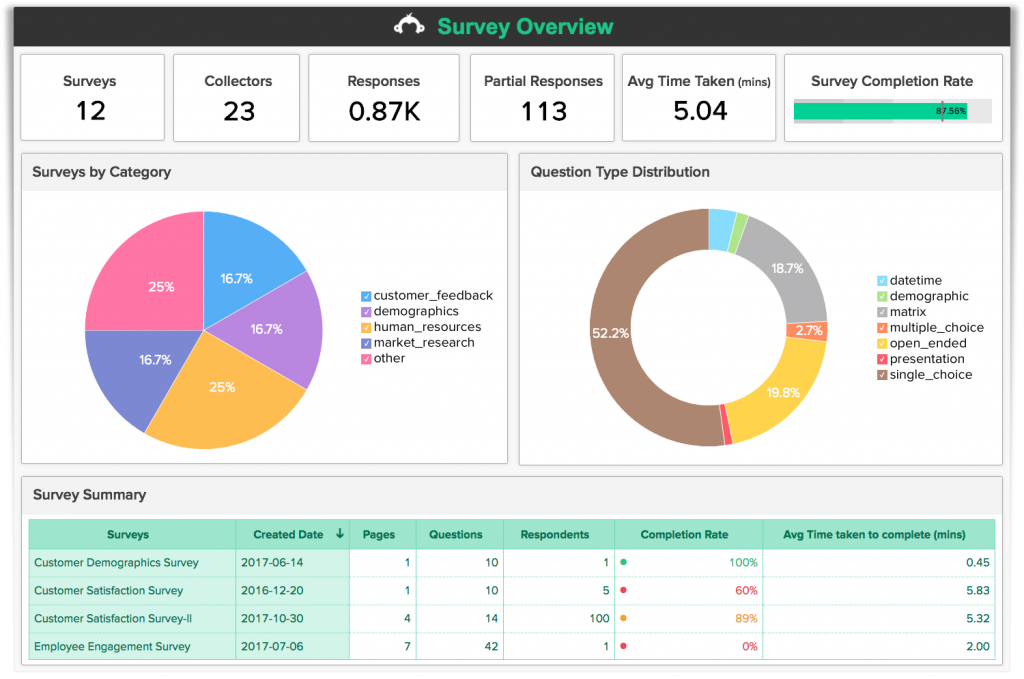
The required stack is there: signed BAA, HIPAA-enabled account settings, audit logging, session timeouts, SSO, and access controls. Your team activates the compliance features on a platform they already know.
The catch is that HIPAA compliance sits entirely behind the Enterprise tier: a sales process, a custom contract, and no trial before you commit.
If you’re currently on a self-serve plan and using it for patient data, that’s a compliance gap you need to close before your next survey goes out.
Pros:
- BAA is available on the Enterprise plan
- Familiar interface reduces training burden for clinical and administrative staff
- Audit logging, session timeouts, and HIPAA-enabled settings are built into the Enterprise tier
- SSO and role-based access controls for team permission management
- Large template library, including patient satisfaction and healthcare feedback templates
Cons:
- HIPAA compliance is Enterprise-only, which requires a custom contract and pricing conversation
- No self-serve access to HIPAA features for smaller practices or teams piloting the platform
- Analytics tools are functional but less advanced than research-grade platforms
Rating: 4.6/5 (Capterra) Pricing: Custom pricing for Enterprise (HIPAA-eligible) plans.
4. Qualtrics CoreXM: Best for Enterprise Healthcare Organizations Needing Research-Grade Compliance
Qualtrics is what I’d recommend when the compliance decision has to survive board-level or legal scrutiny and a self-attested BAA isn’t enough.
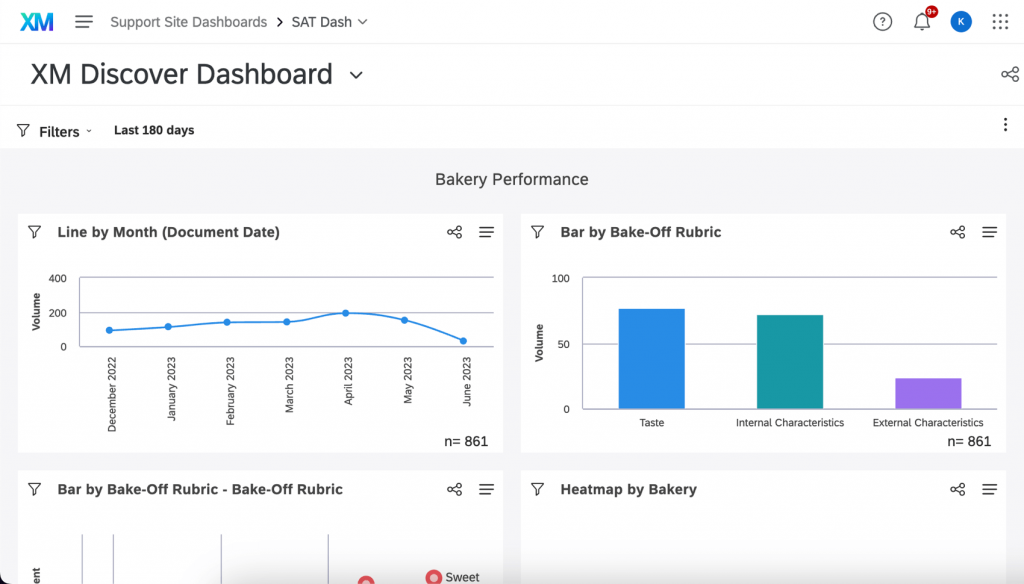
Its HITRUST certification integrates HIPAA and other critical standards into a single third-party validated framework, which is a meaningfully stronger compliance posture than a vendor simply offering to sign a BAA.
For large health systems running patient experience research, employee engagement, and clinical data collection on the same platform, it handles the breadth.
The honest trade-off: Qualtrics is priced and scoped for enterprise health systems. If your team doesn’t have a dedicated research or analytics function, you’ll pay for depth you’ll never use. Mid-market practices and small clinics are the wrong fit on both cost and complexity.
Pros:
- HITRUST certified, going beyond basic BAA to third-party validated compliance
- End-to-end encryption, comprehensive audit trails, and SSO
- Handles patient satisfaction, employee feedback, and research data in one platform
- Advanced analytics, including cross-tab analysis and longitudinal tracking
- Credible compliance posture for board-level and regulatory review
Cons:
- Priced for enterprise health systems; difficult to justify for mid-market or small practices
- High implementation complexity; typically requires dedicated internal resources
- Overkill for teams with straightforward patient satisfaction survey needs
Rating: 4.6/5 (Capterra)
Pricing: Custom pricing. Contact Qualtrics for a quote.
5. Zonka Feedback: Best for Patient Experience Programs Across Multiple Touchpoints
Zonka Feedback is what I look at first when a healthcare team needs to unify patient feedback across multiple channels without building a custom pipeline.
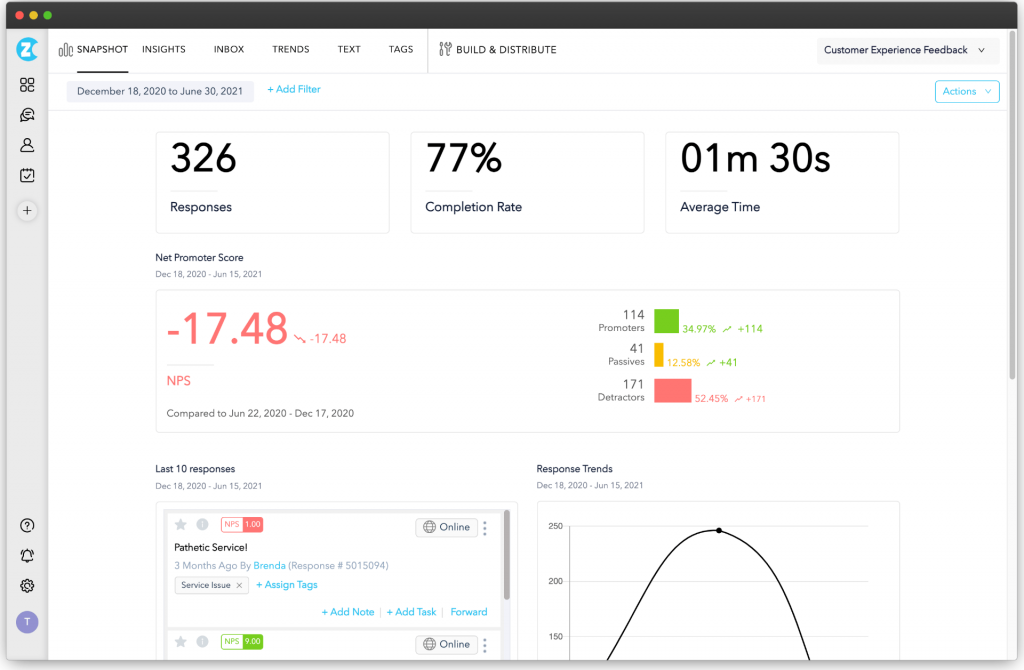
The BAA is available, HIPAA-ready forms are documented, and the platform is built for patient experience use cases: kiosk, SMS, email, web, and in-app, all feeding into a single real-time dashboard.
Department-level access controls let individual care teams see their own responses without touching data from other units, which maps cleanly to HIPAA’s minimum necessary standard.
Where I’d push back is on analytics depth. If your program needs longitudinal trend analysis or research-grade output, Zonka’s reporting layer will feel limited. For teams where the goal is operational visibility rather than research, it covers the essentials well.
Pros:
- BAA available; HIPAA-ready configuration documented
- Multi-channel: kiosk, SMS, email, web, and in-app feedback in one platform
- Real-time dashboards for department-level and organization-wide patient satisfaction tracking
- Role-based access aligns with HIPAA’s minimum necessary standard
- Healthcare-specific templates and use case documentation
Cons:
- Less name recognition and third-party compliance validation compared to enterprise platforms
- Advanced analytics and segmentation HIPAA-compliant tools are less deep than research-grade platforms
- Pricing scales quickly for organizations with high survey volume
Rating: 4.8/5 (Capterra)
Pricing: Custom pricing. Contact Zonka for HIPAA-specific plan details.
6. Jotform: Best for Smaller Practices and Clinics Needing Accessible HIPAA Forms
Jotform is where I’d start for a solo practice, small clinic, or early-stage telehealth startup that needs HIPAA-compliant patient forms without an enterprise sales process.
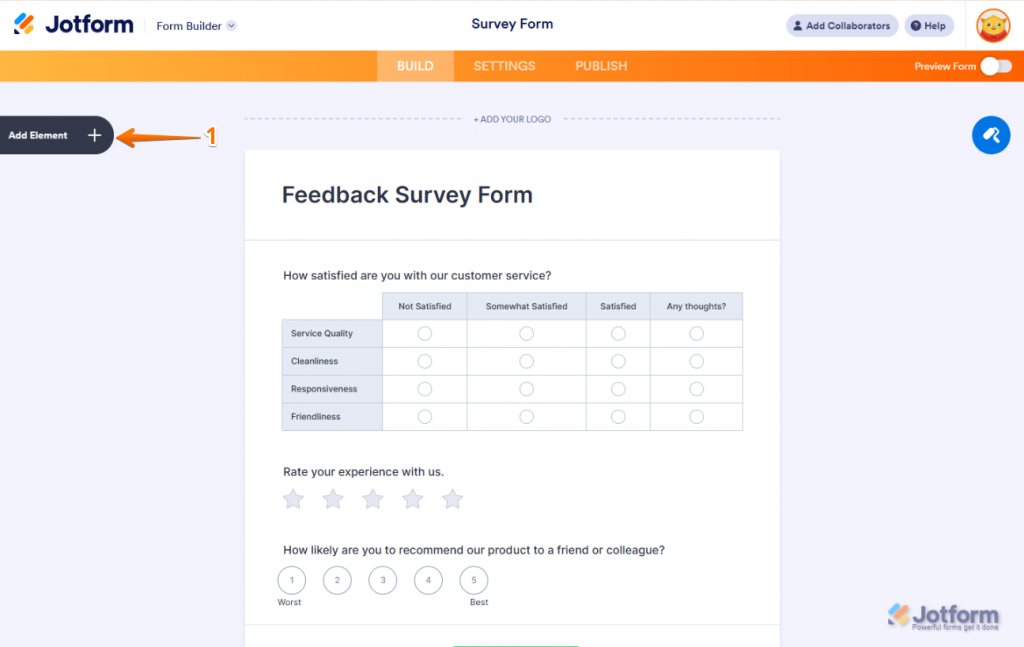
The BAA is accessible on the Gold plan, the form builder requires no survey design background, and healthcare-specific templates are ready to use from day one.
Conditional logic adapts the form flow based on patient responses, keeping forms short for straightforward cases and more detailed when needed.
The honest limitation is analytics. Jotform is built for secure data collection, not patient experience analysis. If you need to track satisfaction trends over time or produce structured reports, you’ll export to another environment.
Pros:
- BAA is available on Gold and Enterprise plans, accessible without an enterprise contract
- Large library of healthcare-specific templates for immediate use
- Easy form builder requires no survey design expertise
- Conditional logic adapts the form flow based on patient responses
- SSL/TLS encryption during collection and storage
Cons:
- BAA access requires a Gold plan or above; entry-level plans are not HIPAA-eligible
- Analytics are basic; deeper analysis requires exporting to a separate tool
- Designed for form collection, not patient experience research or longitudinal tracking
Rating: 4.7/5 (Capterra)
Pricing: BAA available from $19/month. Enterprise plans are available at custom pricing.
7. BlockSurvey: Best for Privacy-First Surveys Involving Sensitive Health Research
BlockSurvey is what I look at when the minimum necessary standard applies to the vendor relationship itself, not just to who on your team can access the data.
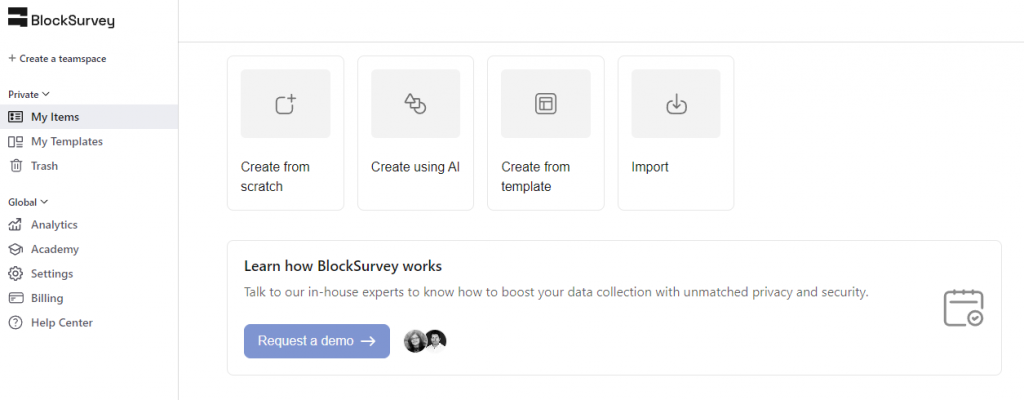
It runs on a zero-knowledge architecture, meaning BlockSurvey structurally cannot access response data stored on its servers.
For healthcare researchers handling sensitive patient disclosures or behavioral health data where even theoretical vendor access is a problem, that’s a meaningfully stronger privacy guarantee than a BAA alone provides.
The trade-off is that BlockSurvey is more technically oriented than everything else on this list. Fewer ready-made templates, less polish on the respondent-facing interface. For research contexts, that’s fine. For a standard patient satisfaction survey in a clinic setting, a more accessible platform will serve most teams better.
Pros:
- Zero-knowledge encryption: the platform cannot access your response data
- End-to-end encryption for sensitive health research where vendor access is itself a risk
- No third-party tracking or advertising on the survey platform
- Suitable for research involving sensitive patient disclosures
- Clean, privacy-oriented design philosophy
Cons:
- Less intuitive for non-technical users; fewer templates than mainstream platforms
- Less suited for standard patient satisfaction workflows than more accessible tools
- Smaller community and support ecosystem than established enterprise platforms
Rating: 4.9/5 (Capterra, 60 ratings)
Pricing: From $39/month.
My Top 3 Picks Across the Best HIPAA-Compliant Survey Tools
After going through every tool on this list, here are the three I’d reach for first, each for a different job.
1. Qualaroo: For the Experience Layer, Every HIPAA Survey Program Is Missing
HIPAA-compliant survey software tells you patient satisfaction scores. Qualaroo tells you what’s producing them.
If your patient satisfaction scores trend down after a new booking system launches, a Nudge™ survey triggered on the scheduling flow tells you whether the drop is a UX issue, a communication gap, or a perceived wait time problem.
That’s the layer that turns a number into a corrective action rather than a quarterly mystery. Catching friction in context produces higher-quality signals than asking about it two days later.
2. Qualtrics CoreXM: For Enterprise Health Systems That Need Board-Level Compliance Credibility
When the legal and compliance team needs third-party validated assurance rather than a vendor’s self-attested BAA, Qualtrics’ HITRUST certification is the most defensible compliance posture on this list.
For large health systems running enterprise-wide patient experience programs, it’s the standard choice and for good reason.
3. Jotform: For Smaller Practices That Need HIPAA Forms Without an Enterprise Contract
For a primary care clinic, physical therapy practice, or small telehealth startup that needs HIPAA-compliant patient forms and satisfaction surveys without a custom contract process, Jotform covers the core requirements at a price that makes sense.
It’s not a research platform. For the job of collecting patient feedback securely in a small practice environment, it does exactly what it needs to.
These three work as a system.
Jotform or Qualtrics handles secure PHI collection.
Qualaroo sits on your patient portal and digital touchpoints, capturing the real-time experience signals that no HIPAA form can surface.
Together, they cover data integrity and behavioral intelligence in the same program.
How Did I Evaluate These HIPAA-Compliant Survey Tools?
1. BAA Availability and Signing Process: Every tool on this list either offers a BAA or has a documented path to obtaining one. I excluded tools that claim HIPAA-readiness without offering a signable BAA, because HIPAA compliance is a legal relationship, not a feature set.
2. Encryption Standards: I looked for TLS 1.2 or higher for data in transit and AES-256 or equivalent for data at rest. These are the current expected standards as documented by Accountable HQ’s 2026 HIPAA survey requirements guide. Tools that only mention “SSL encryption” without specifying standards scored lower on my evaluation.
3. Audit Logging and Access Controls: Audit logs need to be automatic, not optional. Role-based access controls need to be granular enough to comply with HIPAA’s minimum necessary standard. I assessed both as baseline requirements rather than differentiating features.
4. Use Case Fit for Healthcare Teams: I separated platforms built for generic enterprise surveys from those with a genuine healthcare orientation. Templates, terminology, integration options with healthcare systems, and the presence of patient experience-specific features all factored in.
5. Capterra and G2 Review Signal: Where Capterra ratings exist, I used them as a proxy for real-world satisfaction from verified users. These ratings reflect actual experiences from healthcare administrators, patient experience managers, and clinical staff, not marketing claims.
6. Qualitative Context Layer: Because HIPAA-compliant survey software tells you what, not why, I evaluated each tool’s ability to pair with or include contextual, behavioral feedback mechanisms. The highest-value patient feedback programs pair structured HIPAA surveys with in-context signals, and I weighted that accordingly.
FREE. All Features. FOREVER!
Try our Forever FREE account with all premium features!
How Do I Choose the Right HIPAA-Compliant Survey Platform?
The most common mistake I see is picking a platform based on name recognition rather than use case fit.
A HITRUST-certified enterprise platform is the right answer for a large health system. It’s the wrong answer for a solo practice that needs a signed BAA and a simple patient satisfaction form.
Start with the type of patient data you’re collecting and work backward to the tool that fits it.
Use-Case Decision Table
| If Your Primary Need Is | What You Actually Need | Start Here |
| Understanding why patient satisfaction scores look the way they do | In-context feedback, behavioral data at the moment of experience | Qualaroo |
| Secure patient forms and intake data at a small practice | Accessible BAA, easy form builder, HIPAA templates | Jotform |
| Enterprise patient experience research with legal-grade compliance posture | HITRUST certification, advanced analytics, multi-department access controls | Qualtrics CoreXM |
| Multi-channel patient feedback across kiosk, SMS, and web | Unified dashboard across channels, real-time reporting | Zonka Feedback |
| Familiar interface with HIPAA compliance for existing survey workflows | Known platform, BAA on Enterprise plan, audit logging | SurveyMonkey Enterprise |
| Complex enterprise surveys with Salesforce and CRM integration | Advanced logic, connected workflows, and BAA available | Alchemer |
| Privacy-maximum research involving sensitive behavioral health data | Zero-knowledge architecture, end-to-end encryption | BlockSurvey |
Evaluation Framework
| Criterion | What to Look For | Why It Matters |
| BAA Availability | Can you obtain a signed BAA before launching? | No BAA means no lawful use for PHI-adjacent surveys |
| Encryption Standards | TLS 1.2+ in transit, AES-256 at rest | Self-described “secure” is not a standard; these are |
| Audit Logging | Automatic, not optional; exportable for compliance review | Regulators expect a record; you need to produce it |
| Access Controls | Role-based; granular enough for the minimum necessary standard | Blanket access to PHI is a HIPAA violation |
| Use Case Fit | Does it support your actual survey type and distribution channel? | The wrong tool produces compliant but useless data |
| Qualitative Integration | Does it connect to in-context feedback or behavioral analytics? | Scores without context don’t drive improvements |
What Features Should I Look For in HIPAA-Compliant Online Survey Tools?
For Patient Experience Managers and CX Leads
- Signed BAA from the vendor before any patient data is collected
- Encryption in transit (TLS 1.2+) and at rest (AES-256 or equivalent)
- Role-based access so department-level staff see only their patient responses
- Real-time dashboards for tracking satisfaction trends without manual exports
- Multi-channel distribution options, including web, email, SMS, and in-app
For Digital Health Product Teams and Telehealth Platforms
- iOS and Android SDK for in-app feedback inside telehealth applications
- Behavioral targeting to trigger surveys at specific moments in the patient journey
- Exit intent surveys to capture feedback from patients who don’t complete a booking or registration
- Identity-linked responses that connect feedback to a specific patient session without surfacing PHI
- AI Sentiment Analysis for processing open-text patient comments at scale
This is exactly where Qualaroo adds its value for digital health teams.
When your patient portal’s satisfaction scores drop, you need to know whether it’s the login flow, the appointment booking step, or the results page causing the friction.
A Nudge™ survey triggered at the right moment answers that question before your next quarterly review cycle.
Belron maintains its consistently high NPS in part by using AI Sentiment Analysis to catch the patterns in open-text responses that a number scale alone would never surface.

For Healthcare IT and Compliance Teams
- Documented encryption standards, not just “SSL enabled”
- Automatic audit logs that capture all access, modifications, and data exports
- Session timeouts and MFA options
- SOC 2 Type II certification or HITRUST certification as additional validation beyond the BAA
- Incident response documentation and breach notification procedures in the BAA
For All Healthcare Teams: What HIPAA-Compliant Survey Tools Cannot Do Alone
- Tell you why the satisfaction score shifted between one quarter and the next
- Capture the hesitation or confusion a patient experienced on your portal in real time
- Identify which specific moments in the patient journey are producing the most friction
- Connect patient feedback to the behavioral signals visible in session recordings and heatmaps
This is the layer most HIPAA survey programs never build. The compliance infrastructure handles data security. The experience intelligence layer handles the actual improvement cycle.
Running one without the other means you’re collecting compliant data you can’t fully act on.
Which HIPAA-Compliant Survey Tool Should You Start With?
If you’re a patient experience manager or digital health product lead trying to improve patient satisfaction scores, the decision comes down to two things: the type of data you’re collecting, and what you plan to do with it once you have it.
HIPAA-compliant survey tools protect your PHI.
They will not tell you which step in your patient portal is producing the most abandonment, which care setting is driving scores down, or what patients are actually thinking when they see your appointment confirmation page.
That’s the gap most healthcare survey programs never close. You collect compliant data. You get a number. You’re not sure what changed it.
The fix is adding the experience layer: surveys triggered in context, at the moment of friction, not 48 hours after discharge.
That’s where Qualaroo’s Nudge™ format fits. It doesn’t replace your HIPAA survey infrastructure. It tells you what the numbers in that infrastructure actually mean.
Frequently Asked Questions
What is a HIPAA-compliant survey tool?
A HIPAA-compliant survey tool is a platform that collects, stores, and transmits patient data in accordance with HIPAA requirements. It must offer a signed Business Associate Agreement (BAA), data encryption in transit and at rest, role-based access controls, and automatic audit logging. Any survey tool handling Protected Health Information (PHI) without these safeguards puts the covered entity at legal and financial risk.
Do I need a BAA from my survey software vendor?
Yes, if your surveys collect any PHI. Under HIPAA, any third-party vendor that accesses or processes PHI on your behalf is a Business Associate and must sign a BAA before you use their platform for patient data. A vendor that won't sign a BAA is not a viable option for healthcare survey use cases, regardless of their security features.
What encryption standard does a HIPAA-compliant survey platform need?
At minimum, TLS 1.2 or higher for data in transit and AES-256 for data at rest. These are the current expected standards for HIPAA-adjacent data handling. A platform that mentions "SSL encryption" without specifying TLS version and at-rest encryption standard has not met the bar.
What's the difference between HIPAA-compliant and HITRUST certified?
A HIPAA BAA is a legal agreement between your organization and the vendor. HITRUST certification is a third-party validated framework that incorporates HIPAA and additional security standards. HITRUST provides more independent verification of a vendor's compliance posture than a self-attested BAA alone. It matters most for large health systems where the compliance decision will face internal or regulatory scrutiny.
Can I use a standard survey tool like Google Forms for patient feedback?
No. Google Forms does not offer a signed BAA for standard accounts and is not HIPAA-compliant for surveys collecting PHI. Google Workspace for Enterprise users can obtain a BAA covering some Google services, but Forms is not a HIPAA-ready tool without that arrangement, and even then, it lacks the audit logging and access controls a compliant survey program requires.
Why do post-discharge email surveys produce low response rates in healthcare?
According to Press Ganey's 2025 survey methodology benchmarks, the median ambulatory practice achieves a 15% response rate from traditional survey methods. The primary reasons patients skip them: inconvenient timing (38%), surveys that are too long (24%), and lack of trust that feedback changes anything (18%). In-context surveys triggered while the patient is actively engaged with a portal or digital tool capture feedback at the moment of highest relevance and tend to produce substantially better response quality.
What survey questions should I include in a HIPAA-compliant patient satisfaction survey?
Focus on the specific moment you're measuring, not general satisfaction. For booking flows: "Were you able to find a time that worked for you" For telehealth sessions: "How would you rate the quality of your video appointment today" For post-visit: "Is there anything that would have improved your experience" Keep questions short, specific, and tied to a moment the patient just experienced. A single well-timed question returns more usable data than a ten-question post-discharge form that arrives three days later.
Does Qualaroo work with telehealth platforms and mobile health apps?
Qualaroo supports iOS and Android native SDKs, allowing you to embed Nudge™ surveys directly within a telehealth or mobile health app. Behavioral targeting lets you trigger surveys at specific moments inside the app, for example, after a session ends or when a patient navigates to a specific feature. The Identity API connects responses to an anonymous user session without surfacing PHI in the survey data.
FREE. All Features. FOREVER!
Try our Forever FREE account with all premium features!

 We'd love your feedback!
What did you like & how can we make it even better?
 Thanks for your feedback!
 Ask Your Question
Have a question? Get expert help to make your decision easier.